You're staring at a blank CV and a job advert full of familiar words, requirements gathering, SQL, stakeholder management, Power BI, Agile, and you know...
A business analyst career in the UK suits people who think clearly, ask good questions, and want more strategic work. It also suits career changers better than many realise, especially those coming from accounting, bookkeeping, VAT, payroll, final accounts, or accounts assistant roles, where attention to detail and commercial awareness already matter every day.
The Modern Business Analyst in the UK
A modern Business Analyst doesn’t just write requirements documents. The role sits between business teams and delivery teams, helping organisations define problems properly, improve processes, analyse data, and make sure change solves the right issue.

In practice, that means a BA might map an invoicing process, gather requirements for a finance system change, analyse operational data in Excel or SQL, or help stakeholders agree what success should look like before a project starts. In Agile environments, they often work closely with product owners, project managers, developers, and operational teams. A useful grounding in business analysis in Agile environments helps because many UK roles now expect candidates to understand how delivery works, not just how to write notes.
Why the role matters more now
UK demand is strong. Jobs requiring business analytics skills increased by 20% in the last 12 months and 82% over the past five years, according to Heriot-Watt University citing Lightcast data.
That matters because it changes the question from “Is this a viable career?” to “What route gets me job-ready fastest?”
Practical rule: Employers don’t hire junior BAs because they’ve read theory. They hire them because they can gather requirements, structure messy information, and communicate clearly with stakeholders.
What strong junior candidates usually have
The strongest entry-level candidates tend to show a mix of business understanding and practical tool use.
- Process awareness means you can explain how work flows through a team.
- Analytical discipline means you can review data, spot gaps, and ask sharper questions.
- Communication under pressure matters because stakeholders rarely explain a problem neatly the first time.
- Tool confidence helps turn observations into evidence, whether that’s in Excel, SQL, or Power BI.
If you come from finance, payroll, bookkeeping, or accounts support, you’re already closer to this role than you think. You’ve likely spent time reconciling figures, dealing with exceptions, following controls, and explaining numbers to non-finance colleagues. That’s not a weak starting point. It’s a practical one.
Choosing Your Path to a BA Career in the UK
There isn’t one route into business analysis. In the UK, people usually enter through education, apprenticeships, or direct transition from another role. The right option depends on your age, finances, current work situation, and how quickly you need to become employable.
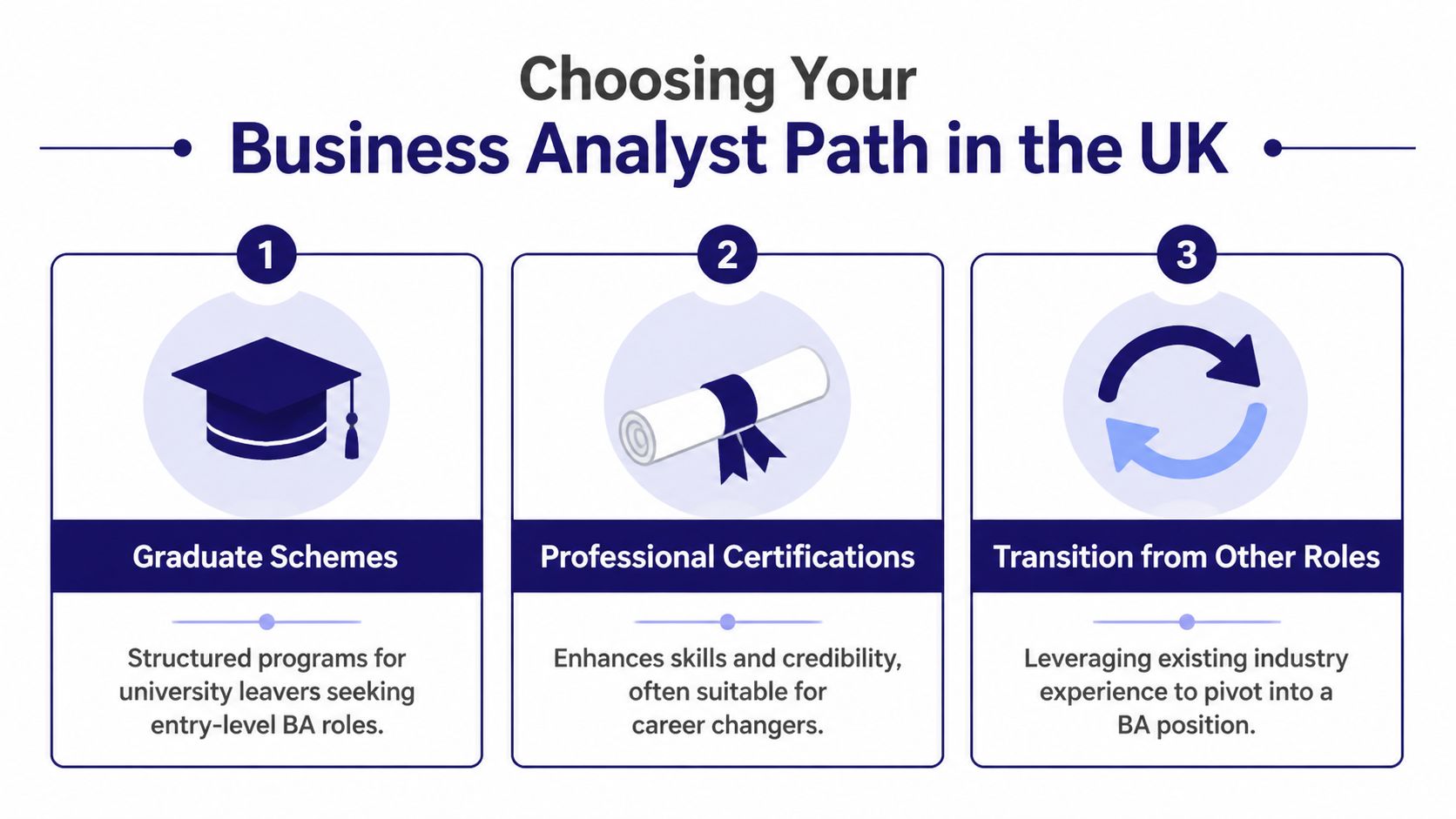
The National Careers Service sets out three distinct routes: university degree, apprenticeship, and direct application for career changers. It notes that university entry typically requires 2 to 3 A levels, while higher or degree apprenticeships typically require 4 to 5 GCSEs at grades 9 to 4 plus A levels, and that degree apprenticeships are a valuable option for people who want to earn while they qualify, as shown in the National Careers Service business analyst profile.
A quick comparison
| Route | Best for | Main advantage | Main trade-off |
|---|---|---|---|
| University degree | School leavers and traditional students | Broad academic foundation | Longer timeline and higher commitment |
| Apprenticeship | People who want paid learning | Real work experience from day one | Fewer openings and more competition |
| Direct training and transition | Graduates and career changers | Faster move into job-ready skills | Requires self-direction and strong portfolio work |
University route
A degree can make sense if you’re early in your career and want a wider base in business, IT, management, or data-related study. It’s often a sensible route for someone with no work history yet.
But there’s a real trade-off. A degree alone doesn’t guarantee BA readiness. Employers still want evidence that you can gather requirements, analyse processes, and work with tools. Candidates often assume academic success will carry them. It rarely does on its own.
Apprenticeship route
Apprenticeships suit people who want structure and workplace exposure together. You learn while earning, and that matters if you prefer practical work over purely classroom learning.
They’re also useful if you want to build confidence gradually inside a team rather than making a hard pivot. The downside is access. You need to secure the apprenticeship itself, and not every applicant will want to wait for the right opening.
Direct transition route
This is often the strongest route for career changers, especially if you already work in accounting, bookkeeping, VAT, payroll, or operations. You don’t need to restart your life. You need to bridge the gap between your current experience and BA expectations.
That usually means focused learning, certification, project work, and better positioning in the job market. If you want to understand common entry credentials, a practical guide to business analyst certification in the UK helps you separate useful certifications from those that merely sound impressive.
The best route is the one that gets you into interviews with proof, not just interest.
Mastering In-Demand Business Analyst Skills
Many individuals don’t struggle because they lack ambition. They struggle because they build the wrong skill mix. They spend too long on theory and not enough time using the tools employers expect.

A practical UK pathway is often built over 6 to 12 months, with a key technical phase of 2 to 3 months focused on Advanced Excel, SQL, and Power BI, according to Professional Careers Training’s business analyst pathway guide. That same guidance stresses that candidates who build technical skills systematically perform better in the job search.
The core technical toolkit
You don’t need to become a software engineer. You do need enough technical fluency to investigate problems and present findings clearly.
- Advanced Excel is still essential. You should be comfortable working with complex formulas, structured data, and data modelling.
- SQL matters because it lets you query data directly instead of waiting for someone else to pull it for you.
- Power BI helps you turn raw information into dashboards and visuals that support decisions.
For finance professionals, this step usually feels more achievable than expected. If you’ve worked with reconciliations, journals, VAT records, payroll reports, or final accounts, you already understand structured data. The challenge is learning to pull, shape, and present it in a BA context.
The business analysis toolkit
Technical tools aren’t enough on their own. UK employers also look for practical BA capabilities:
- Requirements gathering so you can ask the right questions and document what the business needs
- Process mapping so you can show where a workflow breaks or slows down
- Stakeholder communication so different teams understand the same problem
- Data analysis so recommendations are based on evidence rather than opinion
A junior BA who can explain a messy process clearly is often more useful than a candidate who knows the jargon but can’t apply it.
A good training plan should include hands-on project work, interview-style exercises, and feedback on how you present findings. One option in the UK market is Professional Careers Training, which offers business analyst training alongside 1-to-1 support, flexible study times, and recruitment-focused help. That kind of setup is useful for career changers balancing study with work or family commitments.
What employers actually want to see
Employers don’t want screenshots of dashboards with no context. They want to know why you built them, what question you were answering, and what recommendation followed.
That’s also why it helps to strengthen your written communication. If you need a practical refresher on structuring recommendations, this guide to crafting effective business proposals is worth reviewing. Strong BAs often stand out because they present options clearly, not because they use complex language.
A useful learning rhythm looks like this:
- Learn the concept such as requirement types or workflow mapping.
- Use the tool in Excel, SQL, or Power BI.
- Apply it to a business scenario such as billing delays, payroll exceptions, or reporting gaps.
- Present the outcome in plain English.
Later in your preparation, it helps to watch a worked example and compare it against your own approach.
Building a Standout CV and Portfolio
The question most trainees ask is simple. How do you prove BA ability before you’ve held the BA job title?
You do it with a portfolio built from realistic case studies. Not fake “passion projects” with no business context. Actual pieces of work that show how you think, what tools you used, and how you moved from problem to recommendation.
What to include in a BA portfolio
A strong beginner portfolio usually includes 2 to 3 real-world case studies. The emphasis should be on clarity, not volume.
For each case study, show:
- The business problem such as duplicate payments, delayed approvals, reporting errors, or poor stakeholder handovers
- Your analysis approach including process maps, requirement notes, Excel analysis, SQL queries, or dashboard visuals
- Your recommendation with a sensible solution and implementation logic
- Your reflection on what you learned and what you’d improve
If you need inspiration on how to organise work visually, this piece on how to build a dynamic portfolio for creators is useful because the presentation principles carry across. A hiring manager should be able to scan your portfolio quickly and understand your value.
Turning previous work into BA evidence
Finance and accounts candidates often undersell themselves. A bookkeeping or payroll task can become BA evidence if you frame it correctly.
Instead of writing:
- processed invoices
- maintained records
- supported payroll
Write what the work shows:
- reviewed process exceptions and improved reporting accuracy
- identified recurring data mismatches between systems
- supported stakeholder queries by translating financial information into clear actions
Your old job title doesn’t define your future role. The evidence inside that role matters more.
A CV also needs to match the language of UK vacancies. Use terms employers recognise, including requirements gathering, process improvement, stakeholder engagement, data analysis, and reporting tools where you’ve applied them. A practical guide to UK CV writing tips can help if you need to tighten structure, keywords, and impact statements.
Common mistakes that weaken good candidates
| Mistake | Why it hurts |
|---|---|
| Listing tools without projects | Recruiters can’t tell whether you’ve applied them |
| Writing duties instead of outcomes | Your CV looks administrative rather than analytical |
| Using generic case studies | Hiring managers see no evidence of judgement |
| Hiding finance experience | You lose a major commercial advantage |
A portfolio doesn’t need to be flashy. It needs to be credible, relevant, and easy to read.
Navigating the UK Job Market and Interview Process
Once your skills and portfolio are in place, the job search becomes a targeting exercise. Many candidates waste time applying too broadly, then conclude the market is closed. Usually, the problem is positioning.
For junior and transition roles, look for job titles such as Junior Business Analyst, Business Analyst, PMO Analyst, Change Analyst, Systems Analyst, Operations Analyst, and data-heavy roles with strong stakeholder exposure. Some people also enter through finance systems, process improvement, or reporting positions, then move into a more defined BA role once they’re inside.

What salary progression looks like
Pay is one reason this career attracts serious interest. Prospects reports that entry-level business analysts in the UK earn £25,000 to £30,000, mid-level professionals earn £35,000 to £65,000, and senior BAs can reach up to £80,000.
That range tells you two things. First, the career has strong upside. Second, progression depends on skills, sector, and how well you handle more responsibility.
Preparing for interviews with STAR
Most UK BA interviews test competency, not just knowledge. You’ll be asked about handling stakeholders, resolving ambiguity, analysing issues, or improving a process. If your answers drift, you’ll sound inexperienced even if your background is good.
Use the STAR method:
- Situation. What was happening?
- Task. What were you responsible for?
- Action. What did you do?
- Result. What changed?
Here’s the difference.
Weak answer: “I helped improve reporting in my accounts role.”
Stronger answer: “In my accounts support role, the monthly reporting pack often included inconsistent figures from different spreadsheets. My task was to help reduce errors before review. I standardised the input format, flagged recurring mismatches, and built a clearer reconciliation step in Excel. The result was a more reliable reporting process and fewer last-minute corrections.”
That answer works because it sounds like a BA, even though the original role may not have been labelled that way.
Don’t wait for a perfect BA story from a BA job. Use evidence from the work you’ve already done.
A practical approach for international candidates
International candidates often worry they have to remove overseas experience. Usually, that’s the wrong move. Keep it, but translate it into UK-friendly language.
Focus on:
- stakeholder communication
- process ownership
- systems exposure
- reporting work
- analysis tied to business decisions
Also check each vacancy carefully for sponsorship wording before applying. If a role doesn’t mention sponsorship, don’t assume. Prioritise employers and sectors where your experience, tools, and communication style are an obvious fit.
An effective application strategy requires more precision than many candidates anticipate. Build a shortlist, tailor your CV, align each portfolio case study to the role, and practise spoken examples until your answers sound calm and specific.
The Accountant’s Edge Your Advantage as a Career Changer
People often assume the strongest BA candidates come from technical degrees. That’s too narrow. The role is about business change, not just technology.
There’s useful evidence for career changers here. A 2025 Prospects.ac.uk study, cited by IT Online Learning, found that non-traditional career changers from fields like accounting can outperform STEM graduates in mid-level BA roles, and that 41% of business analysts are career switchers who succeed through targeted training and recruitment coaching.
Why finance experience translates so well
If you’ve worked in bookkeeping, VAT, payroll, accounts assistant work, or final accounts, you already understand controls, exceptions, deadlines, reconciliations, compliance, and business impact. You know what happens when a process fails. You know how errors spread. You know that a report is only useful if the underlying data is right.
That commercial grounding is powerful. It means you often ask better business questions than candidates who focus only on tools.
What you still need to add
You don’t need to throw away your old background. You need to layer new skills onto it.
That usually means:
- SQL for querying data
- Power BI for presenting insight
- Excel at a stronger analytical level
- requirements and stakeholder techniques
- portfolio projects that show business thinking
If you’re making a pivot, it also helps to review broader essential skills for career change so you can explain your transition with confidence, not apology.
A strong career change story sounds like progression. It doesn’t sound like escape.
The candidates who do well are usually the ones who stop asking whether they’re “allowed” to move into business analysis. They focus instead on evidence. They train with purpose, build useful case studies, present transferable experience properly, and learn how to interview like analysts.
If you want a structured route into business analysis, especially from accounting, bookkeeping, payroll, or finance, Professional Careers Training offers practical training, flexible study options, and recruitment support that can help you turn existing business knowledge into a job-ready BA profile.