If you're training to become a business analyst, or you already work as one, you've probably noticed AI tools turning up in more of your...
That’s why understanding what makes a successful team is more than a soft skill. It’s a career skill. It affects how quickly you learn, how many mistakes you catch, how calm your month end feels, and whether managers trust you with more responsibility. In finance and data roles, strong teams don’t just feel nicer to work in. They produce cleaner handovers, better checks, faster decisions, and clearer ownership.
For aspiring accountants and analysts, this matters in a very practical way. A good team helps a trainee bookkeeper ask the right VAT question before submission. A good team helps an accounts assistant know who approves journals. A good team helps a data analyst challenge a broken metric before it reaches a director. Team success shows up in the small moments that shape job performance.
The encouraging part is that team effectiveness isn’t some mysterious trait that only experienced managers understand. You can spot it. You can help build it. And you can train for the habits that make you a reliable team member from day one.
Introduction Why Team Success Is Your Career Superpower
Many learners think employers mainly want technical ability. Of course they want that. They want people who can use Xero, Sage, QuickBooks, Excel, SQL, or Power BI well. They want accurate payroll processing, clean reconciliations, and sensible analysis. But technical skill only creates value when a team can coordinate around it.
In a finance office, one person may enter supplier invoices, another may check VAT treatment, another may review aged debt, and another may prepare reports. In an analytics team, one person gathers requirements, another cleans the data, another builds the model, and another presents findings. If those handovers are weak, even strong individual work gets lost.
Where people get confused
A lot of advice on teamwork stays too vague. It says things like “communicate better” or “build trust” without showing what that means when you’re preparing a bank reconciliation or testing a dashboard filter. That’s where people get stuck. They know teamwork matters, but they can’t translate it into daily behaviour.
Here’s the simple version. Team success usually comes from a few practical things working together:
- Shared goals: Everyone knows what the team is trying to deliver.
- Role clarity: People know who owns which task and where handovers happen.
- Trust: Team members feel safe to ask, check, and challenge.
- Useful communication: Information gets to the right person in time.
Career mentor view: If you want to become the person managers rely on, don’t only ask “How do I do my task?” Ask “How does my task fit the team’s workflow?”
Why this matters in training
This is especially important if you’re preparing for roles such as bookkeeping & VAT, advanced payroll, accounts assistant, final accounts, business analyst, or data analyst. These jobs reward people who can follow process, notice risk, and work well with others.
A junior who understands team dynamics often progresses faster than a junior who only focuses on their own to do list. Not because they talk more, but because they reduce friction. They ask clearer questions. They document better. They hand over work properly. They help the whole team move.
That’s why team success is a career superpower. It turns your technical ability into dependable results.
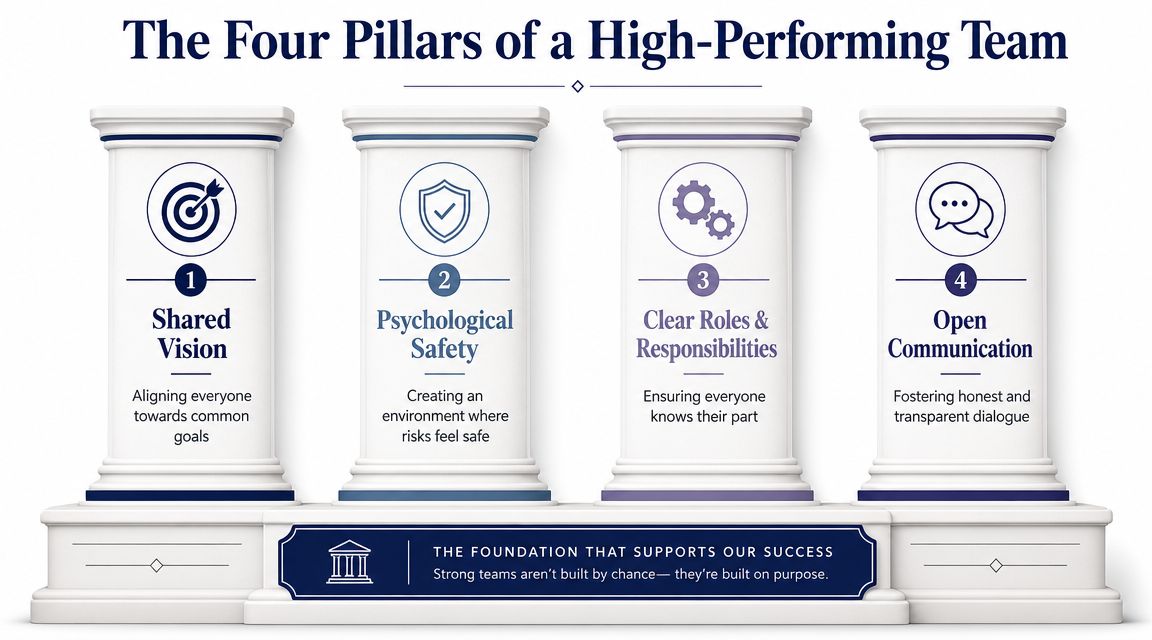
The Four Pillars of a High-Performing Team
One useful way to understand team quality is to look at four core pillars. McKinsey’s team-health research identifies trust, communication, creative thinking, and decision making as the four highest-impact drivers of team performance, and teams scoring above average on these drivers were more likely to be efficient, creative, and produce better stakeholder outcomes according to McKinsey’s research on healthier teams.
Near the centre of that model sits a basic truth. A team is not just a set of people doing similar jobs. If you want a quick way to separate the two ideas, this guide to the difference between team and group is a helpful read. In finance and analytics, that distinction matters because shared output depends on interlocking work, not just people sitting in the same department.
A simple visual can help fix the idea.
Trust and psychological safety
Trust in a team works a bit like a reconciled ledger. People believe the record is reliable because checks happen openly. In the workplace, trust means colleagues believe others will do what they said, share important information, and respond fairly when problems appear.
For an accounts assistant, that could mean saying, “I think this nominal code may be wrong.” For a data analyst, it could mean saying, “This chart looks polished, but the logic behind the metric may not be sound.” Without trust, people stay quiet. Errors survive longer.
Communication and innovative thinking
Communication is not about talking all day. It’s about making sure meaning travels clearly. Good teams don’t leave important points trapped in one person’s inbox or memory.
Creative thinking matters too, especially in business analysis and reporting. It’s the habit of asking whether the current process is the best one. Could payroll checks be documented better? Could a bookkeeping workflow in QuickBooks reduce duplicate entry? Could a Power BI report answer the question more clearly?
Later, if you move into supervision or management, training in leadership and managerial skills can help you turn these habits into repeatable team routines rather than one-off good intentions.
After you’ve got the core idea, this short video gives another useful perspective on what strong teams look like in practice.
Decision making
Decision making is where many teams either become efficient or become exhausting.
A weak team leaves decisions vague. People don’t know who approves a journal, who signs off a dashboard, or who resolves conflicting assumptions. A strong team makes decision rights visible. That doesn’t mean everything becomes rigid. It means people know when to act, when to check, and when to escalate.
Teams perform better when information flows well and decisions don’t get stuck between “someone should handle this” and “I thought you were doing it”.
These four pillars are a strong starting point because they convert a fuzzy idea into something you can observe in real work.
Achieving Crystal-Clear Roles in Finance and Data
Many team problems look personal at first. Someone seems disorganised. Someone looks slow. Someone appears unhelpful. Often the underlying problem is simpler. The role boundaries are blurry.
That matters because DDI’s team-effectiveness model shows that teams perform best when leaders explicitly define individual goals, responsibilities, and work processes for planning, tracking, documenting, and managing work. DDI also notes that when role boundaries and process ownership are ambiguous, coordination costs rise and rework increases, as explained in DDI’s overview of team effectiveness.

What role clarity looks like in real jobs
Role clarity isn’t just a job title. “Accounts assistant” is a title. Clarity is knowing exactly what that person owns, what they support, and what they hand over.
Here’s how that looks in common training paths:
| Role area | Clear ownership looks like | What goes wrong without it |
|---|---|---|
| Bookkeeping & VAT | One person posts transactions, another reviews VAT treatment, and a named reviewer signs off before submission | Duplicate checks, missed exceptions, last-minute panic |
| Advanced payroll | One person gathers changes, one processes payroll, one approves, and one handles employee queries | Unclear approvals, repeated corrections, staff frustration |
| Accounts assistant | Bank reconciliations, supplier statements, and month-end support are assigned by process stage | Work overlaps, deadlines drift, nobody knows the blocker |
| Final accounts | Trial balance prep, adjustments, lead schedules, and reviewer comments follow a set sequence | Rework, version confusion, avoidable errors |
| Data analyst | Requirements, data cleaning, modelling, visualisation, and stakeholder sign-off are split clearly | Dashboards answer the wrong question or get rebuilt late |
| Business analyst | Discovery, process mapping, validation, and recommendation ownership are agreed early | Meetings produce notes but not decisions |
Why this matters for trainees
If you’re new, you may think asking “Who owns this?” makes you look uncertain. It usually does the opposite. It shows that you understand workflow risk.
For example, a trainee bookkeeper working on VAT should know who decides the treatment of unusual transactions. A payroll learner should know who approves amendments after cut-off. A junior data analyst should know who defines the business rule for a KPI. If those points are left vague, people either wait too long or act without authority.
A simple way to improve role clarity
Try this checklist in your current team or placement:
- Name the owner: Every recurring task needs one clear owner, even if several people contribute.
- Map the handoff: Identify where the task leaves one desk and lands on another.
- Define the review point: Some work needs checking. Be specific about who reviews it.
- Set the escalation path: Decide where unusual items go before they become urgent.
- Document the process: A short written workflow beats a verbal assumption every time.
Practical rule: If two people think they own the same task, or if nobody can say who approves it, the process isn’t clear enough.
Good teams don’t rely on memory and goodwill alone. They use structure so that people can do good work with less stress.
The Science of Trust and Team Cohesion
Trust can sound soft until you see what happens without it. Questions stay unasked. Small doubts stay hidden. Mistakes reach the client, the payroll run, or the management report because somebody didn’t feel safe to speak.
The evidence behind this is stronger than many people expect. A review of team effectiveness research reports that team cohesion and team efficacy have well-established positive relationships with performance, and team efficacy shows a substantial relationship to team performance (ρ = .41) across many work settings, according to the NCBI review of team effectiveness research. The same review notes that these relationships become stronger when team members are highly interdependent.
That last point matters a lot in finance and data work. These are highly interdependent environments. Bookkeeping feeds final accounts. Payroll feeds reporting. Data preparation feeds analysis. One person’s uncertainty can become everyone’s problem.
What trust looks like at desk level
Psychological safety is the practical side of trust. It means people can take sensible interpersonal risks. They can ask for help, admit uncertainty, and challenge assumptions without expecting ridicule or blame.
A few examples make this clearer:
- Accounts assistant: “I can’t match this supplier balance. Can someone check my approach before I force the reconciliation?”
- Payroll administrator: “This leaver’s date looks inconsistent with the previous instruction.”
- Business analyst: “The process map says one thing, but the staff interview suggests another.”
- Data analyst: “The dashboard is technically correct, but the metric definition may be misleading.”
These moments protect quality. In a fearful team, people stay silent because they don’t want to look weak. In a healthy team, speaking up is part of doing the job properly.
How trust gets built
Trust rarely comes from motivational slogans. It grows from repeatable behaviour.
- Keep commitments: If you say you’ll send the file by noon, send it by noon or warn people early.
- Respond calmly to issues: If someone raises an error, treat it as useful information first.
- Give credit fairly: People trust teams where effort and ideas are recognised honestly.
- Challenge work, not character: “This assumption needs checking” is very different from “You always get this wrong.”
- Admit your own mistakes: That gives others permission to be open too.
A careful question can save a week of rework. Trust is what makes that question possible.
For trainees, this is good news. You don’t need seniority to contribute to trust. You can build it by being accurate, respectful, honest about what you know, and willing to ask before errors spread.
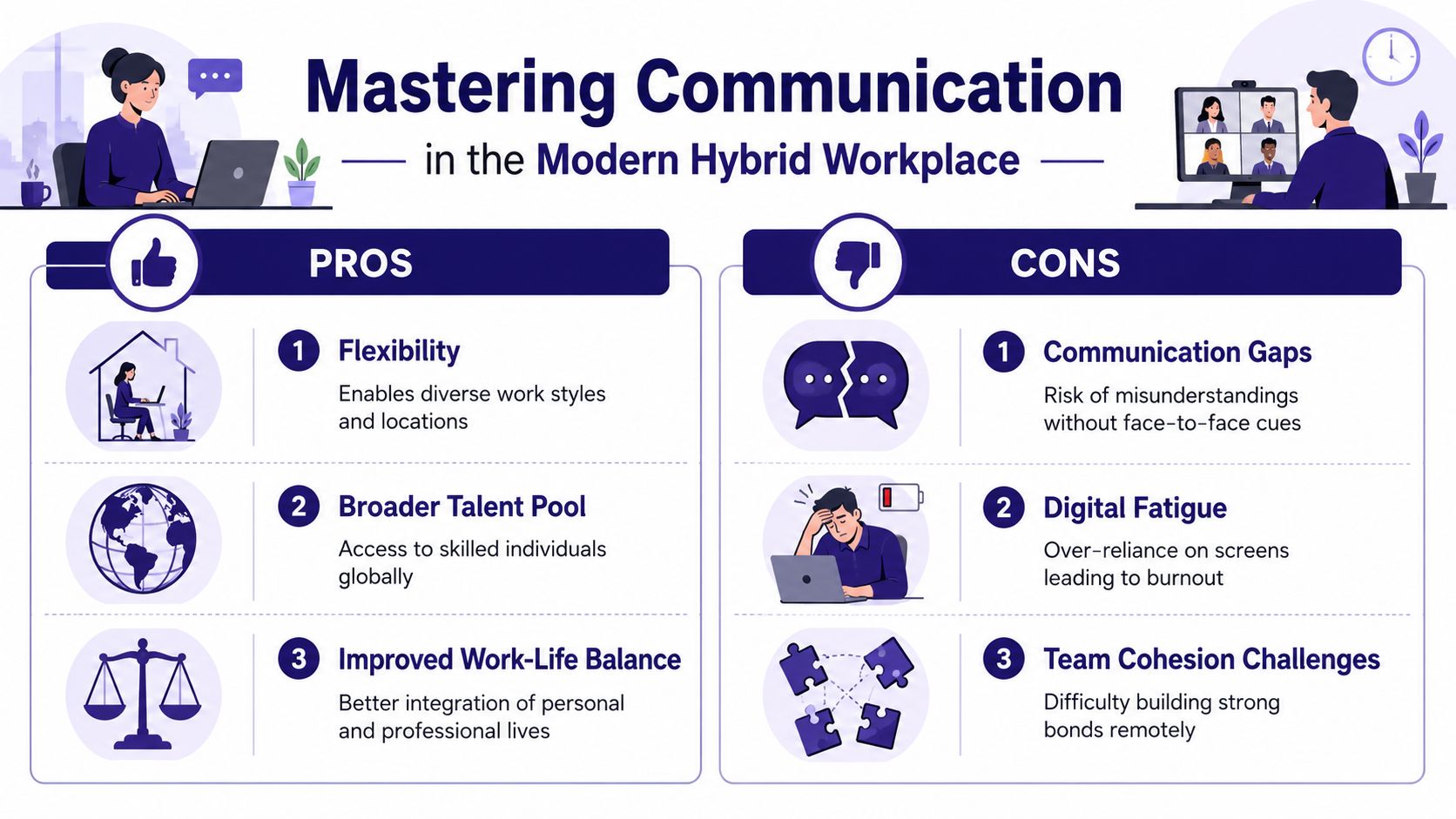
Mastering Communication in the Modern Hybrid Workplace
A lot of teamwork advice assumes everyone is sitting near each other. That’s no longer a safe assumption. In the UK, hybrid working is now a structural norm, and ONS data has shown that a substantial share of working adults continue to work from home. Research also points to the need for explicit norms, asynchronous communication, and deliberate relationship-building, because informal office contact is no longer guaranteed, as discussed in IMD’s guidance on high-performing teams.
That changes what makes a successful team. In hybrid settings, good intentions are not enough. Teams need communication habits that still work when people are split across locations.
Choose the right channel
A common source of confusion is using one tool for everything. That creates noise.
Try a more deliberate approach:
- Email for formal record: Use it for approvals, client-facing summaries, and messages people may need to find later.
- Instant messaging for quick clarifications: Good for short questions, not for complex instructions.
- Shared documents for live status: Progress trackers, issue logs, and review notes should be visible to the team.
- Meetings for discussion and decisions: Use them when people need to resolve ambiguity together.
For finance and data roles, this is especially useful. A payroll cut-off change should not sit buried in a chat thread. A dashboard definition should not depend on memory from a verbal call.
Write for people who aren’t in the room
Hybrid work rewards strong asynchronous communication. That means writing updates that make sense without extra explanation.
A good update usually includes:
- What was done
- What needs attention
- Who owns the next step
- When it’s due
- What risk or blocker exists
That style helps in all the target roles. A bookkeeping trainee can summarise unreconciled items clearly. An accounts assistant can flag month-end blockers. A business analyst can write requirement notes that stakeholders can review later. A data analyst can explain assumptions in a way that survives beyond the meeting.
If speaking up is the difficult part for you, practical support with assertiveness training can help you communicate clearly without sounding abrupt.
Keep meetings short and useful
Meetings fail when people use them to discover basic information that should have been written down earlier.
A better pattern is simple:
| Before the meeting | During the meeting | After the meeting |
|---|---|---|
| Share the update in writing | Discuss only decisions, risks, and disagreements | Record actions and owners |
| Attach supporting files | Confirm next steps | Put notes where everyone can find them |
| State the decision needed | Ask who owns each action | Follow up on deadlines |
Hybrid teams also need deliberate relationship-building. If people only interact when there’s a problem, trust weakens. A short check-in, clear feedback, and visible appreciation go a long way when casual office contact isn’t guaranteed.
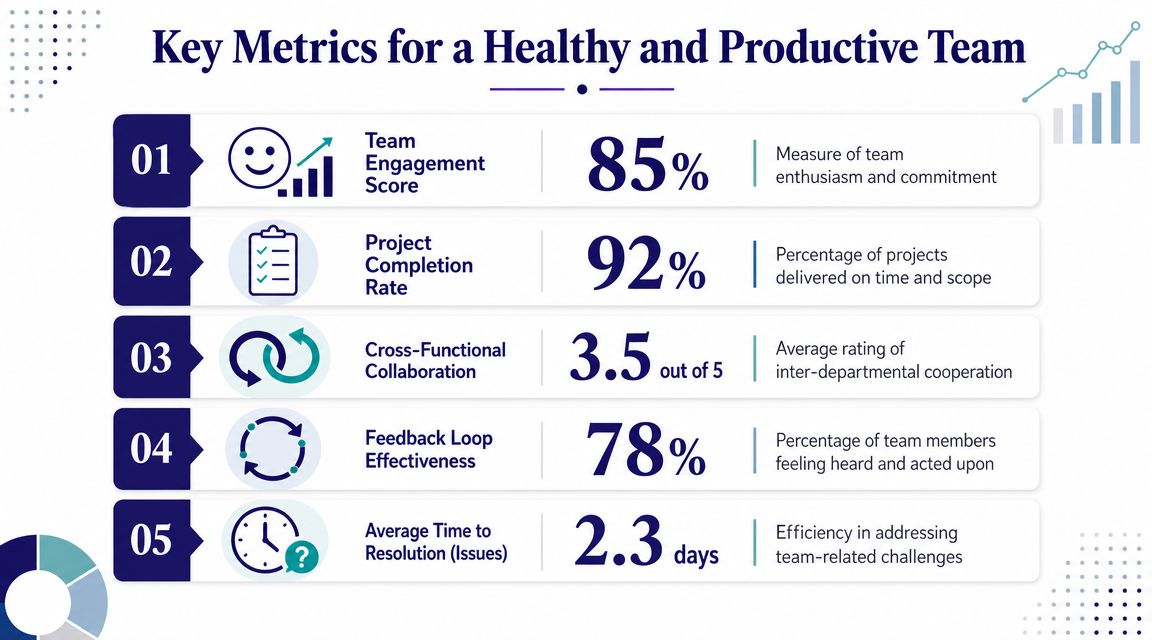
Key Metrics for a Healthy and Productive Team
If you’re training for finance or analytics work, you should learn to think like an observer of systems, not just a doer of tasks. Strong teams leave clues. You can often spot health or strain before anyone says it out loud.
Some of the clearest business links come from engagement and collaboration. A widely cited teamwork statistics roundup reports that collaboration can enhance loyalty for 33% of employees, teamwork can boost company sales by 27%, highly engaged teams can increase profitability by 23%, and highly engaged business units can reduce absenteeism by 81% while lifting productivity by 14%, according to this roundup of teamwork statistics.
Those figures don’t mean every team should obsess over huge dashboards. They do mean team health has real business consequences.
What to watch in everyday work
If you’re not a manager, you can still notice useful signals.
- Deadline reliability: Does the team usually deliver when it says it will?
- Rework level: Are files coming back with the same avoidable issues?
- Handover quality: Do people pass on work with enough context to continue smoothly?
- Error patterns: In payroll, bookkeeping, or reporting, are the same mistakes repeating?
- Response clarity: When someone asks a question, do they get a clear answer and owner?
Role-specific examples
The best metrics often connect to the actual job.
| Role | Useful signs of team health |
|---|---|
| Bookkeeping & VAT | Fewer unclear transactions waiting at the deadline, consistent coding, clear review notes |
| Advanced payroll | Fewer last-minute amendments, cleaner approval flow, faster resolution of employee queries |
| Accounts assistant | Reconciliations completed on time, less chasing for missing paperwork, stronger month-end rhythm |
| Final accounts | Better version control, fewer reviewer comments repeated, smoother completion of support schedules |
| Business analyst | Clearer requirements, fewer meeting loops, faster sign-off on process decisions |
| Data analyst | Fewer metric disputes late in the project, cleaner documentation, stronger stakeholder confidence |
Key takeaway: Measure the points where teamwork becomes visible. Handoffs, approvals, errors, delays, and repeated questions tell you more than broad slogans ever will.
The skill here is not to turn your team into a spreadsheet. It’s to learn which indicators reveal friction early, so the team can fix the process before pressure builds.
How Practical Training Forges Elite Teams
Successful teams are built, and training is one of the main ways that happens. Not just because training teaches software or theory, but because it improves the things teams rely on every day. Confidence. consistency. shared language. process awareness. judgement.
That’s especially true in accounting, finance, and analytics. A trainee who studies bookkeeping & VAT doesn’t only learn entries and returns. They learn the logic behind the workflow. That makes role boundaries clearer and handovers safer. The same applies to advanced payroll, where structured learning helps people understand cut-offs, approvals, adjustments, and audit trails. Technical competence reduces uncertainty, and reduced uncertainty makes teams easier to coordinate.
How training supports each team behaviour
A practical course can strengthen team success in several ways.
- Role clarity improves: When learners understand the full process, they know where their job starts and ends.
- Trust increases: Teammates trust colleagues who can explain their reasoning and document work properly.
- Communication gets sharper: Training often teaches the vocabulary and structure needed to write useful notes, queries, and summaries.
- Decision quality rises: Better technical understanding leads to better judgement when problems appear.
For example, someone studying accounts assistant work becomes more useful when they can link purchase ledger tasks to reconciliations and month-end support. Someone learning final accounts becomes easier to work with when they understand schedules, adjustments, and review expectations. A learner in business analyst or data analyst training becomes more valuable when they can define requirements, test assumptions, and present findings clearly.
Why job-ready practice matters
This is why employers often prefer training that includes realistic tasks rather than theory alone. Working in Sage, Xero, QuickBooks, Excel, SQL, Python, or Power BI helps learners develop habits teams need. File discipline. version control. structured checking. sensible escalation. evidence-based reasoning.
Support outside the classroom can help too. For example, a structured coaching platform can be useful when learners need guidance on communication, confidence, and performance habits alongside technical growth. Team effectiveness often improves when people receive feedback in a focused and practical way.
If you’re helping others learn, there’s value in understanding how to teach skills clearly as well. Programmes on train the trainer can help experienced staff turn personal know-how into repeatable team capability.
The real career advantage
Training changes more than your CV. It changes how you behave inside a workflow.
You ask better questions. You recognise risk earlier. You know when to check and when to proceed. You hand work over in a way the next person can use. That’s what makes someone feel dependable in a bookkeeping team, a payroll team, an accounts department, or an analytics function.
The most valuable professionals aren’t just technically good in isolation. They make the team around them work better.
Conclusion Start Building Your Ultimate Team Today
A successful team doesn’t happen by accident. It grows from a few visible habits. People know the goal. Roles are clear. Questions are safe to ask. Communication works across desks, systems, and locations. Decisions don’t drift. Training gives people the competence and confidence to do their part well.
If you’re starting out in bookkeeping, VAT, payroll, accounts support, final accounts, business analysis, or data analysis, this should encourage you. You don’t need to wait until you become a manager to shape team quality. You can improve it now through the way you communicate, document, check, ask, and hand over work.
Start small. Clarify one recurring process. Ask one better question. Write one cleaner update. Document one task so the next person doesn’t have to guess. Those actions may seem minor, but they’re exactly where strong teams are built.
And if your current team isn’t ideal, don’t treat that as a dead end. Treat it as training. Learning what makes a successful team helps you spot good environments, contribute more confidently, and become the kind of colleague employers want to keep and promote.
The strongest career move isn’t only becoming more skilled. It’s becoming someone whose skills help the whole team succeed.
How PC Training Can Help
If you’re ready to build job-ready skills for accounting, payroll, bookkeeping, business analysis, or data analysis, Professional Careers Training offers practical training designed to improve employability and confidence in real UK workplace settings. Their support includes flexible learning, software training, recognised certifications, and career-focused guidance to help you become the kind of team member employers trust.