

A lot of technically strong people in the UK job market face the same problem. They can reconcile a ledger, prepare payroll, build a dashboard,...
A lot of technically strong people in the UK job market face the same problem.
They can reconcile a ledger, prepare payroll, build a dashboard, spot an error in a VAT return, or explain a variance in Power BI. But when they need to brief a manager, answer a client, write a handover note, or present a finding in a meeting, the value of their work gets diluted.
That gap affects hiring, progression, and credibility. In bookkeeping, payroll, final accounts, business analysis, and data analysis, your work only creates business value when other people understand it and act on it. That is why communication is no longer a nice extra. It is part of technical performance.
A good communication skills trainer helps technical professionals turn knowledge into action. Not by teaching empty presentation tricks, but by building the practical habits employers notice straight away: clearer emails, better updates, sharper stakeholder conversations, stronger interview answers, and more confident handling of difficult questions.
Introduction The Communication Gap in Technical Roles
You might know someone like this. They are excellent with numbers, careful with detail, and reliable under pressure. Yet in meetings they speak too late, in emails they over-explain, and in interviews they struggle to show the value of what they know.
That is not a minor weakness. It is a career bottleneck.
For technical professionals, communication is the bridge between analysis and decision-making. A bookkeeper who can't explain why a figure changed may lose a client's trust. An accounts assistant who gives vague updates can slow month-end close. A business analyst who presents requirements in unclear language can create avoidable project confusion. A data analyst who knows the answer but can't frame the business implication may be ignored.
In the UK, this is not just an individual issue. The UK Government's Employer Skills Survey highlights that communication remains a major need in the workplace. Around 63% of employers identified non-technical skills gaps among staff, and about 37% reported specific shortfalls in communication, making it one of the most common deficits affecting performance, as noted in this overview of becoming a communication skills trainer.
Why technical people get misunderstood
Technical professionals often fall into one of three traps:
- Too much detail: They include every step, every caveat, and every exception, even when the audience only needs the decision point.
- Too little structure: They know the answer, but they don't organise it in a way that helps a manager or client act quickly.
- Wrong level of language: They speak to non-technical people as if everyone shares the same background knowledge.
None of this means they lack intelligence. It usually means nobody has trained them to communicate in role-specific business settings.
Practical rule: If your audience cannot repeat your main point in one sentence, your message probably needs work.
Why this matters in finance and data roles
In finance and data work, communication often decides whether your technical output gets used at all.
Consider a few common examples:
| Role | Technical task | Communication challenge |
|---|---|---|
| Bookkeeper | Recording transactions accurately | Explaining records clearly to a business owner |
| Advanced payroll professional | Processing complex payroll changes | Answering staff queries calmly and precisely |
| Accounts assistant | Supporting reconciliations and reporting | Giving concise updates to managers |
| Final accounts trainee | Preparing year-end information | Presenting adjustments in plain English |
| Business analyst | Gathering and refining requirements | Aligning stakeholders with different priorities |
| Data analyst | Producing insights from data | Turning findings into recommendations |
A specialised communication skills trainer addresses that exact gap. They help technical people make their work visible, credible, and useful.
What a Communication Skills Trainer for Technical Professionals Does
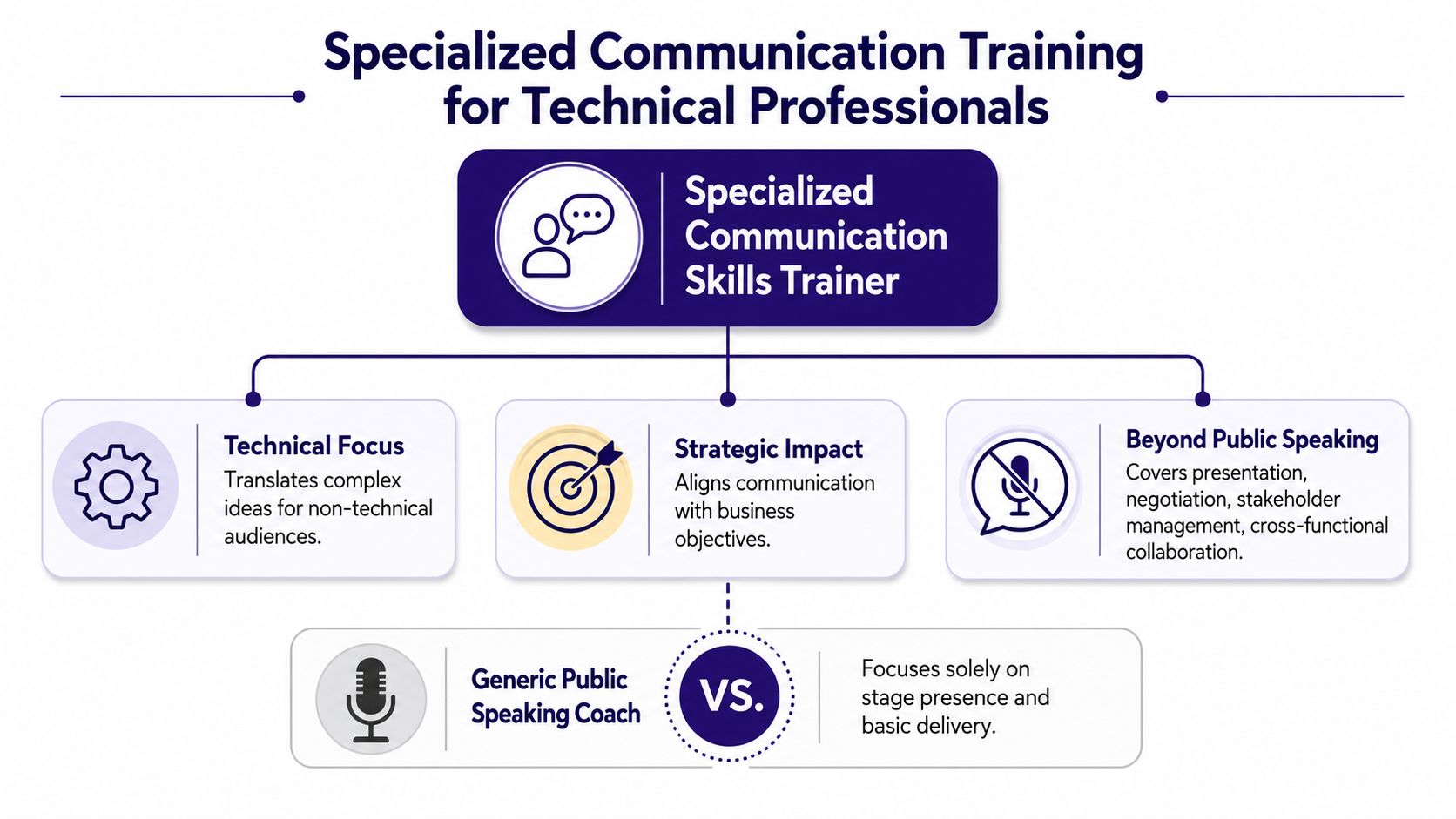
A specialised communication skills trainer does much more than teach people how to stand up and speak confidently. For technical professionals, the primary job is translation. They help you move from expert language to business language without losing accuracy.
That matters because most workplace communication is not a formal speech. It is an email about a missing invoice. A quick verbal update on payroll timing. A dashboard walkthrough for a non-technical manager. A meeting where you need to challenge an assumption politely and clearly.
Not a generic speaking coach
A generic speaking coach often focuses on stage presence, voice, or presentation nerves. That can help in some settings, but it won't solve the everyday communication problems that show up in finance, accounting, and analysis roles.
A communication skills trainer for technical professionals usually works on things like:
- Clarifying business meaning: Turning a spreadsheet result into a simple explanation a client or manager can use.
- Improving stakeholder updates: Helping a business analyst summarise progress, risks, and next steps without waffle.
- Handling questions under pressure: Preparing an accounts assistant or payroll learner to answer follow-up questions with confidence.
- Structuring written communication: Teaching concise email writing, better subject lines, cleaner requests, and clearer escalation messages.
If you also want to strengthen delivery in more formal settings, practical presentation skills training resources can complement this kind of role-specific coaching.
What the trainer actually works on
The training is usually grounded in real work scenarios, not abstract theory.
Here are the sorts of situations a strong trainer will practise with you:
Bookkeeping and VAT
A small business owner asks why the VAT figure differs from what they expected. You need to explain the cause without sounding defensive or overly technical.
A trainer helps you:
- organise the answer,
- remove jargon,
- manage tone,
- and finish with a clear next step.
Advanced payroll
Payroll work often requires accuracy plus discretion. Staff may ask emotional questions about pay, deductions, or timing.
A trainer helps you:
- answer calmly,
- set boundaries,
- explain process clearly,
- and avoid unclear wording that creates more anxiety.
Business analysis and data analysis
Analysts often know more than they can easily say. Their challenge is not knowledge. It is selection.
A trainer will show you how to:
- identify the decision your audience needs to make,
- choose the evidence that supports that decision,
- present the finding in plain language,
- invite questions without losing control of the message.
Strong communication in technical roles means people understand what changed, why it matters, and what happens next.
That is the difference between being seen as “good with numbers” and being trusted as a professional who can influence outcomes.
The Career-Changing Benefits of Targeted Communication Training
The biggest mistake people make is thinking communication training only helps weak communicators. In reality, it often helps capable people show what they already know.
That is why targeted coaching can change career direction quickly. A systematic review found that even relatively short communication-skills training programmes, often lasting between 4.5 hours and 2 days, can lead to measurable improvements in both performance and self-efficacy, according to this systematic review on communication-skills training.
For recent graduates
Graduates in accounting, payroll, business analysis, or data analysis often lose opportunities because they sound less capable than they are.
They may:
- give long, unstructured interview answers,
- describe tasks instead of outcomes,
- or freeze when asked to explain technical work in simple terms.
Targeted communication training helps graduates present evidence better. Instead of saying, “I used Excel to analyse data,” they learn to explain the business purpose, the method, and the outcome in a way recruiters can follow.
It also improves first-year performance. New starters need to ask good questions, write updates, and escalate issues early. Technical knowledge alone won't carry that.
For career changers
Career changers usually have more transferable value than they realise. The problem is language.
A retail supervisor moving into accounts support may already know customer communication, deadline management, and error handling. A trainer helps them reframe those strengths for a finance or analyst role. That changes how they write CVs, answer interview questions, and speak about previous work.
A practical step is improving your online positioning too. If you're trying to boost LinkedIn profile views, clearer messaging about your skills, projects, and business impact can support the same goal as interview coaching.
For international students and newcomers to the UK
Many international learners have strong technical ability but need support with UK workplace expectations.
That often includes:
- sounding polite without sounding uncertain,
- knowing when to be direct,
- understanding how to challenge professionally,
- and adapting tone for email, chat, and meetings.
A communication skills trainer can help decode those unwritten norms. That makes a real difference in interviews, placements, and early employment.
A technically correct answer can still fail if the tone, timing, or level of detail is wrong for the situation.
For employers
Employers often invest in software training and process training but overlook the communication habits that make technical teams effective.
For a finance team, that may mean fewer confusing handovers. For an analyst team, it may mean clearer recommendations. For a payroll function, it may mean better handling of sensitive staff queries.
The benefit is practical. Teams communicate with less friction. Managers spend less time decoding updates. Junior staff become easier to trust with client-facing or stakeholder-facing work.
That's why communication training works best when it is tied to real tasks, not treated as a generic confidence workshop.
Common Training Formats and Sample Modules for Finance and Data Roles
Communication training works best when the format fits the role, the learner, and the pressure points of the job. A trainee bookkeeper needs different practice from a business analyst leading a workshop. A data analyst working remotely needs different support from a payroll professional answering staff queries.
In the UK workplace, written communication matters especially because email remains the dominant workplace channel, while legacy systems still appear in some organisations. A UK-focused survey cited by Acuity Training found that almost 1 in 20 workers still use fax in workplace communications and that 25.34% reported using fax nationally. That mix of modern and legacy channels reinforces the need for trainers to teach clear writing, tone management, and channel choice, as discussed in these UK communication skills statistics.
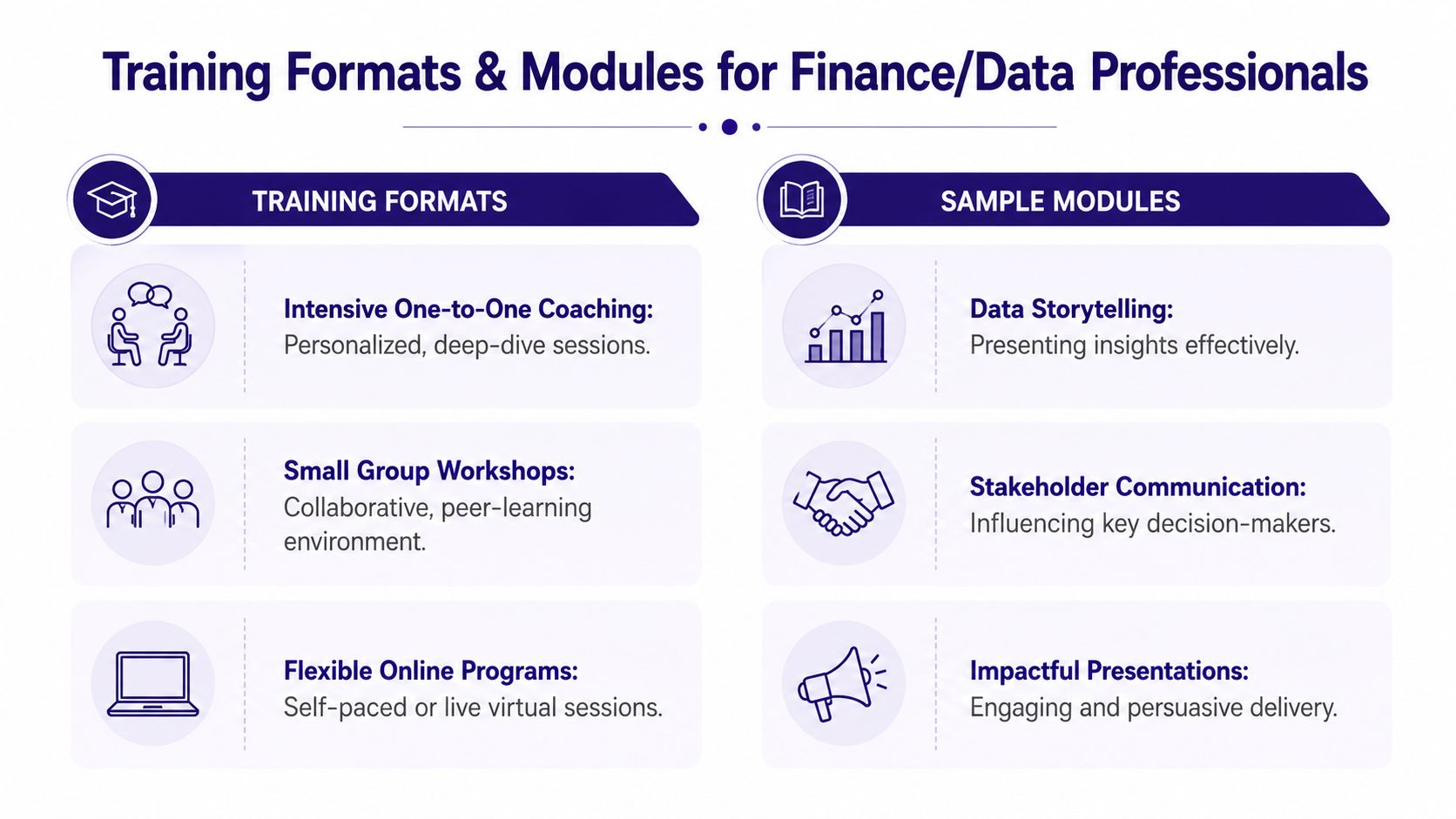
Three common training formats
One-to-one coaching
This is best for professionals with a specific communication barrier.
Examples include:
- an accounts assistant who struggles in meetings,
- a graduate who needs interview practice,
- or a business analyst who must improve stakeholder handling.
The advantage is relevance. The trainer can use your real emails, reports, update notes, and meeting scenarios.
Small group workshops
These work well when several people share a similar context. For example, finance trainees, payroll learners, or junior analysts.
Benefits include:
- role-play,
- peer feedback,
- exposure to different communication styles,
- and practice with common workplace situations.
If confidence and clear self-expression are part of the challenge, practical learning around assertiveness courses and techniques can support stronger workplace communication without becoming aggressive.
Online live or flexible learning
This format suits working learners and those balancing study with job applications. It can be effective if it includes feedback, not just videos.
For technical roles, online training should still involve realistic tasks such as rewriting updates, presenting findings, or responding to stakeholder questions.
Sample modules for specific roles
A strong communication skills trainer builds modules around what the learner does at work.
| Role | Sample module | What it covers |
|---|---|---|
| Bookkeeping and VAT | Client communication for bookkeepers | Explaining figures, handling queries, writing clear follow-ups |
| Advanced payroll | Sensitive payroll communication | Managing pay queries, tone control, privacy, escalation |
| Accounts assistant | Clear updates during month-end | Status updates, issue logging, concise email writing |
| Final accounts | Explaining adjustments simply | Plain-English summaries for managers and clients |
| Business analyst | Stakeholder communication in projects | Requirements discussions, facilitation, summarising decisions |
| Data analyst | Data storytelling for decisions | Turning findings into recommendations non-technical teams can act on |
Hybrid and remote communication practice
Many finance and analyst roles now rely heavily on remote or hybrid communication. That means learners need more than spoken confidence. They need to know when to email, when to message, when to escalate to a call, and how to write updates people can scan quickly.
Good training will include:
- short written briefings,
- meeting summaries,
- decision logs,
- camera-based discussion practice,
- and turn-taking in online meetings.
That is where technical professionals often gain the fastest improvement.
How to Choose the Right Communication Skills Trainer
Choosing the right trainer is not about finding the most polished website or the most energetic personality. It is about finding someone who understands the working reality of technical roles.
Consider a business analyst called Aisha. Before training, she knew her projects well but struggled to hold the room in stakeholder meetings. She gave too much background, buried key risks, and left decisions unclear. Her manager saw her as capable but not yet ready for greater responsibility.
After working with a trainer who understood analyst communication, her approach changed. She learned to lead with the decision needed, summarise risks in plain language, and close meetings with agreed actions. The technical knowledge was always there. The structure was not.
What to look for
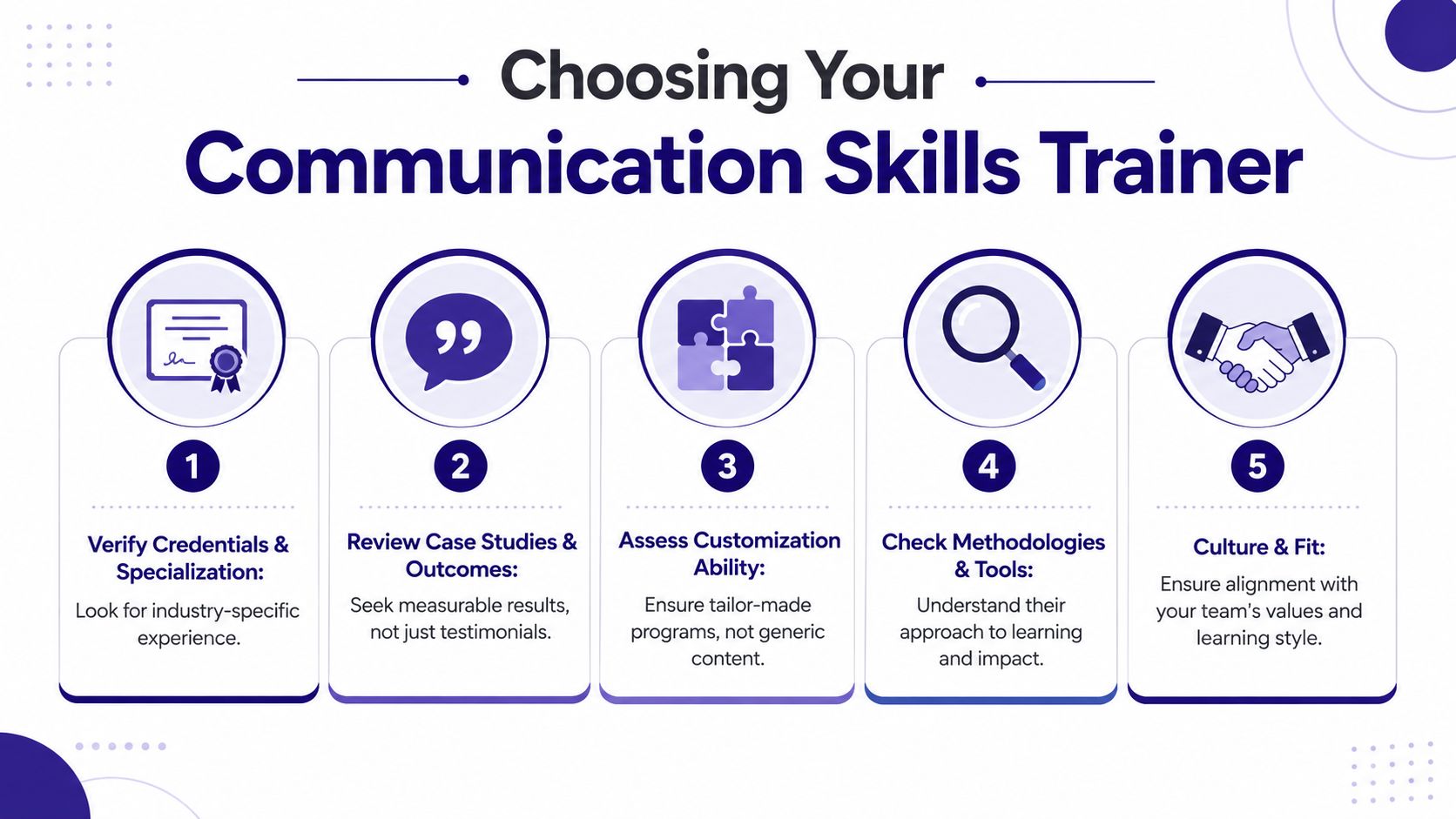
A strong communication skills trainer for finance or data professionals should show evidence of specialism.
Look for these signs:
- Role awareness: They can talk sensibly about bookkeeping, payroll, reporting, analysis, and stakeholder communication without turning everything into generic confidence advice.
- Practical methods: They use real tasks such as email rewrites, update practice, meeting simulations, and question handling.
- Clear outcomes: They define what improvement looks like in observable terms.
- Adaptability: They can coach graduates, career changers, and experienced professionals differently.
- Feedback quality: They don't just praise. They diagnose what is unclear and help fix it.
Questions worth asking
The best way to assess fit is to ask direct questions.
For example:
- How would you help a data analyst present a finding to a non-technical manager?
- How do you coach someone to explain payroll issues clearly and sensitively?
- What does good progress look like for an accounts assistant?
- How do you adapt your training for hybrid meetings and written updates?
- Can you show how you turn vague speaking advice into role-specific practice?
A useful short video can also help you think about what good communication coaching should support in practice.
Ask for examples of exercises, not just promises of confidence.
What to avoid
Some warning signs are easy to miss.
| Warning sign | Why it matters |
|---|---|
| Everything is about public speaking | Most technical communication happens in emails, meetings, and updates |
| No mention of role context | Generic advice rarely transfers to finance or analyst work |
| No assessment of starting point | Good training starts with diagnosis |
| No practice or feedback | Communication improves through rehearsal, not theory alone |
The right trainer should sound like someone who understands how technical work gets communicated inside real organisations.
Engaging a Trainer and Measuring Your Return on Investment
Once you decide to work with a communication skills trainer, the next step is to treat the training like any other professional development investment. You need a clear purpose, a defined scope, and a way to judge whether it worked.
That starts with sharper goals than “be more confident”. Confidence may improve, but it is not the best primary measure. Better goals are visible and role-linked.

Set goals that can be observed
Useful goals for technical professionals include:
- Interview performance: Giving structured answers with clear examples.
- Written clarity: Producing cleaner email updates and fewer confusing handovers.
- Meeting contribution: Speaking earlier, summarising points better, and handling questions more calmly.
- Stakeholder communication: Explaining issues, risks, and recommendations in language non-specialists can follow.
A practical way to think about this is to define a before and after state. Before training, your project updates may be long and unclear. After training, they may become concise, structured, and easier for managers to action.
Measure the right things
The return on communication training can be tracked through observable behaviours that recruiters and employers value. That includes showing improvement in interview situations, structuring project updates clearly in a portfolio, and demonstrating progress through CPD records or performance assessments, as discussed in this evidence review on communication training and employability outcomes.
That gives you a sensible measurement framework.
You can also use a broader guide for corporate training effectiveness to think through how learning translates into workplace outcomes.
A simple ROI checklist
Before you start, agree how success will be reviewed.
Try this checklist:
- Define the target situation: Interviewing, stakeholder meetings, client communication, or internal reporting.
- Collect examples: Save old emails, reports, or presentation notes to compare against later.
- Get manager feedback: If you are employed, ask for feedback on clarity, structure, and confidence before and after.
- Log evidence: Record interview results, portfolio improvements, or performance review comments.
- Connect it to business value: Faster approvals, fewer clarification messages, clearer meetings, and stronger handovers all matter.
If you need to justify the training internally, it helps to build the case in a format decision-makers understand. A practical resource on how to create a business case can help you frame need, benefit, and expected impact.
Communication training earns its place when you can point to changed behaviour, not just a positive learning experience.
That is especially true in bookkeeping, payroll, final accounts, business analysis, and data analysis, where clarity saves time and reduces avoidable mistakes.
Conclusion Building Your Career with Clear Communication
Technical skill gets you noticed. Clear communication gets your work used, trusted, and rewarded.
That is the core value of working with a communication skills trainer. Not surface polish. Not forced extroversion. Not generic advice about “speaking up more”. Its fundamental purpose is learning how to explain technical work so that clients, managers, recruiters, and colleagues can understand it quickly and act on it with confidence.
For bookkeepers, that may mean explaining financial records in plain English. For payroll learners, it may mean answering sensitive questions clearly. For accounts assistants, it may mean giving reliable updates during busy reporting periods. For business analysts and data analysts, it often means turning complexity into decisions.
The modern UK workplace has made that even more important. With hybrid and remote work now embedded in many organisations, the ability to structure a concise written update using a simple three-part brief of context, action, and deadline has become a critical skill for avoiding ambiguity and delay, as highlighted in this discussion of communication training for modern work.
That point matters because many professionals still think communication can be developed informally over time. Some of it can. But targeted training shortens the gap between technical competence and professional impact. It gives you repeatable methods instead of hoping experience alone will fix the problem.
If you are building a career in bookkeeping and VAT, advanced payroll, accounts assistant work, final accounts, business analysis, or data analysis, communication should sit alongside your software, reporting, and compliance skills. It belongs in the same category. It is a job skill.
The professionals who move ahead are rarely the ones who know the most in private. They are the ones who can make their knowledge useful in public, in meetings, in writing, in interviews, and in daily collaboration.
If you want practical, job-focused support in accounting, finance, payroll, business analysis, or data analysis, Professional Careers Training offers flexible training with ACCA qualified Chartered Accountants and CPD approved trainers, plus software training, career coaching, CV support, LinkedIn optimisation, and recruitment guidance. For learners who want technical ability and communication confidence together, that kind of structured support can make the path into UK roles much clearer.