If you're training to become a business analyst, or you already work as one, you've probably noticed AI tools turning up in more of your...
That’s where people often get confused about what CPD certification is. They assume it’s just another certificate to print and file away. In practice, it does something more useful. It shows that your learning is recent, structured, and relevant to the job you want now, not only the qualification you earned before.
Your Next Career Step in Accounting Starts with CPD
A lot of candidates in UK finance hit the same wall. They’ve done the academic part, but employers still want evidence that they can handle current tasks such as payroll processing, VAT compliance, reconciliations, final accounts support, or data reporting in tools like Excel, SQL, Python, or Power BI.
That gap between study and work is where CPD becomes valuable.
Continuing Professional Development, usually shortened to CPD, is the process of keeping your knowledge up to date after your original qualification or training. In regulated parts of the workforce, it’s not optional. Continuing Professional Development is a mandatory requirement for approximately 1.5 million individuals registered to work under 32 regulated professional titles in the UK according to BMJ Open research on UK CPD requirements.
That matters even if your target role isn’t one of those regulated titles. Hiring managers in accounting and finance think in terms of risk. They don’t just want someone who passed exams in the past. They want someone who can work with current rules, current software, and current workplace expectations.
Why people fall behind after qualifying
A qualification teaches foundations. Work changes faster than most syllabuses.
For example, someone may have studied accounting principles but still need fresh, job-ready training in:
- Bookkeeping and VAT: entering transactions correctly, understanding VAT treatment, and working with current reporting practice
- Advanced payroll: processing wages, deductions, and payroll records with confidence
- Accounts assistant work: handling purchase ledger, sales ledger, bank reconciliations, and month-end support
- Final accounts: understanding how records feed into year-end outputs
- Business analysis and data analysis: translating data into decisions with structured reporting tools
A strong CV in finance usually combines foundation knowledge with proof of recent, practical learning.
CPD is more than a compliance task
People sometimes treat CPD as a box-ticking duty. That’s too narrow.
Used well, CPD helps you answer the questions employers consider when they review your CV:
- Are this person’s skills current?
- Can they show recent training in relevant areas?
- Have they invested in their own professional standards?
If the answer is yes, you look easier to hire. That’s a big advantage when several candidates have similar degrees or similar early-career experience.
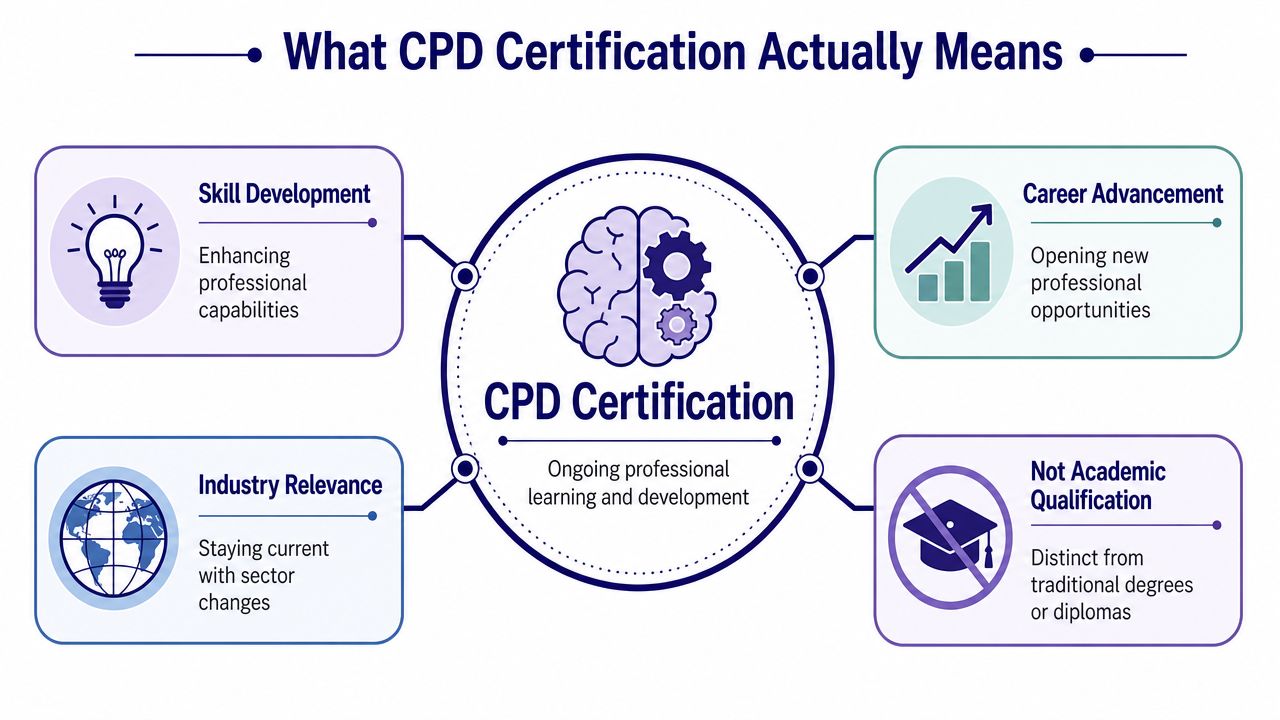
What CPD Certification Actually Means
A simple way to understand CPD certification is this. A degree is your starting qualification. A CPD certificate is proof that you’ve kept building on it.
To illustrate, consider a car. Your degree or diploma is the factory blueprint. It shows what the car was designed to do. CPD certification is closer to an MOT. It shows that the vehicle is still fit for use, maintained, and relevant to the road it’s on today.
That comparison helps because many learners mix up three different things: a qualification, a certificate of attendance, and a CPD-accredited certificate. They are not the same.
It’s a validation, not an academic award
In the UK, CPD certification is not a regulated academic qualification but an independent validation that a training activity meets recognised Continuing Professional Development benchmarks. It also means the learning is structured, relevant, and useful for professional growth. Courses that receive CPD accreditation are given specific CPD credits calculated strictly based on active learning time, as explained in this guide to how CPD-accredited training works in the UK.
So if you complete a course in bookkeeping, VAT, payroll, or data analysis with CPD accreditation, the value isn’t only that you attended. The value is that the learning has been assessed against recognised CPD standards.
Who gives CPD certification
CPD certification comes through accreditation bodies that assess training quality. The point of that external review is simple. It gives employers and learners more confidence that the course has a clear structure, useful outcomes, and professional relevance.
A provider can’t just say, “trust us, this is good training,” and expect that to carry the same weight. Independent assessment is what makes the certification meaningful.
How employers read CPD hours and credits
When a certificate includes CPD hours or credits, it gives a practical signal. It tells the employer how much active learning was involved.
That’s especially useful in job areas where “knowledge” can be vague on a CV. Saying you studied VAT is one thing. Showing recent CPD-backed learning in VAT, payroll, or analytics is much stronger.
For a deeper accounting-specific explanation, this overview of continuing professional development for accountants is a helpful reference point.
Practical rule: If a course helps your career, the next question is whether anyone outside the provider has validated its quality.
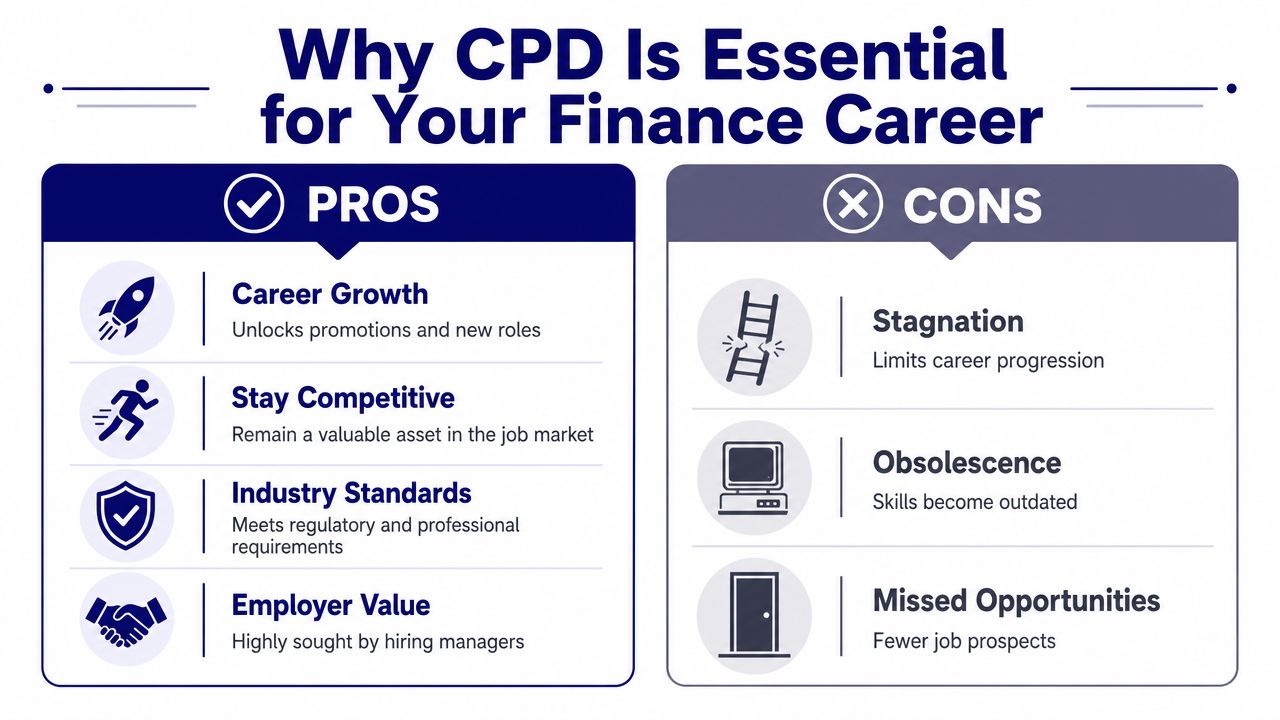
Why CPD Is Essential for Your Finance Career
If you were hiring for an accounts assistant or junior analyst role, you wouldn’t only look for exam results. You’d look for signs that the candidate can step into current work with minimal hand-holding.
That’s why CPD matters so much in finance, accounting, payroll, and data roles.
What hiring managers want to reduce
Employers are usually trying to reduce four risks when they recruit:
- Skills risk: can the person do the tasks listed in the role?
- Compliance risk: do they understand areas like VAT, payroll, ethics, and record-keeping properly?
- Software risk: can they work in systems used by modern teams?
- Training risk: how much time will the employer need to spend bringing them up to speed?
A CPD-certified course helps answer those concerns because it shows structured, recent learning. In the UK, CPD certification is widely recognised and valued by employers across numerous industries, serving as proof that a training course meets established learning and quality standards. Employers also view it as credible evidence of ongoing education, which can support career progression, as outlined in this explanation of how UK employers recognise CPD certification.
Why this matters in accounting and analysis roles
Finance work doesn’t stand still. VAT guidance changes. Payroll procedures evolve. Employers use different accounting software. Analyst roles now expect more than basic spreadsheet use.
A candidate who has recent CPD in bookkeeping & VAT looks more work-ready than someone who only studied broad theory. The same is true for advanced payroll, final accounts, business analyst, and data analyst training. These are all areas where employers want practical judgement, not just textbook familiarity.
When two applicants look similar on paper, recent and relevant learning often becomes the deciding factor.
CPD and career progression
CPD also helps once you’re already in work. It gives you a clearer route from entry-level tasks into broader responsibility.
For example:
- Bookkeeping to accounts assistant: CPD training can show you’re ready to support ledgers, reconciliations, and routine reporting.
- Accounts assistant to final accounts support: targeted learning can strengthen your understanding of year-end processes.
- Payroll administrator to advanced payroll work: CPD signals deeper practical capability.
- Graduate to business analyst or data analyst: recent training in Excel, SQL, Python, or Power BI shows you’ve moved beyond theory.
If your work touches tax processes, compliance, or client support, it also helps to understand the wider standards around choosing a registered tax agent, because employers value people who understand how regulated work is handled in practice.
How to Earn and Record Your CPD Credits
Once people understand the value of CPD, the next question is practical. How do you earn it, and how do you prove you’ve done it properly?
The good news is that the process is usually straightforward when you treat it like any other professional record.

Earning CPD through relevant training
You earn CPD by completing learning that develops your professional knowledge and skills. In the context of accounting, finance, and analytics, that often includes formal courses and structured study.
Examples include training in:
- Bookkeeping and VAT, where you build practical understanding of core VAT principles, rates, thresholds, compliance, complex areas, sector-specific issues, and updates to guidance
- Advanced payroll, where you focus on payroll processes and workplace application
- Accounts assistant training, which supports ledger work, reconciliations, and daily finance operations
- Final accounts, where you connect transaction processing to year-end reporting
- Business analyst and data analyst courses, especially when they include tools such as Excel, SQL, Python, and Power BI
If you want to compare course styles and formats, resources beyond the UK can also help you think clearly about online learning options, such as this small business accounting classes online guide from Bookkeeping and Accounting of Florida Inc..
A useful next step for role-specific options is this page on CPD courses for accountants.
Recording CPD in a way that stands up
A CPD log doesn’t need to be complicated. It does need to be clear.
A good record usually includes:
- Date of activity: when the training happened
- Topic covered: for example VAT, payroll, ethics, final accounts, SQL, or Power BI
- Type of learning: course, workshop, supervised practice, guided study, or reflective review
- Learning time: the active time spent learning
- What you learned: a short note on the skill or knowledge gained
- How it helps your role: a practical reflection linking learning to work
- Evidence kept: certificate, attendance confirmation, training record, or supporting email
Under ICAEW CPD regulations, members must complete at least one hour of independently verifiable ethics-related training per CPD year, and the evidence must include independent corroboration such as an attendance email from the organiser or a course completion certificate, according to the ICAEW guide to CPD requirements.
That example shows why record-keeping matters. It’s not enough to say you learned something. You need to keep proof that would make sense to a professional body or employer.
Here’s a short explainer that can help make the process more visual:
A simple habit that makes CPD easier
Record each activity soon after you finish it. If you wait until months later, details get fuzzy.
Write your reflection while the lesson is still fresh. That’s when you’re most likely to capture what changed in your understanding.
Accreditation vs a Standard Training Certificate
This is one of the biggest areas of confusion for learners, especially when course pages all seem to promise a certificate at the end.
Not every certificate carries the same weight.
A useful analogy is a chef. A chef can say their own cooking is excellent. That’s a self-claim. A Michelin inspector awarding recognition is different because it comes from outside the kitchen. CPD accreditation works in a similar way. It acts as an external trust mark.
Why third-party assessment matters
CPD Accreditation is a specific trust mark awarded only when a training provider’s activity has been assessed and confirmed to meet standards suitable for Continuing Professional Development. That’s why courses in bookkeeping, VAT, or advanced payroll need to be assessed against those standards if they are to count as valid CPD for professional bodies such as AAT or ICAEW, as explained in this summary of CPD accreditation for accounting training.
A standard certificate of completion may still show that you attended a course. It just doesn’t automatically tell an employer or professional body that the course met recognised CPD criteria.
CPD Accreditation vs Certificate of Completion
| Feature | CPD Accredited Certificate | Standard Certificate of Completion |
|---|---|---|
| Who validates it | An external CPD accreditation process has assessed the training | Usually issued by the training provider alone |
| What it shows | Structured learning suitable for professional development | Attendance or completion of a course |
| Employer signal | Stronger evidence of recent, relevant, quality-checked learning | Basic proof that you finished training |
| Professional body value | More useful where recognised CPD evidence is needed | May not meet CPD expectations |
| Best use | Career development, compliance support, stronger CV positioning | General participation record |
The practical question to ask before enrolling
Before paying for any course, ask a simple question. Is this just a completion certificate, or is it CPD accredited?
That one distinction can change how useful the course is for your CV, your interviews, and your professional record. If you want a broader explanation of how career training and formal status differ, this guide to what a professional qualification means is worth reading.
Your CPD Path with Professional Careers Training
For most learners, the primary value of CPD isn’t theoretical. It’s practical. It helps turn knowledge into job readiness.
That’s especially important in fields where employers expect you to work with live processes, software, and reporting tasks from day one. If your aim is to move into bookkeeping & VAT, advanced payroll, accounts assistant, final accounts, business analyst, or data analyst work, CPD-focused training helps you build a clearer path between study and employment.
Matching training to the role you want
Different roles need different forms of evidence.
If you want bookkeeping or accounts assistant work, recent training in ledgers, VAT, reconciliations, and accounting software can make your CV more convincing. If you’re targeting payroll roles, practical payroll learning shows employers you understand routine processing and accuracy. If you’re moving towards analyst jobs, current training in Excel, SQL, Python, and Power BI signals that you can work with real business data, not just discuss it.
That’s why the strongest career plans are usually specific. Not “I want any finance job.” More like, “I want an accounts assistant role, so I need current bookkeeping, VAT, software, and reporting skills.”
Support matters as much as the certificate
A certificate helps. Support around the learning often matters just as much.

Professional Careers Training offers a combination that many learners need for their careers: 1-to-1 mentoring from ACCA qualified Chartered Accountants and CPD approved trainers, flexible timetables with weekend and evening options, official certification in Sage, Xero, and QuickBooks, software support, and recruitment help including CV preparation, career coaching, job hunting strategy, LinkedIn optimisation, and employer referrals.
That matters because the end goal isn’t just to collect certificates. It’s to become easier to hire.
Good CPD should change what you can do at work, what you can prove on your CV, and how confidently you speak in interviews.
If you’ve been asking what CPD certification is, the shortest honest answer is this. It’s the proof that your learning didn’t stop when your formal education ended.
If you want training that connects CPD-certified learning with practical finance and analyst job support, explore Professional Careers Training and choose a path in bookkeeping & VAT, advanced payroll, accounts assistant, final accounts, business analyst, or data analyst work that fits the job you want next.