
You might be in a familiar spot. You've finished a degree, passed a few exams, or built some office experience, yet job adverts still ask...
You might be in a familiar spot. You've finished a degree, passed a few exams, or built some office experience, yet job adverts still ask for Xero, Sage, QuickBooks, payroll software, SQL, Power BI, or advanced Excel. You know the theory, but employers want proof that you can do the work.
That's where CPD online learning starts to make sense.
For people aiming for bookkeeping, VAT, payroll, accounts assistant, final accounts, business analyst, or data analyst roles, CPD isn't just about collecting certificates. It's a practical way to close the gap between classroom knowledge and day-to-day job tasks. It helps you turn “I've studied this” into “I can use this software, complete this process, and explain this clearly in an interview”.
Start Your Career with CPD Online Learning
Many learners arrive at the same frustrating point. They've studied accounting, finance, business, or data. They've done well enough. But when they apply for entry-level roles, they keep seeing tools and tasks they haven't used in a practical setting.
That gap matters. Existing content on CPD online learning in the UK mostly centres on healthcare and education, not on the software-led skills finance teams seek. There's also a clear need for practical software ability, with 68% of UK accounting firms reporting that recent graduates lack practical software competency according to this discussion of the gap in UK CPD content.
Why this matters in finance and data roles
A bookkeeping employer rarely needs another broad explanation of double-entry principles. They need someone who can post transactions in Xero, reconcile bank entries, process VAT correctly, and work confidently in Sage or QuickBooks.
A hiring manager for a data role often thinks the same way. They don't just want someone who understands reporting in theory. They want someone who can clean data in Excel, query tables in SQL, and build a usable dashboard in Power BI.
That's why good CPD online learning feels different from generic online study. It should help you:
- Build work-ready skills: Learn tasks you'll perform in a finance office or reporting role.
- Gain relevant evidence: Show certificates, software practice, and completed exercises on your CV.
- Study around life: Fit learning around work, childcare, or other commitments.
- Move with purpose: Choose training that points to a specific job title, not just a broad subject area.
CPD works best when it solves a job problem, not when it just fills your spare time.
Why online study now has real weight
The wider UK online learning market is large and still growing. The UK's Online Education & Training industry is projected to reach £5.0 billion in 2026, according to IBISWorld's industry outlook. That matters because it means learners now have real choice. You're not limited to rigid evening classes in one town. You can look for training that matches the software, support style, and career path you need.
For a career changer, that might mean bookkeeping and VAT. For a graduate, it might mean accounts assistant training with payroll. For someone moving into analytics, it might mean advanced Excel, SQL, and Power BI in one clear pathway.
What Is CPD and How Does Accreditation Work
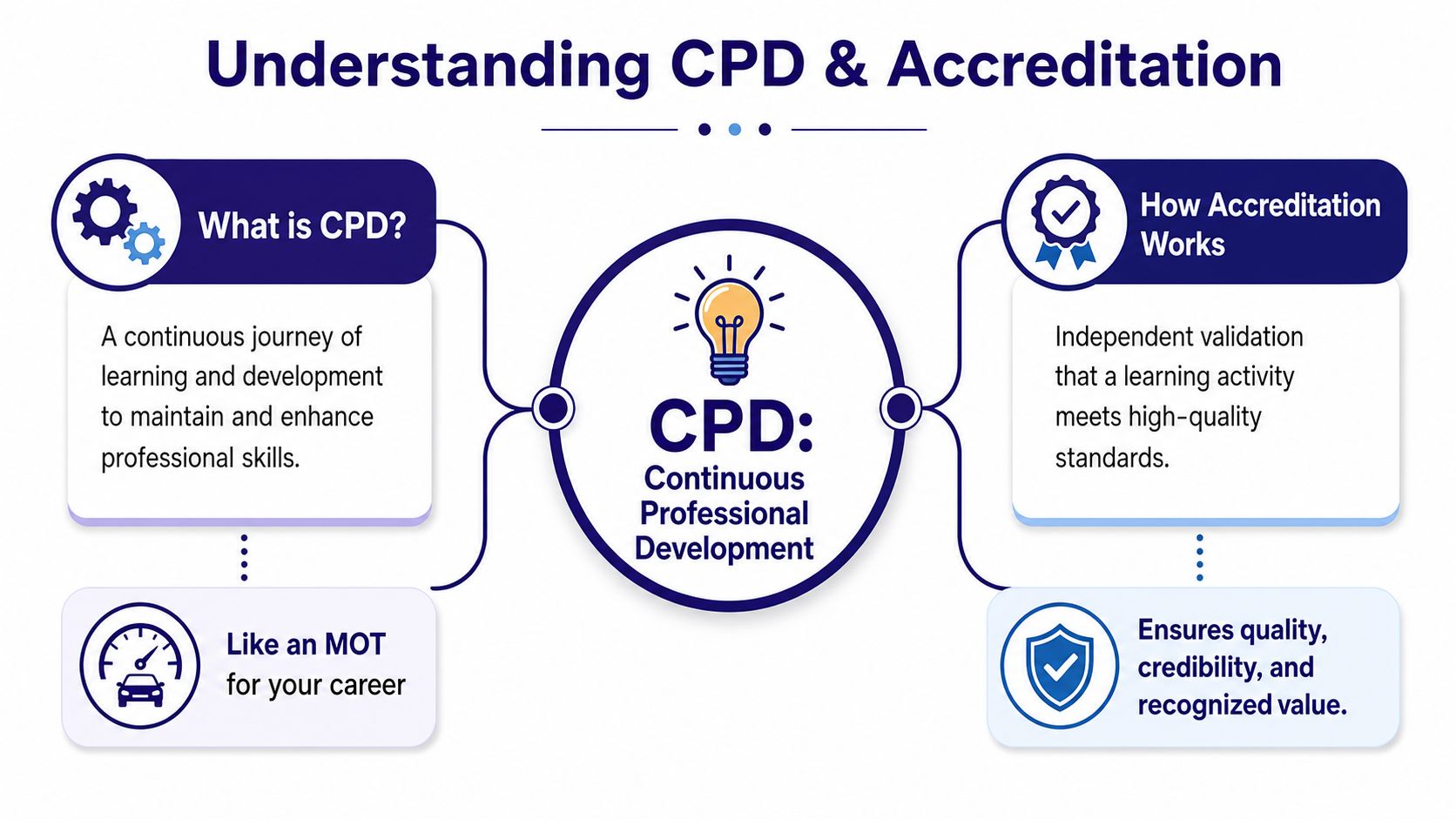
Think of Continuing Professional Development, or CPD, as an MOT for your skills. Your career doesn't stand still, so your knowledge can't stand still either. Software changes. employer expectations change. Processes change. CPD is the habit of keeping your skills current and useful.
For finance and data roles, that often means learning beyond your original qualification. A person may have a degree in accounting but still need training in Sage 50, Xero, payroll processing, or Power BI reporting. CPD fills that practical gap.
What accreditation actually means
When a course is described as CPD accredited or CPD approved, the key idea is quality and recognised learning value. In plain terms, it means the learning activity has been structured in a way that supports professional development and can usually be counted as evidence of learning.
That matters because CPD is not just a private goal for many people. In the UK, CPD is mandatory for approximately 1.5 million individuals across 32 regulated professional titles, with annual requirements ranging from 10 to 50 hours, and a mean of 23 hours, as reported in BMJ Open's review of UK CPD requirements.
For readers in accountancy and finance support roles, this matters in two ways:
- You may need formal evidence later. Even if your first role doesn't ask for it, regulated environments often value a clear learning record.
- Employers like structured development. A certificate tied to relevant learning is easier to recognise than a vague statement like “self-taught”.
If you want a straightforward overview intended for finance learners, this guide to continuing professional development for accountants is a helpful companion.
How CPD hours and certificates fit in
People often get confused here. They wonder if a certificate is the same as a qualification. It usually isn't.
A CPD certificate normally shows that you completed a defined learning activity. It can support your record of ongoing development. A formal qualification, such as the AAT Level 3 Certificate in Bookkeeping, serves a different purpose. That's a recognised qualification route into bookkeeping.
Both can be useful. They answer different questions.
- A qualification says: you've met the standard for a defined course of study.
- A CPD certificate says: you've continued developing relevant professional skills.
- A portfolio says: you can apply those skills to practical tasks.
Practical rule: If you're choosing between a course that sounds interesting and a course that gives you skills, evidence, and a clear job link, choose the second one.
How Online CPD Boosts Your Employability
Online learning helps when speed and flexibility matter. That's one reason it suits people who are trying to enter finance or data roles while juggling work, family, or job applications.
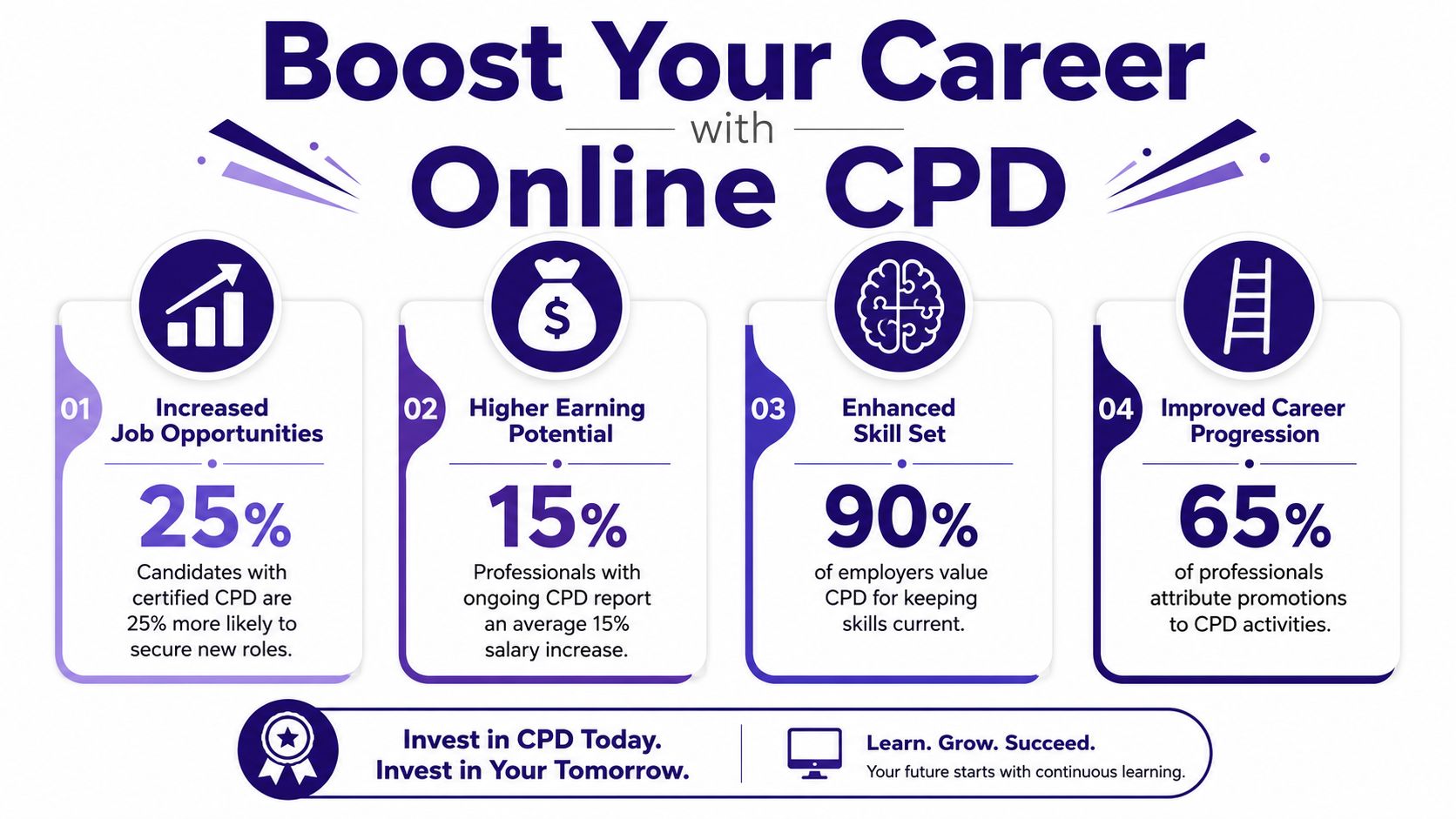
A strong practical reason stands out. Online learning has shown a 40% to 60% reduction in time needed to master a subject, alongside a 25% to 60% boost in learner retention, according to Devlin Peck's online learning statistics summary. If you're trying to become job-ready in the evenings or at weekends, that efficiency matters.
For graduates who need their first role
A lot of graduates have enough theory for an interview, but not enough examples of doing the work. Online CPD can help them build that missing middle.
Instead of saying, “I studied management accounting”, they can say:
- I've practised sales and purchase ledger work in Sage
- I understand bank reconciliation
- I've worked through VAT return tasks
- I can produce reports in Excel
That changes the conversation. Employers often need junior staff who can contribute quickly.
For career changers who need a realistic route in
Career changers usually need three things at once. They need flexibility, a clear sequence, and confidence that the learning points to a real job.
Online CPD is well suited to that because it lets you study in stages. You might begin with bookkeeping fundamentals, then move into VAT and payroll, then add software practice. Or you might start with Excel, then progress into SQL and Power BI if you're aiming for a business analyst or data analyst post.
A well-designed virtual learning environment for professional study can make that path easier to follow, especially when you need to fit study around your current job.
Here's a short explainer that shows how online training is commonly delivered in practice:
For working professionals who want progression
If you already work in accounts, administration, or reporting, online CPD can help you move beyond repetitive tasks.
A payroll administrator might add advanced payroll knowledge and become more valuable during month-end work. An accounts assistant might learn final accounts support. A reporting assistant might add SQL and Power BI to move towards analyst work.
The strongest CPD choices are the ones that let you explain a better version of your job story. Not just what you learned, but what you can do next.
How to Choose an Accredited Online CPD Course
You find a course called “Professional CPD for Finance and Business.” The title sounds promising, the certificate looks polished, and the sales page says it suits a wide range of learners. Then you look closer. There is no clear mention of Xero, Sage, SQL, or Power BI. No examples of workplace tasks. No sign of how the training connects to an accounts assistant job, a bookkeeping role, or a junior data post.
That is usually the point where learners either save themselves time or head into a course that feels useful at first but adds little at interview stage.
Ask practical questions before you enrol
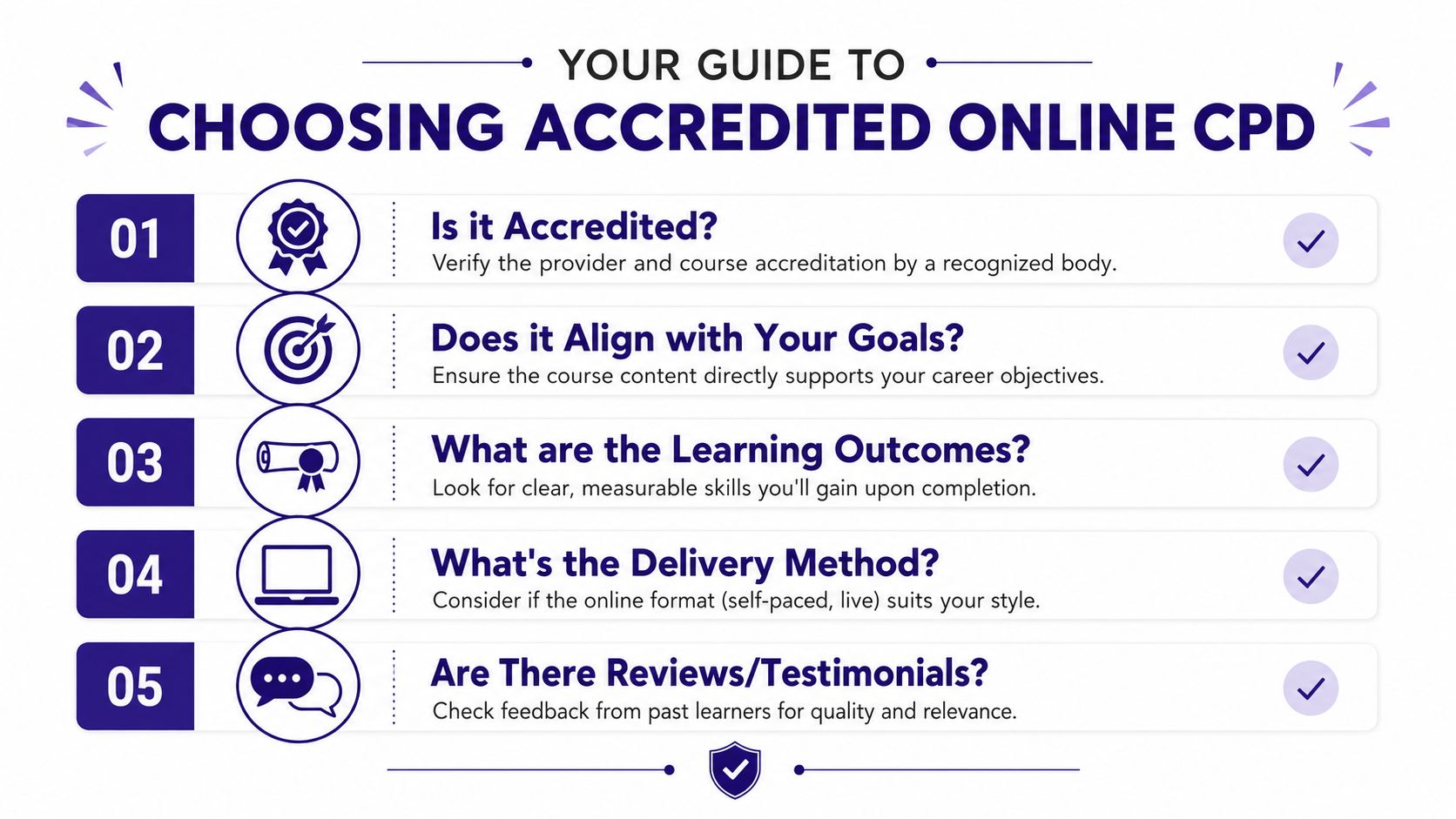
A strong CPD course should answer one simple question. What will I be able to do after this that I cannot do now?
That matters because accredited CPD can still be too broad. A course may meet CPD standards and still leave you with knowledge that is hard to use in an accounting office or reporting team. For vocational roles, the better option is training that links theory to software, routine tasks, and the pace of real work.
Ask questions such as:
- Which job does this course prepare me for? “Accounting” is too wide. Look for training linked to bookkeeping, VAT, payroll, accounts assistant work, final accounts support, business analysis, or data analysis.
- Which software will I practise? For finance roles, that often means Xero, Sage, or QuickBooks. For data roles, it may mean Excel, SQL, and Power BI.
- How practical is the learning? Screen demonstrations, exercises, case studies, and workflow tasks usually help more than slide-based theory alone.
- Who teaches it? Tutors with office and industry experience can explain why a task matters, not just how to complete it.
- What proof of learning will I leave with? A certificate helps, but so do completed tasks, software practice, and examples you can talk through in an interview.
A useful way to judge this is to treat the course outline like a job description in reverse. If the course topics do not line up with the duties of the role you want, the fit is weak.
Match the course to your next role
Many learners pick a course for the name rather than the outcome. A better method is to start with the job and work backwards.
If you want bookkeeping work, a course should cover reconciliations, ledgers, VAT, and accounting software. If you want to move into data analysis, the training should not stop at general business theory. It should include handling data, writing basic SQL queries, and building reports in Power BI.
This quick comparison can help:
| Your target role | What the training should include |
|---|---|
| Bookkeeper | VAT, reconciliations, ledgers, Xero, Sage, QuickBooks |
| Accounts Assistant | Purchase ledger, sales ledger, Excel, month-end support |
| Payroll role | Payroll processing, payslips, deductions, compliance workflows |
| Final Accounts support | Adjustments, journals, trial balance, year-end preparation |
| Business Analyst | Excel, requirements thinking, reporting, dashboard interpretation |
| Data Analyst | Excel, SQL, Power BI, data cleaning, reporting logic |
If you're comparing providers, this directory of CPD courses for accountants shows the kind of role-based course selection that helps learners avoid generic study.
Check what happens after the lessons
Good teaching is only part of the picture.
Career-focused CPD should also help you turn learning into evidence. That might mean tutor feedback, support with difficult topics, guidance on what to study next, or help explaining your training on your CV.
Look for signs such as:
- Tutor access: You can ask questions when a process or software step is unclear
- Practical feedback: Someone reviews your work, rather than leaving you to watch and guess
- Career support: You get help presenting your training to employers
- Clear progression: The provider shows what course comes next if you want to build from bookkeeping into payroll, or from Excel into SQL and Power BI
A certificate shows you attended. Practical, software-based CPD shows what you can do. For accounting and data roles, that difference often matters more.
In-Demand CPD Topics for Accounting and Data Roles
The most useful CPD topics are the ones that map cleanly to business tasks. If you can connect a course to a process, a software tool, and a job title, you're usually on the right track.
Bookkeeping and VAT
This is one of the strongest entry routes into finance support work. Good training should cover day-to-day bookkeeping, ledgers, bank reconciliations, invoicing, and VAT treatment in practical terms.
VAT knowledge matters because businesses can't treat it casually. In the UK, a business must register for VAT if taxable turnover exceeds £90,000 in any 12-month period, while registration below that point is voluntary, as explained in this VAT registration guidance video. For a bookkeeper, that means VAT isn't a side topic. It's part of accurate records and compliant reporting.
Relevant software often includes Xero, Sage, and QuickBooks.
Advanced payroll
Payroll training suits learners who like structured processes and detail. The work involves accuracy, deadlines, and consistent handling of pay data.
A strong payroll CPD route should include:
- Payroll processing: Entering employee data and pay information correctly
- Payslip understanding: Knowing how figures flow through gross pay and deductions
- Routine compliance awareness: Following the correct process and record-keeping steps
- Software confidence: Using payroll systems without hesitation
Accounts assistant and final accounts
Accounts assistant training often gives learners their first broad finance-office skill set. It usually sits between bookkeeping and more advanced accounting support. Typical tasks include ledger work, reconciliations, credit control support, and spreadsheet reporting.
Final accounts training moves a step further. It helps learners understand how records flow into year-end work. That may include journals, adjustments, trial balance checks, and preparation support.
If you want to stand out in an accounts interview, show that you understand where your daily tasks fit in the wider month-end or year-end process.
Business analyst and data analyst training
These paths suit learners who like patterns, reporting, and problem-solving. They're especially attractive to people moving from finance, operations, or admin roles into more analytical work.
The software focus usually shifts:
- Advanced Excel for cleaning, formulas, lookups, pivots, and structured reports
- SQL for querying data
- Power BI for dashboards and visual reporting
- Python in some pathways, especially where data handling becomes more technical
The practical difference between the two roles can confuse people. A business analyst often focuses on business needs, reporting requirements, and process improvement. A data analyst usually spends more time handling datasets and building analysis outputs. In real workplaces, though, the tools can overlap.
High-Value CPD Courses for UK Careers
| CPD Training Area | Key Software Covered | Leads to Roles Like |
|---|---|---|
| Bookkeeping and VAT | Xero, Sage, QuickBooks, Excel | Bookkeeper, Junior Bookkeeper, Finance Assistant |
| Advanced Payroll | Payroll software, Excel | Payroll Administrator, Payroll Assistant |
| Accounts Assistant | Sage, Xero, QuickBooks, Excel | Accounts Assistant, Finance Assistant |
| Final Accounts | Excel, accounting software | Accounts Assistant, Assistant Accountant support |
| Business Analyst | Advanced Excel, Power BI, SQL | Business Analyst, Reporting Analyst |
| Data Analyst | Advanced Excel, SQL, Power BI, Python | Data Analyst, Junior Data Analyst, Reporting Analyst |
Creating Your CPD Plan and Evidencing Your Learning
CPD becomes much easier when you stop thinking of it as one big commitment and start treating it as a simple plan.
A basic CPD plan you can use
You don't need a complicated template. Start with five short headings and keep your answers practical.
Career goal
Example: “Get an accounts assistant role” or “Move into a junior data analyst post”.Skill gap
Write what's missing. That might be Xero, VAT, advanced payroll, SQL, or Power BI.Learning activity
Name the course or training area you'll complete.Target date
Give yourself a realistic finish point.Evidence collected
List what you'll save, such as a certificate, spreadsheet task, dashboard sample, or reflective notes.
If you want ideas for how to structure your goals, Visbanking's professional development plan examples can help you turn broad ambitions into a more usable personal plan.
What evidence to keep
Many learners finish a course and then forget to organise proof of what they did. That's a missed opportunity.
Keep a simple folder with:
- Certificates: Save PDF copies in one place
- Software exercises: Keep practice files from Xero, Sage, Excel, SQL, or Power BI
- Screenshots: Capture dashboards, reports, reconciliations, or completed tasks where appropriate
- Short reflections: Write a few lines on what you learned and where you can use it
- CV updates: Add relevant software and training as soon as you complete it
Make your evidence interview-friendly
Your learning record should help you answer common questions such as:
- What systems have you used?
- Can you give an example of a finance process you understand?
- How have you kept your skills up to date?
- What reporting tools can you work with?
A tidy CPD record makes those answers easier. It also helps you sound more confident because you're speaking from recent practice, not vague memory.
Achieve Your Career Goals with Professional Careers Training
You finish work, open your laptop in the evening, and try to move your career forward. The problem is not motivation. It is choosing training that leads to a real accounting or data job, rather than another generic CPD certificate that does little for your CV.

Professional Careers Training is designed for that practical gap. Instead of broad CPD that stays at theory level, the training focuses on the software and tasks employers ask about in UK accounting and data roles, including Xero, Sage, QuickBooks, reporting work, and job-based finance processes. That matters because employers do not only want proof that you studied. They want evidence that you can use the tools their teams rely on.
The 1 to 1 support is a strong example of how this helps. Learning software on your own can feel like being handed a map without any street names. You may complete lessons but still get stuck on the small points that matter in interviews or at work, such as how to post transactions correctly, understand reconciliations, or explain a report clearly. Support from ACCA qualified Chartered Accountants and CPD approved trainers gives you someone to ask, someone to correct mistakes early, and someone to help you connect a course task to the kind of work done by a bookkeeper, accounts assistant, or junior data analyst.
Flexibility also affects career progress more than many learners expect. Evening and weekend study options make it easier to keep training going around work, family, or a job search. That steady routine is often what helps people finish. A flexible timetable works like a training plan you can keep, which gives you a better chance of turning good intentions into completed software practice and recognised certification.
The career support is where the training becomes more than a course. CV preparation, LinkedIn optimisation, job search guidance, and employer referrals all point towards the same outcome. Getting into work. If your goal is a role in bookkeeping, payroll, final accounts, business analysis, or data analysis, that support helps you present your new skills in a way employers can understand quickly.
Some learners also benefit from extra coaching around confidence, focus, and professional direction. The Acheloa Wellness guide offers a useful outside perspective on professional development coaching and staying consistent with your goals.
Professional Careers Training suits learners who want CPD to lead somewhere specific. If you want practical software skills, recognised certification, tutor support, and recruitment guidance that match UK accounting and data roles, Professional Careers Training offers a clear route from study to employment.