
If you're training to become a business analyst, or you already work as one, you've probably noticed AI tools turning up in more of your...
I see this most at transition points. Starting bookkeeping and VAT training. Moving into advanced payroll. Tackling final accounts. Shifting from classroom Excel into workplace reporting. Learning SQL or Python, then having to explain findings in plain English to a manager who doesn’t care how elegant the query was. Those moments don’t just test knowledge. They test identity.
Overcoming imposter syndrome starts when you stop treating confidence as a personality trait and start treating it as a trainable professional skill.
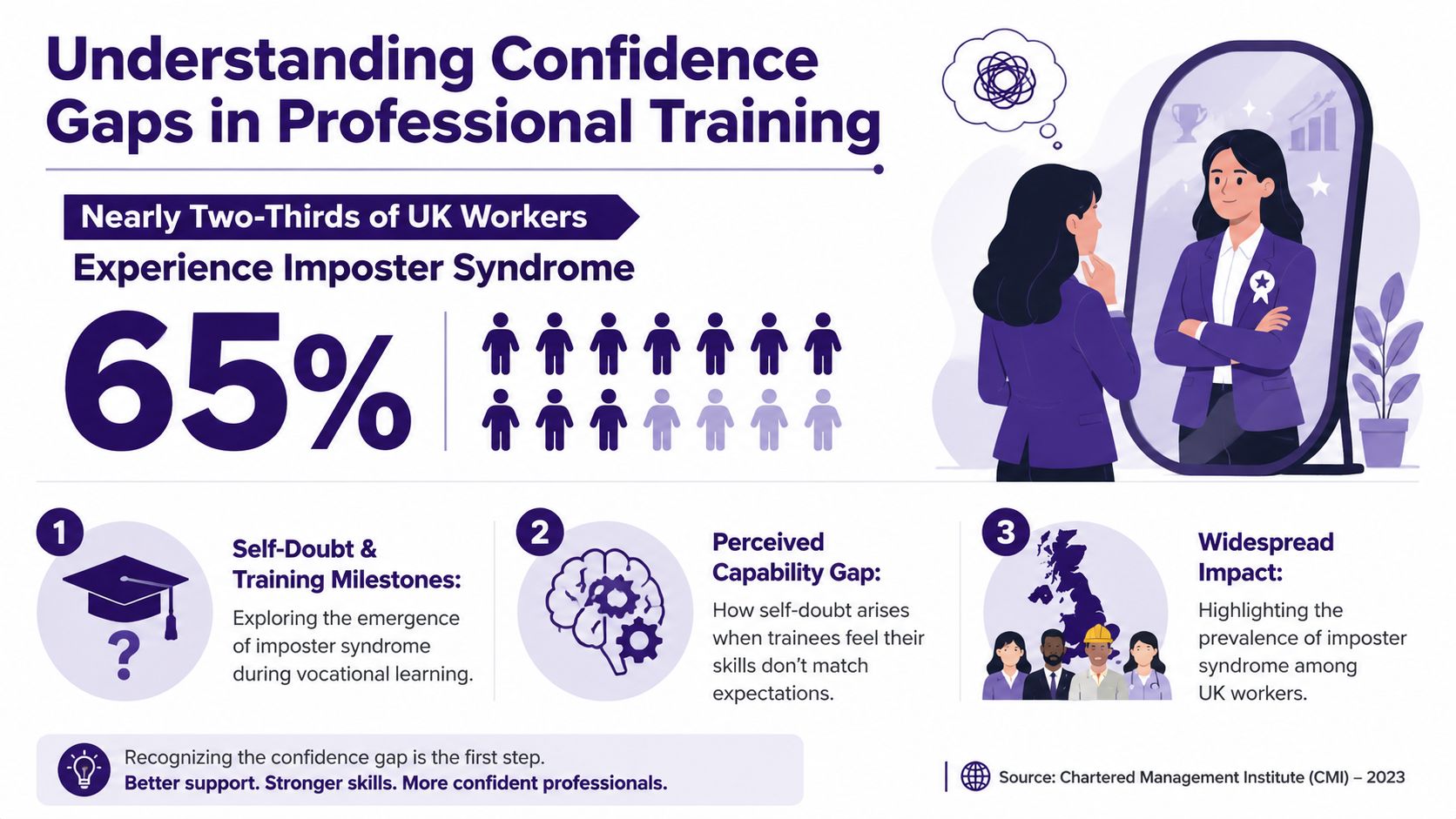
Understanding Confidence Gaps in Professional Training
The confidence gap in vocational learning is rarely about laziness or lack of ability. More often, it appears when a learner can complete tasks but can’t yet see how those tasks fit into a wider professional standard. A trainee might pass a module in bookkeeping, complete reconciliations in Sage or Xero, or produce a clean spreadsheet in Advanced Excel, yet still think, “A real professional would find this easy.”
That thought gets stronger in structured training environments. Bookkeeping and VAT courses, advanced payroll training, accounts assistant roles, final accounts work, business analyst tasks, and data analyst projects all involve visible outputs. If the trial balance doesn’t balance, if the payroll run feels high stakes, if the dashboard doesn’t land well in a meeting, the learner often reads that as proof of inadequacy rather than a normal part of training.
Why technical progress doesn’t always feel like confidence
Passing an assignment doesn’t automatically settle self-doubt. That’s because imposter thinking isn’t only about evidence. It’s about interpretation. Many trainees discount progress with thoughts such as:
- “I only passed because I revised hard.” They treat preparation as evidence against competence, when it is integral to competence.
- “I can do it in training, but not in a real job.” They split learning from work instead of seeing training as the bridge into work.
- “Other people understand the bigger picture faster.” They compare their private uncertainty with other people’s public composure.
This shows up across role types. In bookkeeping and VAT, learners can process transactions correctly but still feel shaky when asked why the treatment is correct. In advanced payroll, they can use software but freeze when exceptions appear. In final accounts, they may know the steps yet worry they don’t sound credible enough to discuss them. In business analysis and data analysis, trainees often build the report but understate the insight.
Practical rule: Confidence usually arrives after repeated use under mild pressure, not immediately after learning the theory.
Why this matters in UK vocational routes
The UK training path often combines technical study, software practice, and employability pressure at the same time. Learners aren’t only trying to master bookkeeping principles or data tools. They’re also trying to sound professional, perform in interviews, and adapt to workplace expectations.
That pressure is real. The same Funding Guru study notes that 38.98% of UK workers experience these feelings weekly or more frequently, and 1 in 20 face them daily within the wider pattern described in the study (Funding Guru workplace imposter syndrome findings). If you feel this during your first payroll task, your first month as an accounts assistant, or your first dashboard presentation, you’re not failing. You’re hitting a common professional barrier that needs structure, not shame.
Spotting Your Imposter Triggers in Accounting and Data Roles
Imposter syndrome rarely appears as one dramatic moment. It usually runs as a sequence. A trigger happens. Your body tightens. Your thinking narrows. Then your behaviour shifts. Once you can identify that chain, you can interrupt it earlier.
In UK finance and data roles, the trigger is often ordinary work. A client asks a follow-up question on VAT. A payroll manager wants a second look at an exception. A senior asks an accounts assistant to explain a posting. A business analyst is asked, “What’s the decision from this data?” A junior data analyst is invited to walk through a SQL result.
Common trigger patterns
A simple way to spot your pattern is to track three things. What happened, what you told yourself, and what you did next.
| Role area | Typical trigger | Common self-talk | Behaviour that follows |
|---|---|---|---|
| Bookkeeping and VAT | Reconciliation mismatch | “I’ve missed something basic” | Rechecking for too long, delaying questions |
| Advanced payroll | Payroll variance or exception | “If I ask, they’ll know I’m not ready” | Silent stress, over-preparing notes |
| Accounts assistant | Being asked to explain a process | “I can do the task, but I can’t explain it” | Speaking vaguely, apologising too much |
| Final accounts | Presenting draft figures | “Someone senior will spot a flaw immediately” | Reading from notes, avoiding eye contact |
| Business analyst | Stakeholder meeting | “I understand the data but not the room” | Overloading slides, under-explaining value |
| Data analyst | Query review or dashboard demo | “My logic must be perfect before I speak” | Hiding behind technical detail |
These patterns have a real cost. In the UK, imposter syndrome can cost employees up to 10 full workdays per year and causes 45% of workers to avoid promotions due to fear of exposure (UK imposter syndrome productivity and promotion impact). In training, that often means the learner doesn’t just feel bad. They hold back from stretch tasks that would build confidence.
Build your trigger cascade
Use this short exercise after a difficult task or meeting.
-
Name the moment
Write one line only. “Senior asked why I used that VAT treatment.” Keep it factual. -
Record the body signal
Notice what happened physically. Tight chest, fast speech, dry mouth, frozen mind. -
Catch the first thought
Don’t polish it. Write the actual thought. “I’m about to be found out.” -
Mark the behaviour
Did you over-explain, go silent, rewrite, avoid, or delay? -
Choose the earlier interrupt point
Pick the first point you can realistically change next time. Usually that’s the thought or the behaviour.
The goal isn’t to stop all nerves. It’s to stop the spiral that turns normal pressure into a false verdict on your ability.
This also matters in job search settings. Many strong trainees can do the work but weaken their applications because they undersell their evidence or overcomplicate their CV. If you’re unsure whether your CV presents your skills clearly enough to pass applicant tracking systems, review the structure before assuming you’re underqualified. Sometimes the issue isn’t your ability. It’s how the evidence is being translated.
Reframing Self-Doubt with Evidence-Based Techniques
Generic reassurance doesn’t work well for imposter syndrome. “Just be confident” isn’t a method. People in accounting and data need something more concrete. They need a way to test the thought, replace it, and act while still feeling some nerves.
There is also a clear gap in support for trainees. A UK-focused angle on accounting trainees during the first stage of ACCA or CPD-linked development notes that 85% of UK professionals suffer from imposter syndrome but lack targeted interventions (Complygate on imposter syndrome in UK professionals). That gap explains why many learners keep hearing broad advice without getting role-specific tools.
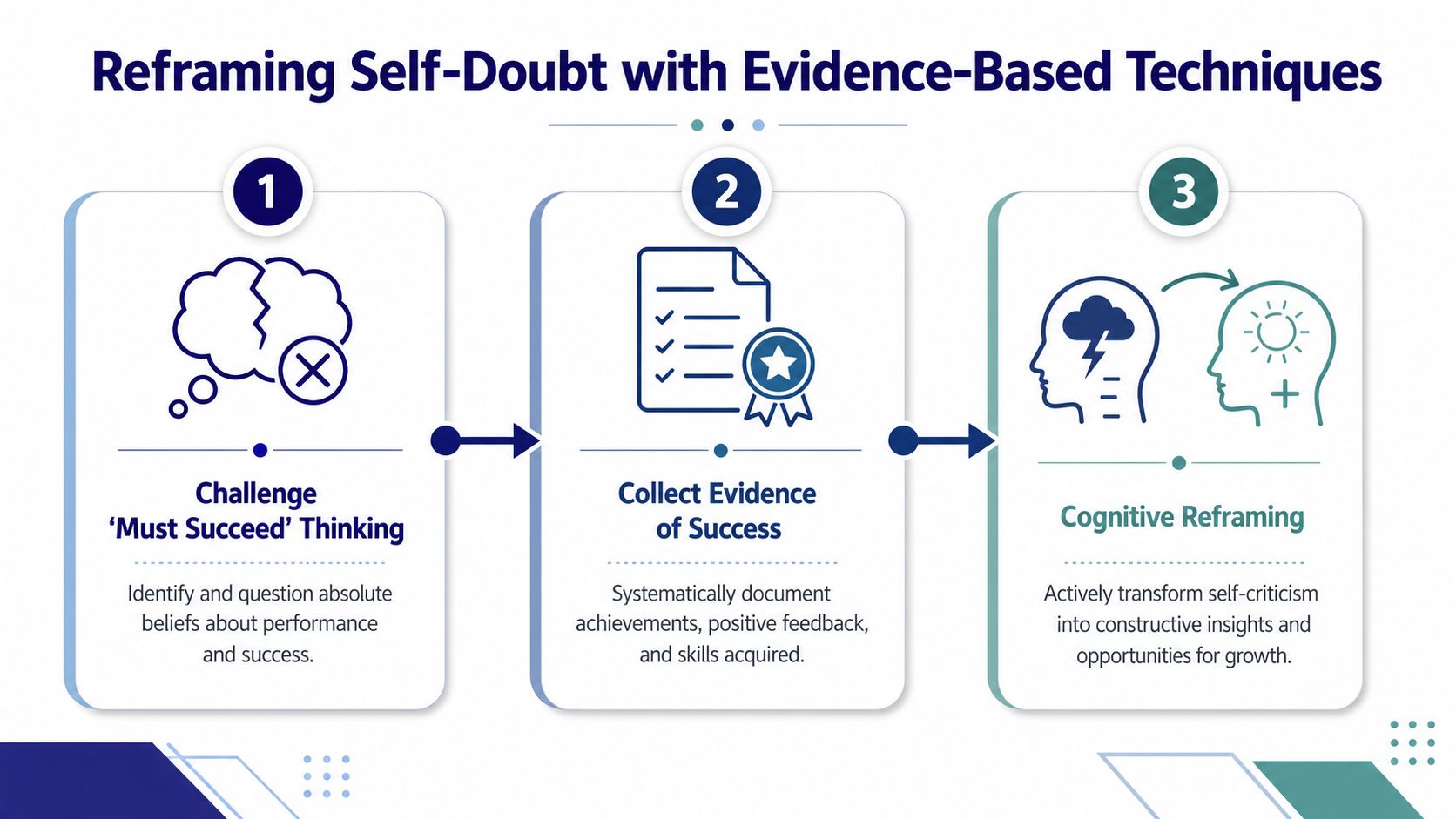
Challenge the absolute thought
Imposter thinking often uses hard words. Always. Never. Must. Everyone else. Those words create false pressure.
Try this format:
- Original thought
“I must answer every question perfectly in the meeting.” - Test question
“Is perfect performance the actual standard, or is clear professional reasoning the standard?” - Balanced replacement
“I need to explain my reasoning clearly and handle follow-up questions calmly.”
That shift matters in final accounts reviews, payroll discussions, and dashboard presentations. Perfection isn’t the job. Judgement is.
Build an evidence file
Keep a simple running record of proof. Not praise alone. Proof.
Your evidence file can include:
- Completed tasks such as reconciliations, payroll checks, variance reviews, dashboard builds
- Software wins in Xero, Sage, QuickBooks, Excel, SQL, Python, or Power BI
- Feedback snippets from tutors, peers, managers, or interviewers
- Problems solved especially corrections, exceptions, and clarifications
Working principle: Feelings change slowly. Evidence accumulates faster. Lean on the evidence first.
If presentation nerves are part of your confidence problem, visual presence may be adding pressure. Some trainees become more self-conscious when recording practice videos or preparing a professional profile image. In that case, Secta’s guide on photo confidence can help you reduce one avoidable layer of self-criticism before interviews or LinkedIn updates.
A short video can also help reset your thinking before practice.
Use a role-based reframe script
For a learner presenting a VAT report to a finance director, I wouldn’t use vague affirmations. I’d use a script tied to real competence.
“I have already learned the process, checked the treatment, and prepared the figures. I don’t need to know everything in advance. I need to explain what I’ve done, answer what I can, and note what needs confirmation.”
That works because it is believable. Good reframing doesn’t flatter you. It puts you back in contact with reality.
Role Specific Exercises and Scripts for Finance and Data Trainees
Generic confidence advice often fails when the actual problem is situational. A trainee doesn’t need to “believe in themselves” in the abstract. They need to know what to say when a manager asks about a payroll discrepancy or when a stakeholder asks what action should follow from a dashboard.
The demand for these skills isn’t fading. The UK bookkeeping industry is projected to reach a market size of £6.8 billion in 2026, with 1.7% CAGR between 2020 and 2025, and 6,059 businesses operating in the sector, which reflects sustained demand for bookkeeping and VAT capability (IBISWorld UK bookkeeping industry outlook). That means trainees need confidence that is usable in work, not confidence that only appears in the classroom.

Bookkeeping and VAT rehearsal
A bookkeeping trainee I coached kept double-checking every entry before sending work for review. The issue wasn’t poor technical understanding. It was fear of appearing careless. We replaced endless checking with a timed confidence drill.
Exercise
Set a timer. Complete a small bookkeeping task or VAT treatment review. Then stop and answer three questions out loud:
- What did I check?
- What am I confident about?
- What would I flag for review?
Useful script
“I’ve checked the source documents, matched the entries, and reviewed the VAT treatment based on the information available. I’m confident in the posting. The one point I’d like confirmed is the treatment of this item because the context affects the final decision.”
That script works because it sounds professional without pretending certainty where certainty isn’t possible.
Advanced payroll peer review
An advanced payroll learner once said, “I only feel calm when no one is watching.” That’s common. Payroll feels sensitive, and even minor doubts can trigger panic.
Use a peer-review role-play. One person acts as reviewer. One acts as trainee. The reviewer asks short questions such as, “What changed from last run?” or “Why does this exception appear?” The trainee answers in brief, then pauses instead of filling silence.
Reflection prompts
- Where did you over-explain?
- Where did you apologise unnecessarily?
- Which answer sounded clear and grounded?
If interview confidence is part of the same pattern, practise the same skill in a hiring context with these competency-based interview preparation strategies. Clear examples reduce self-doubt because they force you to speak from evidence rather than from anxiety.
Final accounts speaking drill
For final accounts, many trainees know the work but tense up when presenting it. I prefer a mirror rehearsal over silent review. Speak through the figures standing up. Keep it short.
Try this structure:
- State the purpose
“I’ve prepared the draft figures and reviewed the supporting schedules.” - Highlight the main point
“The key movement this period is here.” - Flag judgement areas
“This section may need senior review because the treatment depends on the final documentation.”
Speak as if clarity is your job, because it is. Sounding polished matters less than sounding structured.
Business analyst and data analyst briefing template
A data trainee can write solid SQL and still feel exposed in front of non-technical colleagues. The fix is often translation practice, not more technical study.
Use this three-part briefing template after any analysis task:
| Part | Prompt | Example language |
|---|---|---|
| Business question | What were we trying to find out? | “We wanted to understand where delays were appearing.” |
| Result | What did the data show? | “The pattern points to repeat delays in one stage of the process.” |
| Action | What should happen next? | “I recommend checking that stage first and validating the data source.” |
A business analyst can use the same framework in workshop notes or stakeholder updates. A junior data analyst can use it when demoing Power BI or explaining a Python output. The aim isn’t to sound senior. The aim is to sound useful.
Tracking Confidence Building with Measurable Goals
Confidence grows faster when learners can see proof of change. Otherwise, they improve, forget they improved, then treat each new challenge as the first one. That’s why mindset work on its own often fades. It needs a record.
UK vocational qualifications provide a useful model here. Vocational qualifications in the UK, including bookkeeping, VAT, and payroll, are tracked and certified by Ofqual, with national data published through the Department for Education, which reinforces the value of structured monitoring in recognised training routes (Ofqual vocational qualifications dataset). Trainees can borrow that discipline for confidence building.
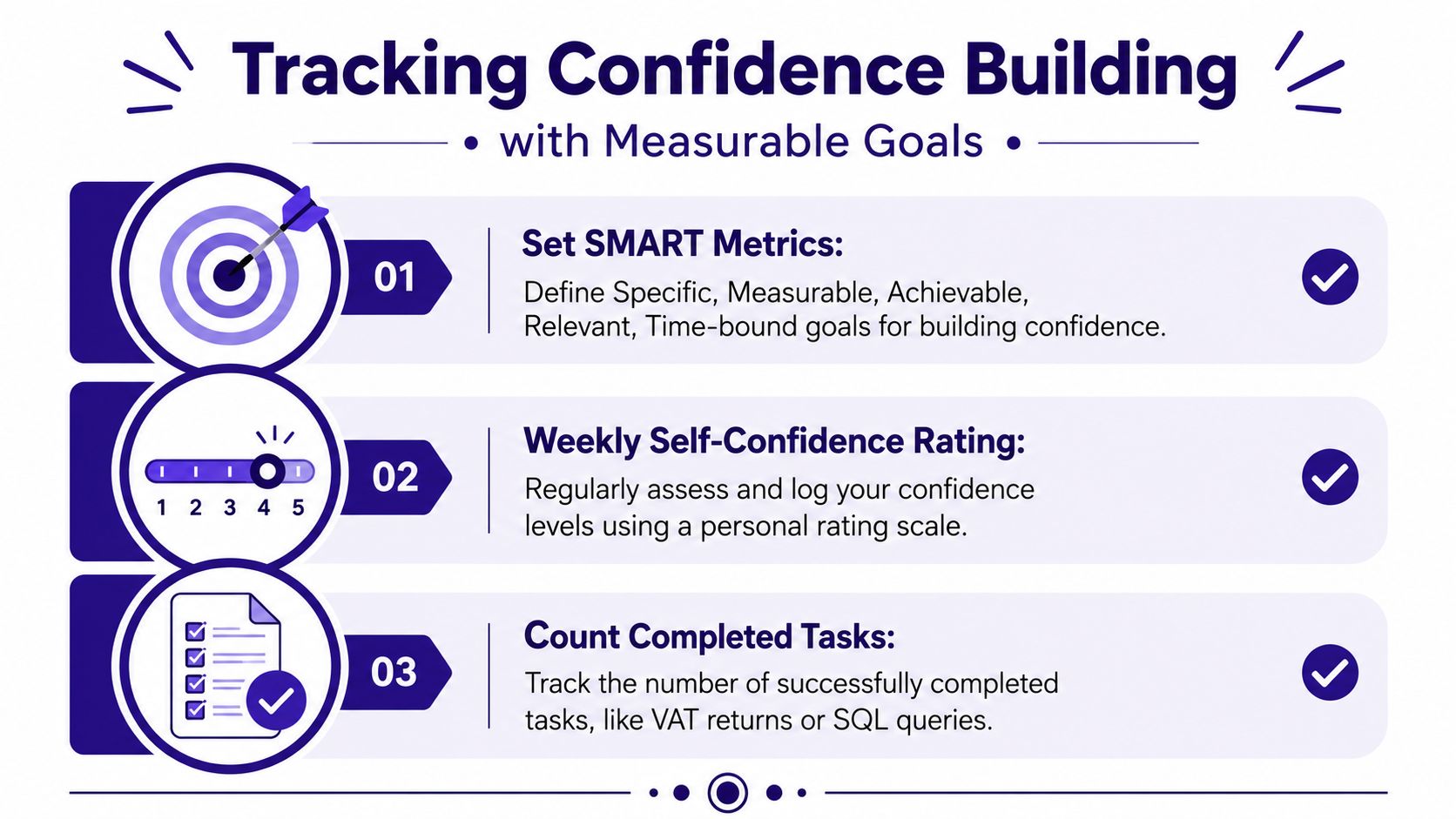
What to track each week
Use a small log, not a complicated journal. The best tracker is one you’ll keep using.
-
Confidence rating
Score your confidence before and after one meaningful task each week. Keep the wording consistent. -
Completed evidence tasks
Record what you finished. VAT return draft, payroll check, reconciliations, interview answer practice, dashboard explanation. -
Communication moments
Note where you spoke up, asked a useful question, or explained your reasoning clearly. -
Recovery speed
Write how quickly you settled after a wobble. That matters. Faster recovery is real progress.
Turn vague growth into review points
At the end of each month, look for patterns rather than perfection. Are you avoiding fewer tasks? Are you speaking with less apology? Are you asking better questions earlier?
A simple review works well:
| Review question | Why it matters |
|---|---|
| Which task felt easier this month? | It reveals genuine adaptation |
| Which trigger still bites? | It tells you where to practise next |
| What evidence did I produce? | It stops emotional amnesia |
| What support do I need now? | It turns insight into action |
If you need a broader structure for that review process, career support frameworks can help connect technical growth with professional confidence. This kind of coaching for career development is useful because it links learning, communication, and progression instead of treating them as separate problems.
Sustaining Confidence with Long-Term Strategies
Overcoming imposter syndrome isn’t a one-off breakthrough. It’s a maintenance practice. Most trainees don’t need a dramatic mindset shift. They need repeatable habits that stop self-doubt from reclaiming space every time the role gets bigger.
The strongest long-term pattern is simple. Keep learning, keep speaking, keep recording evidence, and keep returning to pressure in manageable doses. Rehearse before high-stakes moments. Review after them. Don’t wait to feel fully ready before acting. Readiness usually follows action.
A practical long-term routine
Build a rhythm you can sustain:
- Monthly reflection on where you avoided, where you improved, and what still feels too loaded
- Peer practice for payroll reviews, final accounts explanations, and data presentations
- Quarterly skill audit across software, communication, and judgement
- Assertiveness practice for meetings, interviews, and follow-up questions
One useful support area is direct communication. Many capable trainees sound less certain than they are. Focused work on courses in assertiveness can help you replace apologetic language with clear professional language.
Confidence lasts when it is tied to behaviour. If you keep acting with structure, self-doubt loses authority.
Treat confidence as part of your professional training, just like bookkeeping accuracy, payroll knowledge, final accounts judgement, or data reporting. It isn’t separate from competence. It’s one of the ways competence becomes visible.
If you’re ready to build confidence alongside technical skill, Professional Careers Training offers practical support across bookkeeping and VAT, advanced payroll, accounts assistant, final accounts, business analyst, and data analyst training. Their flexible programmes include 1-to-1 support from ACCA qualified Chartered Accountants and CPD approved trainers, software training in Sage, Xero, QuickBooks, and employability help with CV preparation, job hunting strategy, LinkedIn optimisation, and interview coaching.