If you're training to become a business analyst, or you already work as one, you've probably noticed AI tools turning up in more of your...
You've got the tab open, the deadline emails are already landing, and you're trying to work out whether accountancy is a sensible route or just another polished graduate brochure. Maybe you like numbers, maybe you want a stable first job, or maybe you're trying to avoid drifting into a role that doesn't build towards anything. Graduate schemes in accounting can look intimidating from the outside, but they're often the clearest path from a degree into paid training, professional exams, and real responsibility.
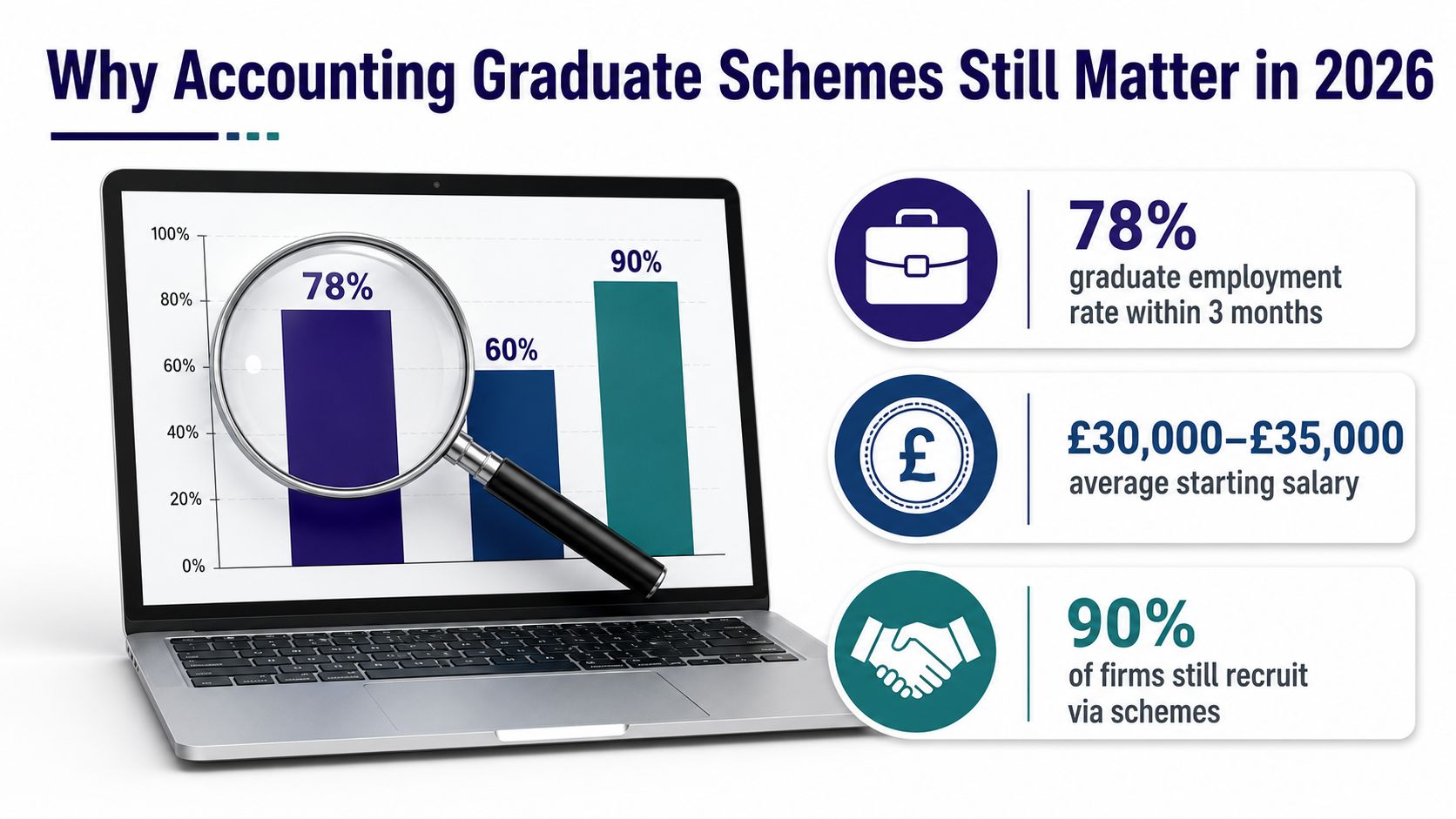
Why Accounting Graduate Schemes Still Matter in 2026
A final-year student can spend weeks comparing portals and still feel unsure whether accountancy is a smart move or a safe option dressed up as ambition. The honest answer is that the profession is still big, still structured, and still recruiting. The Financial Reporting Council's 2025 review said the UK and ROI accountancy bodies had more than 408,000 members, with total membership rising 0.8% year on year and worldwide membership rising 1.1%. It also showed that fee income at the Big Four UK audit firms rose by only 1.2% in 2024 after much stronger growth in the two previous years, which tells you something important, this is a mature market, not a lottery ticket market. FRC key facts and trends in the accountancy profession 2025
That maturity matters because it makes graduate hiring feel serious rather than gimmicky. Firms need people who can move from posting entries to understanding reporting, controls, and business decisions. A graduate scheme gives you a paid route into that world, while a standard accounts assistant role often gives you a narrower slice of it.
Practical rule: if you want a career that can grow into audit, management accounting, finance business partnering, or analysis, a scheme usually gives you more movement early on than a static entry-level post.
It's also a competitive market. UK careers guidance says graduate accounting schemes reportedly receive about 250,000 applications a year, while around 800,000 graduates enter the labour market annually, and over 50% of applications are rejected at the first screening stage. That means the scheme route is attractive, but it isn't casual. UK graduate accountancy schemes guidance
A useful way to judge the path is to ask what the scheme gives you that a regular bookkeeping or accounts assistant job usually doesn't. The answer is rotation, exam sponsorship, and visibility across different parts of the finance function. If you want a broad launchpad rather than a single task set, that difference is the whole story.
For more context on where graduate accounting jobs sit in the broader market, see this guide to accounting jobs for graduates.
What a Graduate Accounting Scheme Actually Is
A graduate accounting scheme is a structured, employer-paid training programme. You work as a salaried employee, you study toward a professional qualification, and you move through planned placements that teach you how finance runs in a business. The work and the study are linked, so the qualification isn't something you do on the side after hours, it sits inside the job.
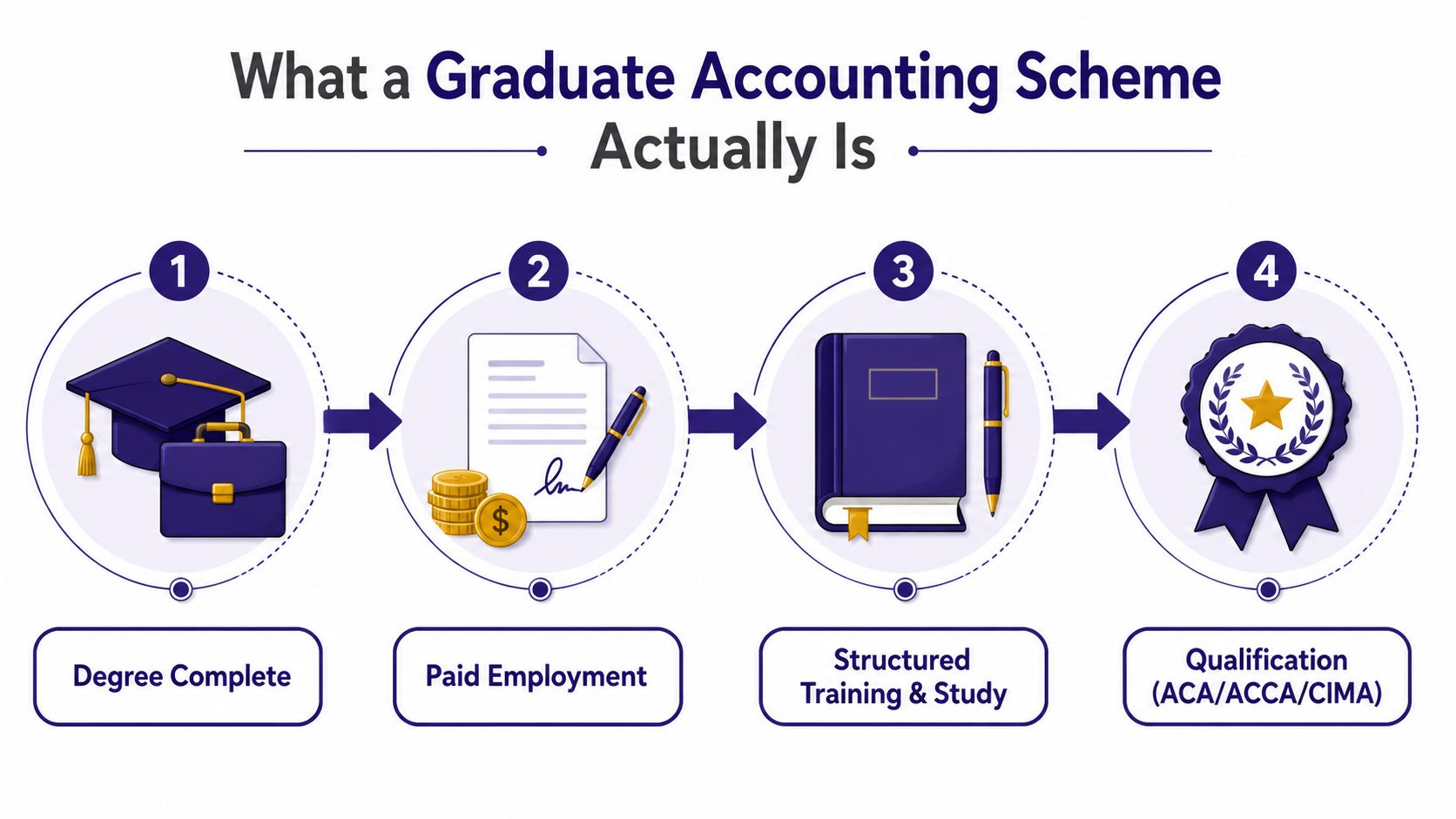
A regular graduate job may give you one team, one manager, and one type of work. A scheme usually gives you a wider circuit. That matters because accountancy is not just posting invoices or reconciling bank accounts. It includes financial reporting, management accounting, controls, technical advice, and business judgement, all of which make more sense once you've seen how different departments work together.
How the rotation model works
Most UK accounting graduate schemes run for 2 to 3 years, and some extend longer. Zurich's finance graduate scheme is a clear example of the rotation model, with a three-year programme made up of three one-year rotations across accounting teams. HMRC's finance graduate scheme runs for four years with four placements and study toward CIMA or CIPFA. Zurich finance graduate scheme
The logic is simple. One placement teaches detail, another teaches pace, and another exposes you to a different part of the financial cycle. By the time you've moved across teams, you've usually seen reporting, controls, and commercial decision-making from more than one angle. That's why schemes often produce stronger qualification readiness than single-role jobs.
You're not just being trained for a job title. You're being trained for judgement, and that takes repeated exposure to different finance settings.
What study support usually looks like
Most schemes build in exam leave, study days, and structured support around a qualification pathway. That can sound generous, but it's also demanding. The employer is paying you to learn while you contribute, so you're expected to manage client work, monthly deadlines, and revision at the same time. That's why good schemes suit people who can handle routine and pressure without losing accuracy.
If you're comparing offers, focus less on the glossy wording and more on the rhythm of the year. Ask how often you'll rotate, how study support works in practice, and whether the scheme helps you move towards the type of finance work you want.
Types of Accounting Graduate Schemes in the UK
The UK market looks messy until you group it properly. Once you do, most employers fall into a handful of tracks, and each one suits a different personality, not just a different CV. A candidate who wants brand recognition and fast-paced client work may look at one route, while someone who wants steadier hours and internal finance exposure may prefer another.
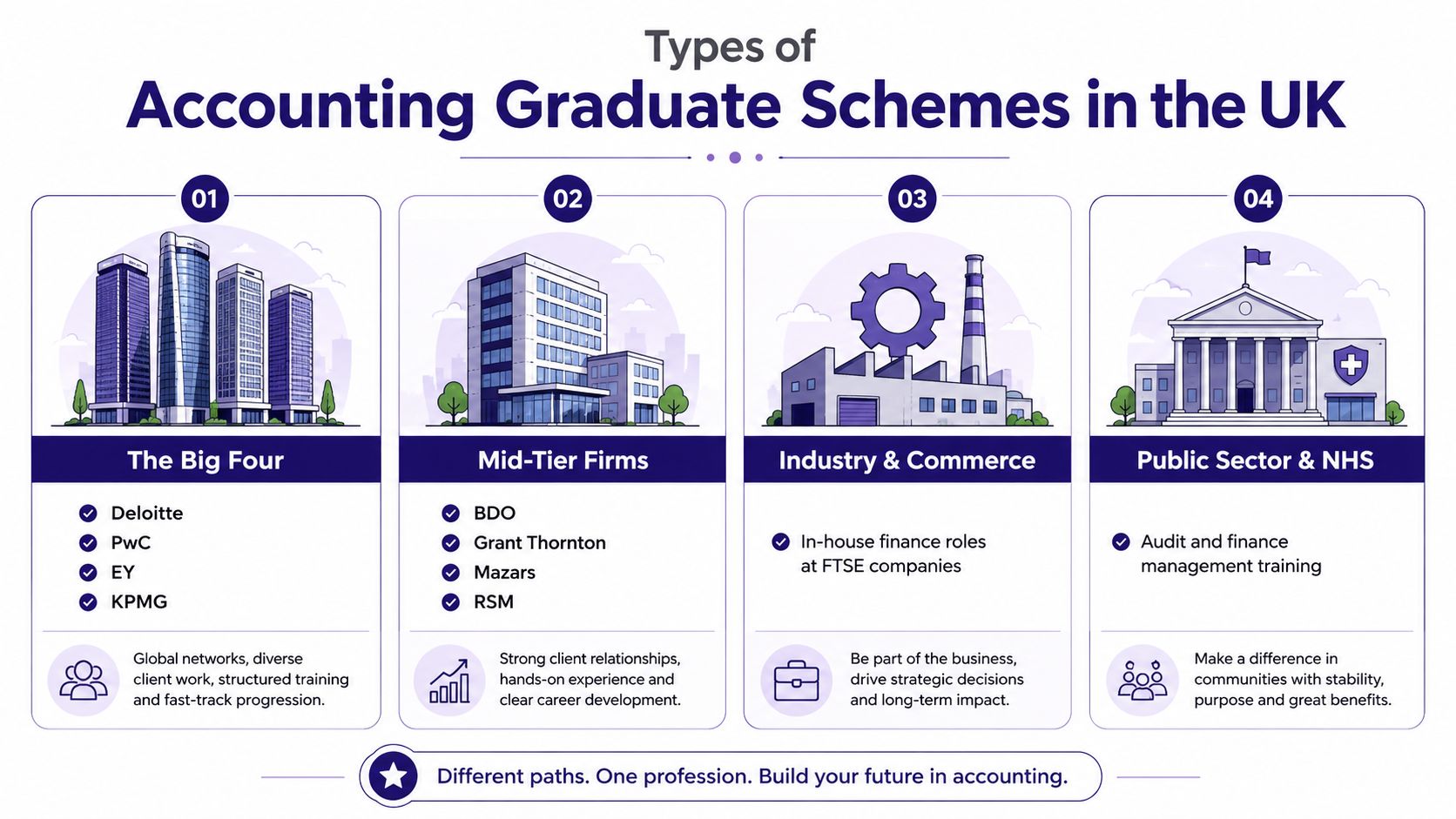
The main employer groups
The Big Four. Deloitte, PwC, EY, and KPMG are the names most candidates recognise first. They usually offer the most visible graduate programmes, especially in audit and advisory, and they often suit candidates who want a highly structured brand name on the CV. The trade-off is obvious, the brand is strong, the pace is intense, and the selection process is unforgiving.
Mid-tier and challenger firms. BDO, Grant Thornton, Mazars, and RSM often give you a slightly different mix of exposure. The work can still be technically demanding, but the culture can feel less vast and more personal. Some graduates like that because they want quicker access to responsibility and a clearer line of sight to managers.
In-house finance schemes. Banks, insurers, and large employers hire finance graduates into internal teams. You're more likely to see commercial finance, reporting, forecasting, and business partnering than external client work in these roles. These roles can suit candidates who want a closer relationship with one organisation rather than a portfolio of clients.
Public sector routes. HMRC, the NHS, and other public bodies run finance graduate schemes that can lead toward public-sector accounting, controls, and management reporting. If you want mission-led work and a clearer public interest context, these routes deserve attention.
There are also industry and commerce schemes at large corporates, along with small-practice training contracts. The small-practice route often gives wide exposure to clients and bookkeeping, but the structure can be more variable and the employer brand less obvious.
A useful reading habit before you apply
A lot of confusion comes from jargon. If a job advert says audit, assurance, or controls and you're not sure what that means, use a glossary before you guess. The Alignmint audit glossary is a sensible place to translate the language into plain English before you spend an evening on an application.
The right scheme isn't the one with the flashiest office photos. It's the one whose work, study structure, and pace fit how you learn.
Qualification Routes You Can Study On a Scheme
The qualification letter matters, but it matters less than many applicants think. Employers usually shape the route for you, and the decision is often which scheme gives you the qualification and the work mix you want. If you choose carefully, the employer and the exam route support each other. If you choose badly, you can end up with a qualification that is fine on paper but less aligned with your long-term work.
| Qualification | Awarding body | Exam count | Typical scheme sponsor | Best-fit candidate |
|---|---|---|---|---|
| ACA | ICAEW | Varies by route | Audit firms, finance teams | People who want audit, financial reporting, and a traditional chartered route |
| CA | ICAS | Varies by route | Scottish and UK employers | Candidates who want a chartered qualification with strong technical depth |
| ACCA | ACCA | Varies by route | Firms, corporates, some public bodies | Candidates who want flexibility and portability |
| CIMA | CIMA | Varies by route | Industry, commerce, finance teams | People who prefer management accounting and commercial finance |
| CIPFA | CIPFA | Varies by route | Public sector employers | Candidates drawn to public finance and government-style reporting |
Choosing between the qualification families
ACA and CA usually suit graduates who are happy in audit, financial reporting, and technically dense work. You'll spend time understanding how accounts are built, checked, and signed off. That can be a strong fit if you like precision and don't mind detailed rules.
ACCA tends to appeal to candidates who want a broader, more flexible route. The qualification is often attractive to people thinking beyond one employer type, especially if they want portability across sectors or countries. For a deeper look at that route, this guide to how to become ACCA qualified is worth a read.
CIMA is often the better match if you're more interested in internal finance, decision support, and commercial analysis. That links neatly to management accounting and the kind of finance role that helps managers decide what to do next, not just what happened last month.
CIPFA is the public-sector route. It suits candidates who care about government, public value, and the financial management of public bodies.
Why the work matters as much as the letters
The same qualification can feel very different depending on the scheme. A graduate on an audit-heavy route will spend a lot of time on external reporting and evidence. A graduate on a commercial finance route may spend more time with budgets, forecasts, and operational insight. That difference is why the scheme itself is often the bigger decision than the qualification badge.
If you like the idea of rotating through bookkeeping, VAT, accounts assistant tasks, final accounts, business analysis, and data analysis, look for schemes that deliberately mix transactional work with reporting and commercial exposure. That's where the learning curve is steepest.
Eligibility, Salary and the UK Application Timeline
A graduate scheme can look open from the outside and still be selective once you read the fine print. Many employers still ask for at least a 2:1, but some now assess applicants with more flexibility, which helps candidates whose grades are lower than they wanted or whose route into university was less direct. The key is to show evidence that fits the employer's criteria, not just a strong final mark. Targetjobs accounting graduate guidance
What you can realistically expect on pay
Pay matters, but it should not be the only lens you use. In graduate accounting schemes, the starting point is usually an entry salary in the mid-£20,000s to low-£30,000s, with variation depending on employer type, location, and the balance between study support and work responsibility. A Big Four audit programme, a regional firm, and an in-house finance scheme may all sit in a similar broad band while offering very different day-to-day experience.
The better question is how the salary fits the package. One employer may offer more structured exam support, while another gives earlier client exposure or stronger rotational experience. That trade-off is often more useful to compare than a headline figure alone.
When to act
The application cycle starts earlier than many graduates expect. Online forms often open in September and October, assessment centres often follow in December and January, and many offers are made before spring. If you wait until spring to begin, you are usually trying to join a process that has already moved on.
A simple month-by-month plan keeps the process manageable:
- September: update your CV, build a target list of employers, and shape your personal statement around the scheme requirements.
- October: submit applications and practise psychometric tests.
- November to January: prepare for interviews and assessment centres.
- By spring: compare offers, check study support, and review any conditions before you accept.
Timing matters because employers do not use one shared calendar. Some firms recruit in a tight autumn window, while others recruit on a rolling basis and close once places are filled. That means a later application can be a weaker application even if your grades are strong, because the employer has fewer spaces left and less time to assess new candidates. For support with the interview stage, this guide to competency-based interview preparation explains how to turn experience into clear examples.
The job title alone will not tell you enough. A bank scheme, a Big Four audit route, and a public-sector finance programme may all fit different graduates, but each one asks for a different story in your application. A credible shortlist starts with your grades, your preferred sector, and how much rotation you want, then works back to the evidence you can present.
How to Prepare for Each Stage of the Selection Process
A strong application is usually the one that shows you understand how the process works before you ever reach the interview room. In graduate accounting schemes, recruiters are not just checking whether you meet the entry requirements, they are looking for evidence that you can follow instructions, work accurately, and explain your choices clearly. The selection process can feel like a series of gates, and each gate asks for a different kind of proof. A helpful overview of graduate accountancy schemes in the UK can also give you a sense of how employers structure these stages, although your best preparation still comes from matching each answer to the employer's wording.
Stage one, application form and CV screening
Recruiters read for evidence, not adjectives. They want signs of accuracy, teamwork, commercial awareness, and a real reason for wanting that particular firm, not just any finance job.
If your CV says you are “hard-working” but never shows where you handled data, reconciled figures, supported a team, or worked to a deadline, the reader has nothing concrete to assess. The same applies to the application form. Short answers need to do more than repeat your degree title. They should show how your experience fits the work the scheme does.
A practical rule helps here. Write each application as if a finance manager will scan it in under a minute, because that is often close to the mark. That means clear structure, specific examples, and the employer's language used back to them where it fits naturally. If you want a full walkthrough of that structure, our guide on how to write a personal statement CV that gets hired covers exactly this stage in more depth.
Stage two, psychometric tests
Numerical tests, verbal reasoning, and situational judgement tests are common. The challenge is rarely the topic itself. It is usually the pressure of working quickly and accurately at the same time.
Preparation is plain but effective. Practise the format until the mechanics stop getting in the way, then review every mock test answer carefully. If you only learn which option was right, you miss the actual lesson. You need to understand why the wrong options were attractive, because that is how these tests are designed. A useful place to start is this competency-based interview guide, especially if you want to get better at turning practice into clear examples.
Stage three, assessment centre
Assessment centres often show candidates more clearly than a CV ever can. In a group exercise, one common mistake is speaking too much and listening too little. In a case study, another is rushing to a conclusion before checking the figures properly.
Employers watch for more than confidence. They are looking at how you think, how you handle disagreement, and whether you can stay precise under pressure. A candidate who talks over others may seem energetic at first, but that same habit can look poor in a finance team where accuracy and coordination matter. A candidate who stays quiet throughout can miss the chance to show judgement.
The best approach is balanced. Contribute early enough to show presence, then pause long enough to show you are using the evidence in front of you. That is closer to real work in audit, tax, and finance than a polished speech delivered at speed.
Stage four, final interview
The final interview often checks motivation, commercial awareness, and fit. It is also the point where employers try to see whether your earlier answers hold together. A good interviewer will often return to the same theme from a different angle, because consistency matters in a profession built on trust.
Prepare short stories around your experience, what you did, what changed, and what you learned. That structure keeps you grounded when the questions become more open. It also helps you avoid sounding rehearsed, because you are drawing on real events rather than memorised lines. If you can explain why you chose a specific firm, how the scheme fits your career plans, and what sort of work you want to do after qualification, you will sound more credible than someone who only says they want a “career in accounting.”
You do not need heroic confidence. You need repeatable preparation, honest examples, and enough commercial understanding to speak like someone who has already started the job mentally.
Using Training and Certifications to Strengthen Your Application
A generic CV becomes stronger when it shows job-ready training, not just intent. That's especially true for accounting schemes, because employers want to see that you can handle real transactional work before they invest in formal training. Bookkeeping and VAT courses are a good starting point, because they give you fluency in the language of entries, returns, and reconciliations. Advanced payroll and final accounts training add another layer, especially if you want to sound credible in interviews about month-end work and compliance.
The tools employers notice
If your training includes Xero, Sage, or QuickBooks, say so plainly. These platforms show you can work with the systems many firms and clients already use. Add Advanced Excel, and you're closer to the day-to-day reality of finance teams than most applicants who only mention their degree.
If you want a more analytical angle, business analyst and data analyst training can help, especially if you can talk about SQL, Python, and Power BI in a practical way. Those skills are useful because modern finance roles increasingly rely on data, not just ledgers.
Professional Careers Training is one option that combines accountancy training, software certification support, and recruitment help, including CV preparation, career coaching, job hunting strategy, and LinkedIn optimisation.
How to turn training into interview material
A course only helps if you can explain the result. Don't say you “did a bookkeeping course”. Say you learned how to process transactions, handle VAT logic, and work accurately with finance records. That gives an interviewer something to probe, and it turns training into evidence rather than decoration.
Common Misconceptions and FAQs About Accounting Graduate Schemes
The biggest myth is that a 2:1 is always required. It isn't. Many employers still like it, but some have moved away from it, and that shift matters if you're a career changer or an international graduate with a different academic background. The better question is whether you can show evidence of accuracy, commitment, and commercial thinking.
Another myth is that only the Big Four matter. They matter, but they're not the whole market. Mid-tier firms, in-house finance teams, public-sector employers, and industry schemes can all lead to strong careers, often with different rhythms and less pressure on the branding side.
A final myth says you need a master's degree to get in. For graduate schemes, that's often unnecessary. What matters more is whether you match the role, understand the qualification path, and can handle the selection process well.
FAQs
What salary can I expect? Graduate accountants commonly start in the mid-£20,000s to low-£30,000s, with finance and professional services averages also sitting higher in some survey data.
Is a training contract the same as a graduate scheme? Not quite. A scheme is usually broader and rotation-based, while a training contract is often more tightly linked to a single qualification route and firm structure.
Can I apply with a non-accounting degree? Yes, many employers accept that. They're usually looking for aptitude, not just subject title.
Do international students have a chance? Yes, but they often need to prepare harder on recruitment style, UK conventions, and evidence of fit, especially where hidden screening criteria can affect outcomes for working-class applicants and other underrepresented groups.
The real barrier is rarely interest. It's usually preparation, presentation, and choosing the right employer type.
If you want practical help turning bookkeeping, VAT, payroll, final accounts, Excel, and interview preparation into a stronger graduate application, Professional Careers Training can help you build those skills in a structured way. Visit Professional Careers Training to see how its accountancy training and recruitment support can fit around your scheme applications and interview prep.