Missing a VAT deadline used to mean a single surcharge letter from HMRC, calculated as a rising percentage of whatever was late. Since January 2023,...
Missing a VAT deadline used to mean a single surcharge letter from HMRC, calculated as a rising percentage of whatever was late. Since January 2023, VAT has worked differently. Late returns and late payments are now penalised separately, through a points-based system for filing and a tiered system of charges for payment.
If you handle VAT for your own business, or you’re training for a bookkeeping or accounts role where you’ll be doing it for clients, the mechanics matter. Get them wrong and a single missed deadline can cost more than the headline £200 penalty suggests, especially once late payment charges and interest start running at the same time. This guide sets out how the points system works, what late payment actually costs in 2026, and the practical steps that keep both under control.
Why the VAT Penalty System Changed
HMRC replaced the old VAT default surcharge with the current system for accounting periods starting on or after 1 January 2023. The surcharge system charged an escalating percentage of the VAT owed for every late payment within a rolling 12-month period, and it applied the same way whether a business was a day late or three months late. It was also criticised for hitting small, occasional late payers as hard as persistent non-payers.
The system now in place separates the two failures. Filing your return late earns a penalty point. Paying late triggers a different set of charges, calculated on the amount outstanding and how long it stays unpaid. The two run independently, so filing on time but paying late, or vice versa, is treated on its own terms rather than blended into one surcharge figure.
The old default surcharge, in brief
Under the previous system, a first late payment triggered a warning with no financial penalty. Each further default within 12 months raised the surcharge rate, starting around 2% and rising toward 15% of the VAT due. The rate reset only after a full 12-month run of on-time returns and payments. None of that applies to VAT periods starting from January 2023 onward, though it can still apply to older, unresolved periods.
How the Late Submission Points System Works
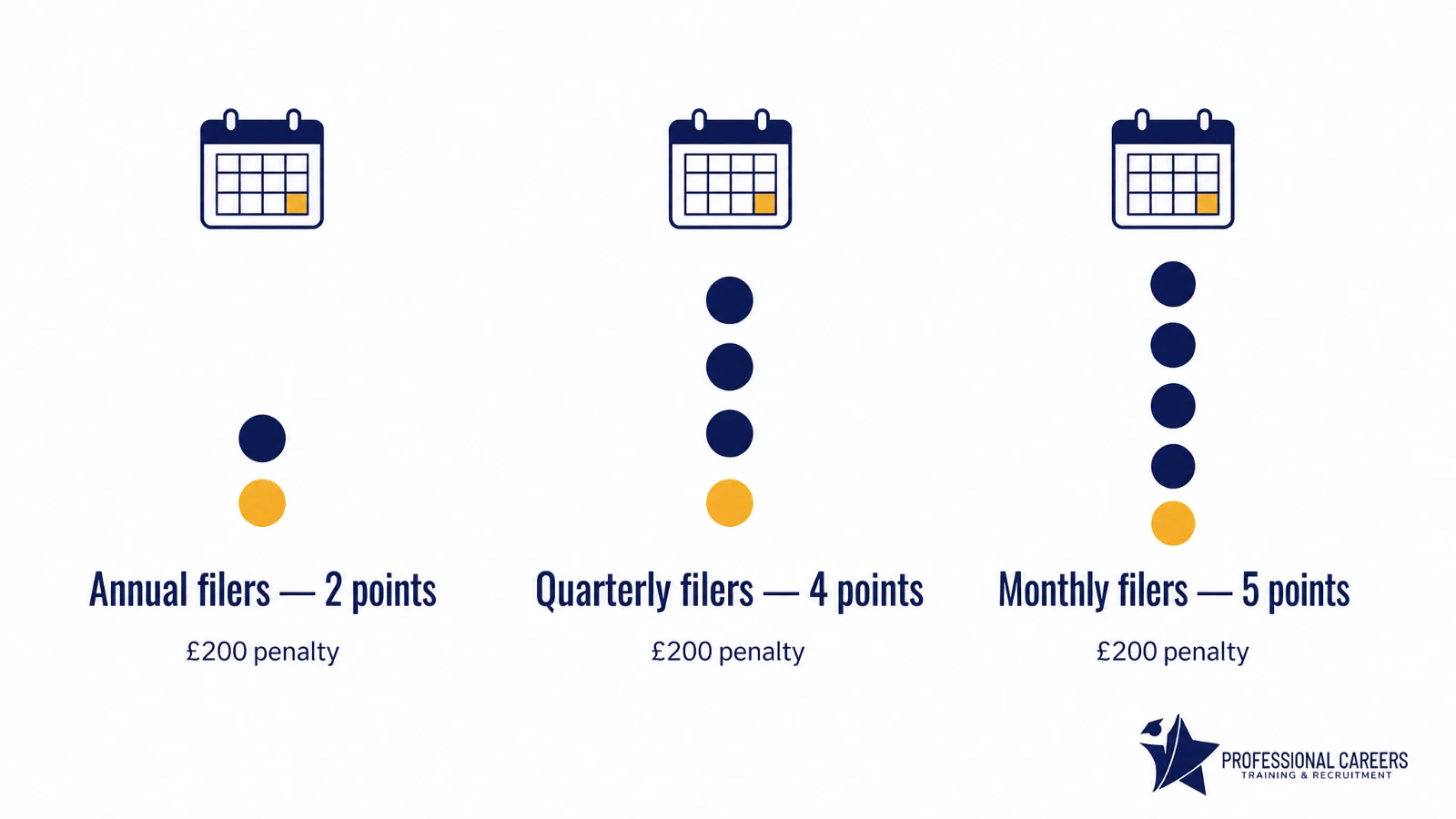
Every VAT return you submit late earns one penalty point, regardless of how late it is or how much VAT is involved. A return submitted a day late earns exactly the same point as one submitted a month late. Points build up until you reach a threshold set by how often you file, and reaching that threshold triggers a fixed £200 penalty.
| Filing frequency | Points threshold | Approx. time to reach it if consistently late |
|---|---|---|
| Annual | 2 points | 2 annual returns |
| Quarterly | 4 points | 12 months |
| Monthly | 5 points | 5 months |
Once you’re at the threshold, HMRC issues a £200 penalty and then a further £200 for every subsequent late return while you remain at or above it. A nil return, one where no VAT is actually due, still earns a point if it’s filed late. The points system doesn’t care whether money changed hands, only whether the return arrived on time.
How points expire
Individual points expire automatically 24 months after the month the late return was due, as long as you’re below the threshold at that point. If you’ve already reached the threshold, clearing back to zero takes more than time passing. You need a full compliance period of on-time returns: 24 months for annual filers, 12 months (four consecutive quarters) for quarterly filers, or 6 months (six consecutive months) for monthly filers, and every return due in the previous 24 months has to have been submitted, not just the ones in that compliance window.
- Submit every return on time, including nil returns, since a late nil return still earns a point.
- Use Making Tax Digital-compatible software with built-in deadline reminders rather than relying on memory.
- Check for a submission confirmation from HMRC, not just a “sent” message from your software, since a failed submission that looks successful still counts as late.
- If you change filing frequency (for example moving from quarterly to monthly), check how that affects your existing points and threshold, since it isn’t always a simple like-for-like carryover.
A late return earns a point, not automatically a fine. The £200 penalty only lands once you cross your filing frequency’s threshold, but every point counts toward it, including ones from nil returns with no VAT actually due.
Late Payment Penalties: What They Actually Cost
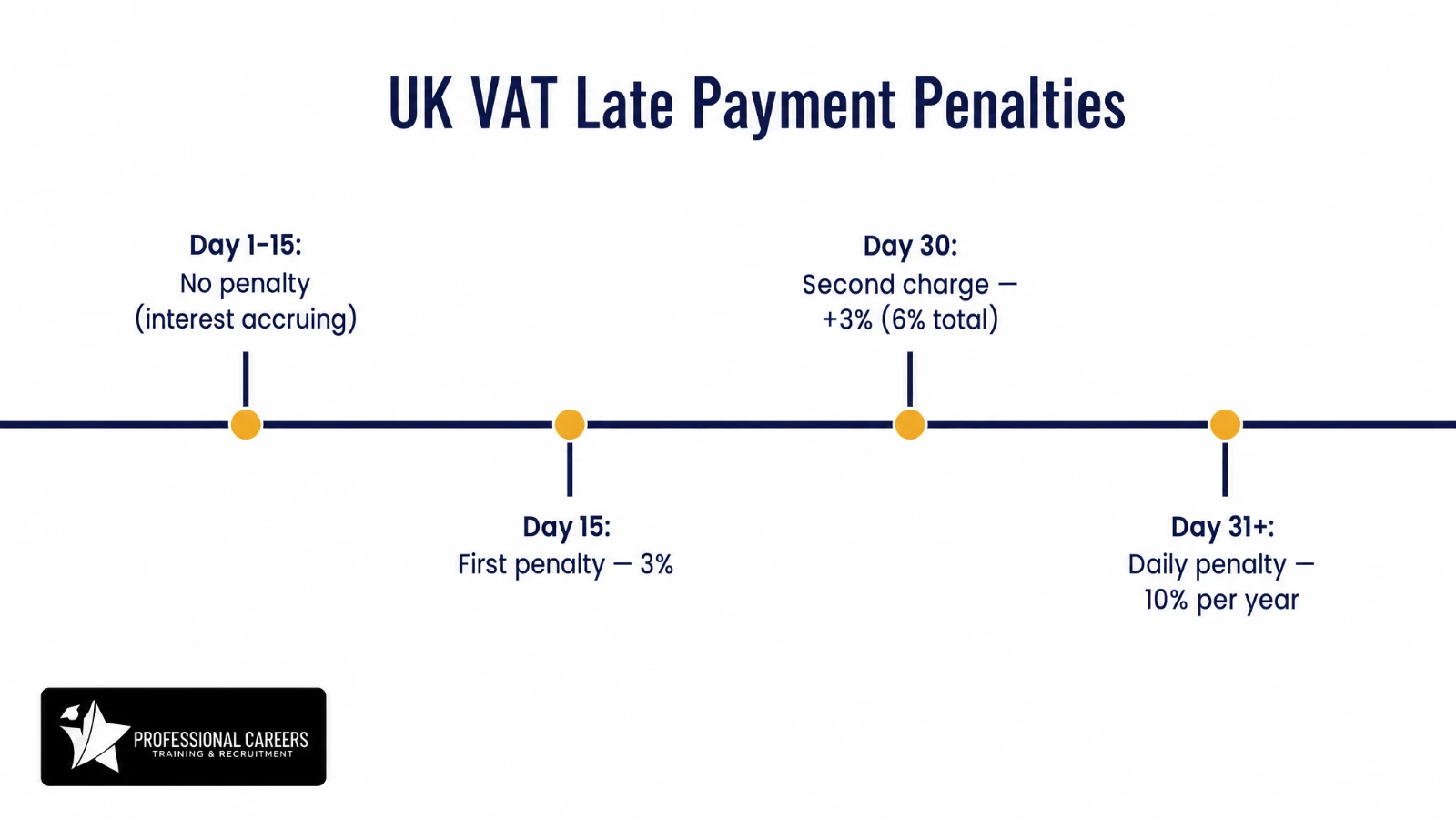
Paying late is penalised on a separate scale, based on how much is outstanding and how many days have passed since the due date. The rates were increased from April 2025, so figures you may have seen from earlier guidance are now out of date.
The current rates
- Days 1 to 15: no late payment penalty, though interest starts accruing from day one regardless.
- Day 15, if still unpaid: a first penalty of 3% of the VAT outstanding at that point.
- Day 30, if still unpaid: a further 3% of whatever remains outstanding at day 30, on top of the first penalty.
- Day 31 onward: a second penalty accrues daily, calculated at an annualised rate of 10% on the remaining balance, for as long as it stays unpaid.
Put together, a business that pays nothing for 30 days faces fixed penalties of 6% of the VAT due, before daily interest and the ongoing 10% annualised charge are even added. On a £10,000 VAT bill left untouched for 30 days, that’s £600 in fixed penalties alone, with more accruing every day it remains unpaid after that.
Time to Pay arrangements
If cash flow, not oversight, is the problem, agreeing a Time to Pay arrangement with HMRC before a penalty is triggered stops that penalty clock. Interest keeps accruing on the outstanding balance throughout the arrangement, but the escalating penalty charges don’t apply while you’re keeping to agreed instalments. It’s usually the most effective option when you know in advance that you can’t pay in full, rather than waiting to see what happens.
Late Payment Interest
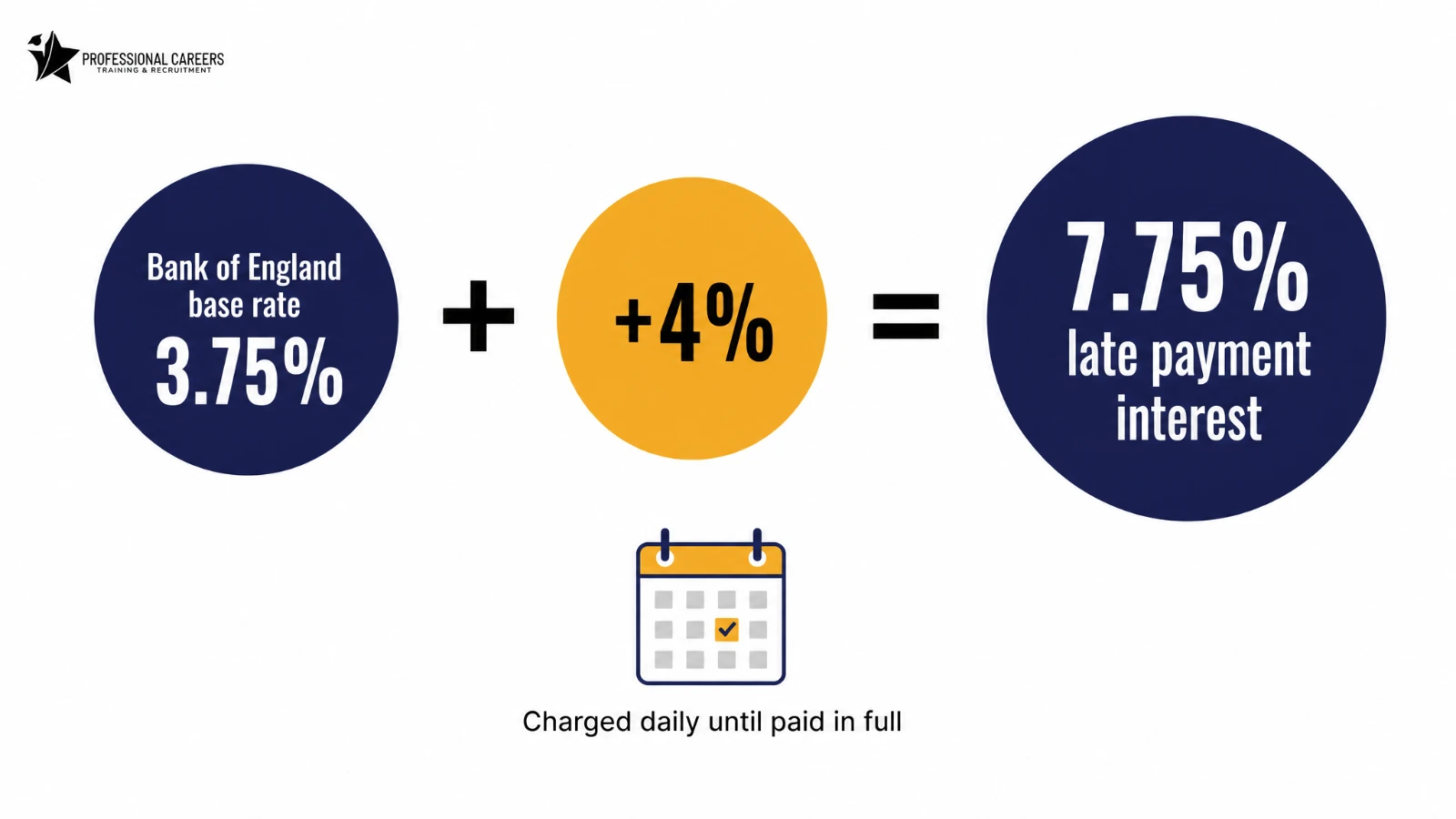
Separately from any penalty, HMRC charges interest on VAT paid late, calculated at the Bank of England base rate plus 4%. With the base rate held at 3.75% as of the Monetary Policy Committee’s July 2026 decision, that puts current late payment interest at 7.75%. Interest runs from the first day payment is late until the date it’s paid in full, and it applies whether or not a penalty has also been charged.
Penalties and interest run at the same time, on the same unpaid balance. A bill that looks like a 6% penalty for 30 days late often works out closer to 9% or 10% once daily interest is added on top, and it keeps climbing the longer it’s left.
How to Avoid VAT Penalties in Practice
Most VAT penalties come from process gaps rather than genuine inability to pay. A few habits close most of them.
- File and pay through Making Tax Digital-compatible software, and set a reminder for the payment clearing date, not just the filing date.
- If you’re paying by bank transfer or BACS, send the payment a few working days before the deadline rather than on the day itself, since HMRC needs cleared funds by the due date, not just an initiated payment.
- Set up Direct Debit for VAT payments where practical. HMRC collects automatically a few days after the deadline, which removes the risk of a manual payment being missed or delayed.
- Contact HMRC as soon as you know you can’t pay in full, ideally before the due date, rather than after a penalty has already been triggered.
- If you’re new to VAT or still building confidence with the rules, get a second set of eyes on a return before it’s submitted, particularly around registration thresholds and scheme choices.
Checking Your Points and Penalties
Your VAT penalty points balance is visible in your HMRC online VAT account, under the penalties and appeals section. It shows your current point total, your threshold, and the date each point is due to expire, so you don’t need to wait for a letter to know where you stand.
This is worth checking periodically even if you believe everything has been filed on time, particularly if more than one person handles VAT for the business. A return submitted by a colleague, an accountant, or bookkeeping software that failed silently can add a point without anyone noticing until the £200 penalty letter arrives.
Who’s responsible when a bookkeeper or accountant files on your behalf
Using an accountant or bookkeeper to handle VAT doesn’t shift legal responsibility for filing and paying on time. That sits with the VAT-registered business itself, whatever arrangement is in place behind the scenes. In practice, this is exactly why accuracy and deadline discipline matter so much in bookkeeping and accounts roles: a missed date on your side becomes a real penalty on your client’s VAT account, not just an internal mistake.
It’s also why building a reliable system, rather than relying on memory, is one of the first habits worth developing in this line of work. Diary reminders set against the payment clearing date, a second check before submission, and a clear record of what’s been filed and confirmed all reduce the chance of an avoidable penalty landing on a client you’re responsible for. The same discipline carries over into preparing final accounts and other deadline-driven work later in an accounts career.
What to Do If You’ve Already Been Penalised
A penalty notice from HMRC will set out which points or charges apply and why. It’s worth checking the detail before assuming it’s correct, since points and penalties are sometimes issued for returns that were submitted on time but processed late on HMRC’s side.
You can appeal a penalty if you have a reasonable excuse, such as a system failure outside your control, serious illness, or a genuine unforeseen event that prevented you from filing or paying on time. Examples HMRC has accepted in the past include a documented IT outage on HMRC’s own systems, a bereavement close to the deadline, or a software failure you can evidence. Cash flow difficulty alone generally isn’t accepted as a reasonable excuse on its own, though agreeing a Time to Pay arrangement early is treated far more favourably than missing the deadline and appealing afterward.
Appeals are usually made through your VAT online account or in writing, and there’s normally a 30-day window from the date of the penalty notice to lodge one. Keep evidence of whatever caused the delay, since a reasonable excuse claim without supporting detail is far less likely to succeed than one backed by dates, screenshots, or correspondence.
If a first late payment penalty has been charged and you genuinely couldn’t have avoided it, it’s still worth contacting HMRC to discuss a Time to Pay arrangement for anything still outstanding. It won’t undo a penalty already issued, but it stops the position getting worse while the appeal, if there is one, is being considered.
Does a VAT penalty point affect my other taxes?
No. VAT penalty points are tracked separately from Income Tax Self Assessment and any other tax you’re registered for. A VAT point has no effect on your Self Assessment record, and the reverse is also true.
Do I get a penalty point for a late nil return?
Yes. The points system tracks whether a return arrived on time, not whether any VAT was actually due. A nil return filed after the deadline earns a point in exactly the same way as a return with VAT to pay.
Can I appeal a VAT penalty?
Yes, if you have a reasonable excuse for the late return or late payment. Appeals are usually made through your VAT online account or in writing to HMRC, generally within 30 days of the penalty notice.
Does the £200 late submission penalty replace the late payment penalty?
No. They’re entirely separate. It’s possible to be charged the £200 fixed penalty for reaching your points threshold, the late payment penalties for missing the payment deadline, and daily interest, all on the same VAT period.
What’s the current VAT late payment interest rate?
Late payment interest is charged at the Bank of England base rate plus 4%. With the base rate at 3.75% following the Monetary Policy Committee’s July 2026 decision, that puts the current rate at 7.75%, though it moves whenever the base rate changes.
The mechanics here come up constantly in real bookkeeping and VAT work, from checking a client’s filing history to explaining a penalty notice they’ve just received. Our Bookkeeping & VAT Training course covers this alongside the practical side of preparing and submitting VAT returns, with guaranteed job placement support once you’re qualified. If you’re just getting started with VAT, our guides to VAT registration and Making Tax Digital for VAT are a good place to begin.
For the full official rules, HMRC’s own guidance on penalty points and penalties for late VAT returns is the authoritative source, and it’s worth checking directly if you’re dealing with a specific penalty notice rather than relying on general guidance like this.