A letter arrives from a local council, the Child Maintenance Service, or the Department for Work and Pensions. It instructs you to deduct money from...
If you run payroll, or you’re training to, student loan deductions are one of those jobs that looks simple on paper and catches people out in practice.
There are five different plan types, each with its own threshold, and the rules change every April. Get it wrong and an employee either repays too much or too little, and either way it’s your payroll department that has to sort it out.
This guide covers exactly how student loan and postgraduate loan deductions work in UK payroll for 2026/27: the plan types, the current thresholds, how to work out which plan applies, and how to calculate the deduction itself.
What Are Student Loan and Postgraduate Loan Deductions?
Student loan repayments are collected automatically through PAYE, the same system that collects income tax and National Insurance.
Once an employee’s earnings go above a set threshold, the employer deducts a percentage of the amount above that threshold and pays it to HMRC alongside the rest of that period’s PAYE liability.
The employee doesn’t choose whether this happens. If HMRC has told the employer to make deductions, the employer is legally required to do so, and cannot stop simply because the employee asks.
The Student Loan Plans Explained
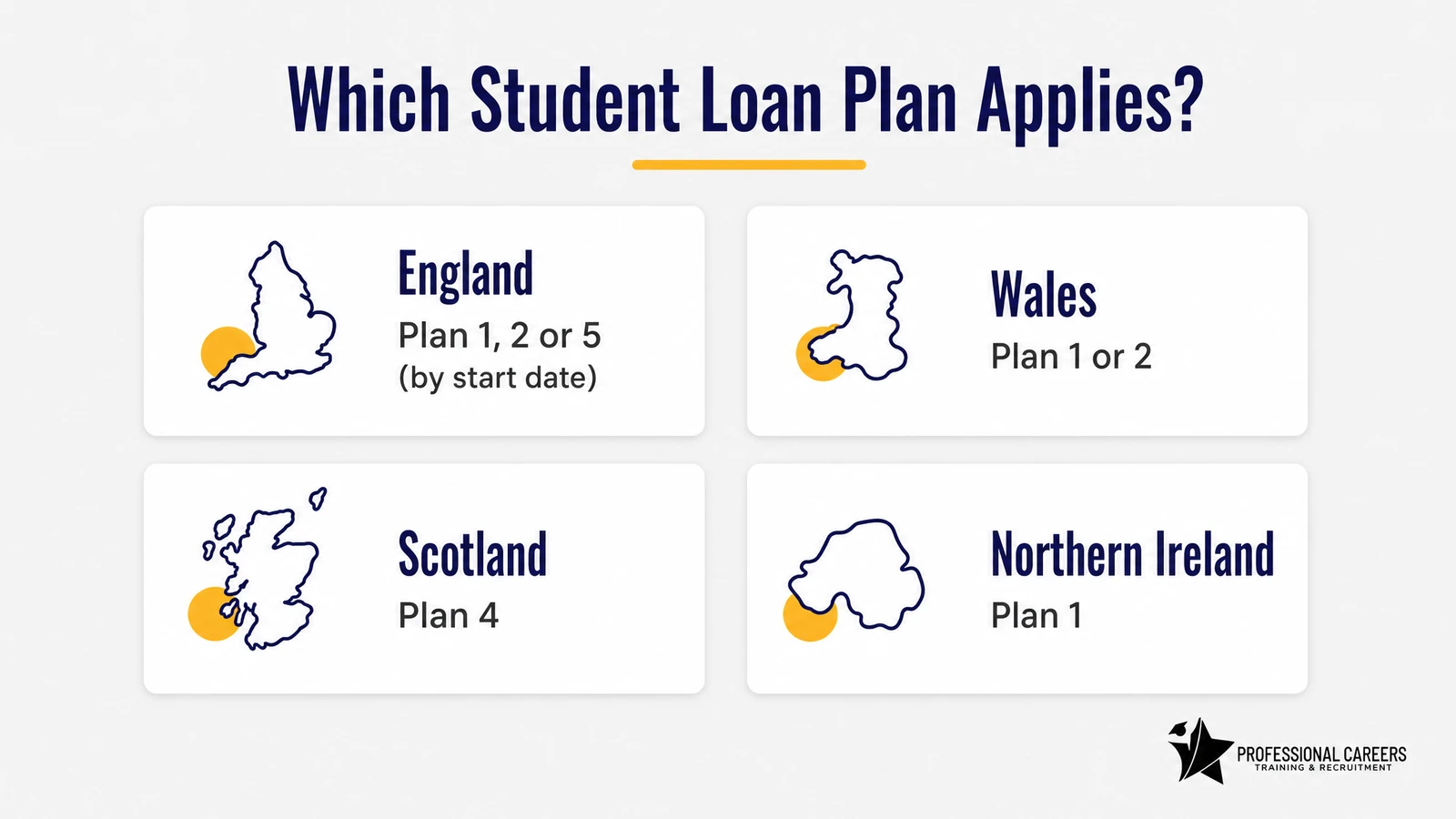
Which plan an employee is on depends on where they lived when they took out the loan, when their course started, and what they studied. There are five plan types in total.
Plan 1
Plan 1 covers English and Welsh students who started their course before 1 September 2012, and all Northern Ireland students regardless of start date.
Plan 2
Plan 2 covers English and Welsh students who started between 1 September 2012 and 31 July 2023. Wales has no equivalent to Plan 5, so Welsh students starting from August 2023 onwards stay on Plan 2.
Plan 4
Plan 4 covers Scottish students, funded through the Student Awards Agency for Scotland, regardless of when their course started.
Plan 5
Plan 5 is the newest plan, covering English students who started their course on or after 1 August 2023. April 2026 is the first year these borrowers become liable to repay, since repayments only start the April after graduation or course leaving.
Postgraduate Loan
Postgraduate Loans are a separate scheme, run alongside whichever undergraduate plan (if any) the borrower also has. A postgraduate loan deduction can run at the same time as a Plan 1, 2, 4 or 5 deduction, each calculated separately.
Five plan types exist because loan terms changed as government policy changed, not because there’s one “normal” plan. Never assume a Plan 2 default — the plan type has to come from HMRC or the employee’s own paperwork.
2026/27 Student Loan Repayment Thresholds and Rates
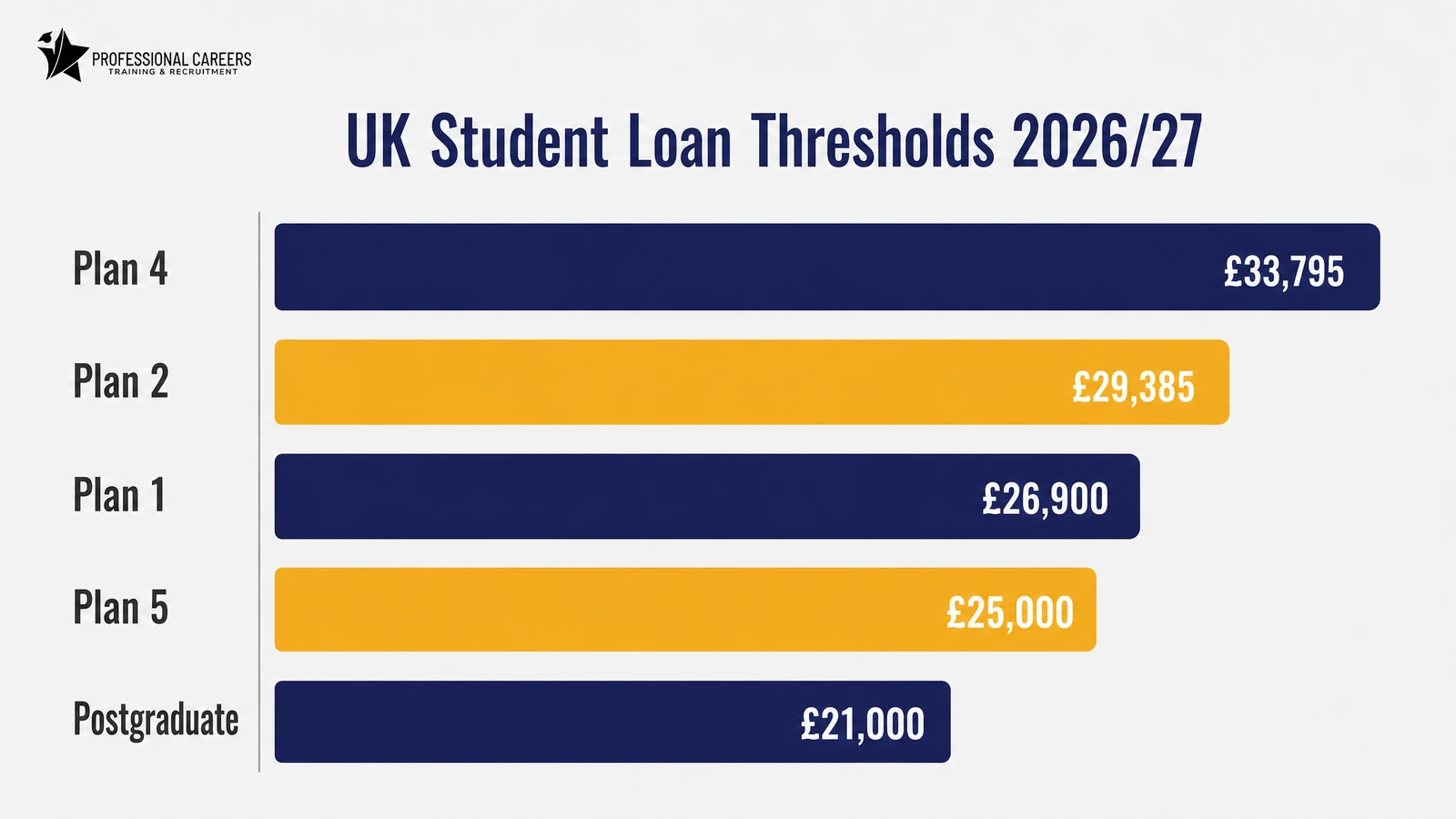
Every plan’s annual threshold rises most years. Here are the confirmed 2026/27 figures, alongside the period-equivalent thresholds payroll software actually applies.
| Plan | Annual threshold | Monthly threshold | Weekly threshold | Deduction rate |
|---|---|---|---|---|
| Plan 1 | £26,900 | £2,241.67 | £517.31 | 9% |
| Plan 2 | £29,385 | £2,448.75 | £565.10 | 9% |
| Plan 4 | £33,795 | £2,816.25 | £649.90 | 9% |
| Plan 5 | £25,000 | £2,083.33 | £480.77 | 9% |
| Postgraduate Loan | £21,000 | £1,750.00 | £403.85 | 6% |
Plan 1, Plan 2 and Plan 4 all rose from their 2025/26 levels. The Postgraduate Loan threshold stayed frozen at £21,000 for another year.
The government has already confirmed the Plan 2 threshold will be frozen at £29,385 from April 2027 through to April 2030, so this is one figure payroll teams won’t need to re-check for a few years once 2027/28 arrives.
How Employers Know Which Plan to Apply
Payroll doesn’t get to guess which plan an employee is on. HMRC confirms it through one of several routes.
- SL1 start notice from HMRC, confirming a student loan plan type and telling the employer when to start deducting (see gov.uk’s employer guidance for the full set of notice types).
- PGL1 start notice, the equivalent notice for postgraduate loans.
- The employee’s P45 from a previous employer, if it shows an existing student loan indicator.
- The starter checklist, completed by a new employee with no P45, where they declare their loan plan themselves.
- Generic Notification Service (GNS) messages, sent through payroll software to flag a change HMRC needs actioned.
If an employee says they have a loan but can’t confirm which plan, HMRC’s guidance is to default to Plan 5 in payroll software until an SL1 arrives confirming otherwise.
The plan type always comes from HMRC or the employee’s own documentation, never from an assumption. When in doubt and no confirmation exists yet, Plan 5 is the correct default to start from.
How to Calculate a Student Loan Deduction
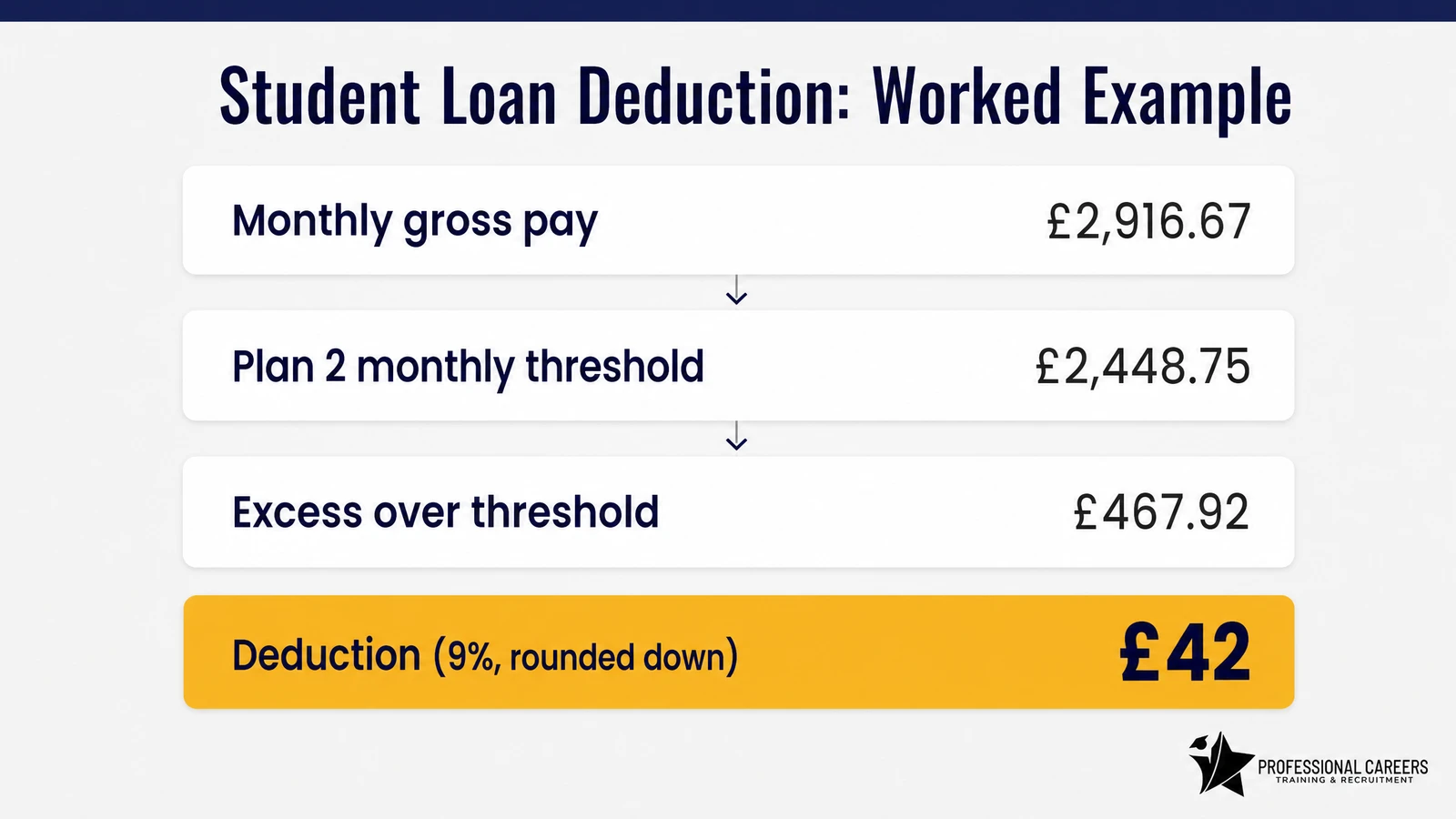
The calculation itself is straightforward once you have the right threshold and plan type. Payroll software does this automatically, but understanding the mechanics matters for spotting when something looks wrong.
- Take the employee’s gross pay for the period, using the same figure used for employer’s secondary Class 1 National Insurance.
- Subtract the period threshold for their plan (the annual threshold divided by 12 for monthly pay, or by 52 for weekly pay).
- Multiply the result by the deduction rate: 9% for Plan 1, 2, 4 or 5, or 6% for a Postgraduate Loan.
- Round the result down to the nearest whole pound. HMRC’s rule, confirmed in its Collection of Student Loans Manual, is that deductions always round down, never up.
Here’s a worked example. An employee on a £35,000 annual salary, paid monthly, on Plan 2:
- Monthly gross pay: £2,916.67
- Plan 2 monthly threshold: £2,448.75
- Excess over the threshold: £467.92
- 9% of the excess: £42.11
- Deduction, rounded down: £42
If this employee also had a Postgraduate Loan, a second deduction would be calculated the same way against the £1,750 monthly postgraduate threshold, at 6% instead of 9%, and both amounts would appear as separate lines on the payslip.
Student Loan Deductions with More Than One Job
A common misconception is that an employee’s earnings across all their jobs get combined before the threshold applies. They don’t.
HMRC’s own guidance is explicit: “if an employee has more than one job you should ignore earnings from the other employer.” Each employer calculates the deduction independently, based only on what they themselves pay that employee.
This means someone earning £20,000 at one job and £20,000 at another, £40,000 in total, could fall under both employers’ Plan 2 thresholds individually and have no student loan deducted anywhere, even though their combined income sits above it.
It also means a change at one employer, a pay rise or a drop in hours, has no effect on how the other employer calculates their own deduction. Each payroll runs its own numbers in isolation.
How Long Until a Student Loan Is Written Off?
Student loan deductions aren’t necessarily for life. Every plan has a fixed period after which any remaining balance is written off, regardless of how much is still owed.
- Plan 1: written off 25 years after the borrower first became eligible to repay (for loans taken out from 2006/07 onwards).
- Plan 2: written off 30 years after first becoming eligible to repay.
- Plan 4: written off 30 years after first becoming eligible to repay (for courses starting 2007/08 onwards).
- Plan 5: written off 40 years after the borrower is due to start repaying, the longest term of any plan.
None of this changes what payroll actually does day to day. Deductions carry on exactly as instructed until HMRC sends a stop notice, whether that’s because the loan is repaid, written off, or the employee’s circumstances change in some other way.
A write-off date doesn’t cancel anything on the payroll side automatically. Deductions keep running until HMRC’s own stop notice arrives, whatever the reason behind it.
The Effect of Pension Salary Sacrifice
Pension salary sacrifice arrangements genuinely reduce the student loan deduction, because they reduce the gross pay figure the calculation is based on.
When an employee sacrifices part of their salary into a pension, their contractual gross pay falls by that amount, before tax, National Insurance and student loan deductions are worked out. A relief-at-source pension contribution, taken from net pay after tax, has no such effect.
On a £40,000 Plan 2 salary sacrificing £2,400 a year into a pension, gross pay for deduction purposes drops to £37,600.
The repayable amount falls from £10,615 above the threshold to £8,215, cutting the annual student loan repayment from £955.35 to £739.35, a saving of £216 a year.
Payroll doesn’t need to do anything special here beyond processing the salary sacrifice correctly in the first place. Once contractual gross pay is reduced, the student loan calculation follows automatically from the lower figure.
Starting and Stopping Deductions
Deductions start from the next available payday once the plan type is confirmed, whether that’s through an SL1/PGL1 notice, a P45, or the starter checklist.
They stop only when HMRC sends an SL2 or PGL2 stop notice, effective from the first available payday after the deduction stop date shown on that notice.
An employee leaving employment, reaching the end of their loan term, or believing they’ve repaid in full doesn’t change anything on the payroll side until the matching stop notice actually arrives.
Deductions are switched on and off by HMRC’s own notices, not by anything the employee tells payroll directly. Acting on an employee’s word alone, in either direction, is a common source of errors.
Common Payroll Mistakes with Student Loan Deductions
A handful of errors account for most of the student loan problems payroll teams run into.
- Stopping deductions because an employee asked, without a genuine SL2 or PGL2 stop notice from HMRC.
- Using the wrong plan type, particularly defaulting to Plan 2 out of habit rather than checking for Plan 1, 4 or 5 specifically.
- Missing a second, simultaneous Postgraduate Loan deduction alongside an undergraduate plan.
- Rounding the deduction up instead of down, which overcharges the employee even by small amounts, period after period.
- Not updating thresholds in April, particularly for older Plan 1, 2 and 4 borrowers whose thresholds do move most years, unlike the frozen Postgraduate Loan figure.
Most student loan errors come from acting on the employee’s word rather than HMRC’s own notice, or from carrying an old threshold past April. Both are avoidable with a simple annual check.
Why This Matters for Anyone Training in Payroll
Student loan deductions come up in almost every payroll run once a business has more than a handful of staff, which makes this one of the more consistently tested areas of practical payroll knowledge.
Getting the plan-identification and calculation steps right, and knowing exactly when a change is and isn’t authorised, is a core, everyday skill rather than an edge case, alongside other statutory areas like National Minimum Wage compliance and statutory sick and parental pay.
Our Advanced Payroll Training course covers student loan deductions alongside PAYE, National Insurance, statutory payments and the other deductions payroll staff handle day to day, with guaranteed recruitment support once you finish.
If you’re new to payroll and want the fundamentals first, our beginner’s guide to payroll is a good starting point before tackling plan-specific deductions like these.
What are the 2026/27 student loan thresholds?
Plan 1 is £26,900, Plan 2 is £29,385, Plan 4 is £33,795, Plan 5 is £25,000, and the Postgraduate Loan threshold is £21,000. All are annual figures; employers apply the period-equivalent (divided by 12 for monthly pay, by 52 for weekly).
How do I know which student loan plan an employee is on?
HMRC confirms it via an SL1 or PGL1 start notice, or the employee declares it on a P45 or starter checklist. If nothing confirms it yet, HMRC’s guidance is to default to Plan 5 until an SL1 arrives.
Can an employee ask payroll to stop their student loan deduction?
No. Deductions stop only when HMRC issues an SL2 or PGL2 stop notice. An employer must keep deducting until that notice arrives, regardless of what the employee says about their loan balance.
How is the deduction amount calculated?
Subtract the period threshold from gross pay for that period, apply 9% (or 6% for a Postgraduate Loan) to the excess, then round the result down to the nearest whole pound.
Can someone have a student loan and a postgraduate loan deduction at once?
Yes. They’re calculated independently against their own thresholds and rates, and both amounts should appear as separate lines on the payslip.