AI is already part of the data analyst's job, not a future threat to it. Across UK finance and data teams, AI tools now help...
AI is already part of the data analyst’s job, not a future threat to it.
Across UK finance and data teams, AI tools now help clean data, draft formulas, and flag patterns that used to take hours to find by eye.
This doesn’t make the role less valuable.
It changes what a good data analyst actually does day to day, and it changes what employers screen for at interview.
If you’re training to become a data analyst, or already working as one, it’s worth understanding exactly where AI fits in, what it can’t do, and which skills are becoming more valuable rather than less.
If you want the wider picture across finance roles, our guide to technology for accounting covers how AI is changing accounting work more broadly.
How AI Is Actually Showing Up in Data Analysis Work
Most of the AI used in data analysis today is built into tools analysts already use, not a separate system bolted on top. Three areas show the change most clearly: preparing data, querying it, and spotting patterns in it.
Cleaning and Preparing Data Faster
Cleaning messy data has always eaten into an analyst’s week. AI-assisted features in Excel, Power Query and dedicated data-prep tools can now suggest how to handle missing values, flag inconsistent formatting, and merge data from different sources automatically.
This doesn’t remove the analyst’s judgement. Someone still has to decide whether a suggested fix is actually correct for that dataset.
But it cuts the mechanical part of the job down from hours to minutes on a lot of routine tasks.
Asking Questions in Plain English
Tools like Copilot in Excel and Power BI let analysts type a question in plain English, such as ‘show me sales by region for Q3’, and get a formula, chart or measure back instead of building it from scratch.
This is genuinely useful for speed. It’s also where the biggest skills gap shows up.
Someone who doesn’t understand what a good answer looks like can’t tell when the AI has got it wrong, which happens more often than the marketing suggests.
Spotting Patterns and Anomalies
AI is also used to scan large datasets for outliers, trends or anomalies that would be easy to miss manually, such as a sudden spend spike or a data entry that doesn’t fit the normal pattern.
This works best as a first pass, not a final answer. The tool points at something interesting. The analyst still has to work out why it happened and whether it actually matters.
Our guide to data validation techniques covers the manual checks that still matter once AI has flagged something.
AI speeds up the mechanical parts of data analysis. It doesn’t remove the need to understand what the data is actually telling you — if anything, that understanding matters more, not less.
The AI Tools UK Data Analysts Are Actually Using
It helps to be specific about which tools this actually means, rather than talking about ‘AI’ as one vague thing.
Copilot in Excel and Copilot in Power BI are the two most common entry points.
Both let an analyst type a plain-English request, such as summarising a table or building a chart of revenue by month, and get a working result to check and refine.
Power Query’s AI-assisted transformations help spot inconsistent data formats and suggest cleaning steps automatically, cutting down the manual prep work that used to dominate the start of most projects.
General-purpose AI assistants like ChatGPT and Claude are increasingly used to draft SQL queries or Python scripts from a plain-English description, which an analyst then checks, tests and corrects rather than trusting outright.
None of these tools are experimental or niche. They’re built into software UK data teams already use, which is exactly why AI-tool fluency has become something employers expect rather than something they treat as a bonus.
A Quick Example: AI-Assisted Analysis in Practice
Here’s what that looks like in practice. A retail finance team wants to know why returns have risen in one region over the past quarter.
Without AI, an analyst would write the SQL to pull the data, build a pivot table, and manually chart it by month and store.
With Copilot in Power BI, the same analyst can ask ‘show me returns by region and month for the last quarter’ and get a working chart in seconds, then refine it from there.
The time saved doesn’t come from skipping the thinking. It comes from skipping the typing.
The analyst still has to notice that one store’s returns spiked after a specific product change, check the data actually supports that, and explain it to the finance team in plain terms.
That judgement step is the part AI can’t do, and it’s the part that was always the real value of the job.
The AI tools data analysts use aren’t separate systems to learn from scratch. They’re features inside the software you already use, which is exactly why not knowing them is starting to stand out on a CV.
The UK Data Analyst Job Market in 2026
The job market backs this up. Demand for data analysts in the UK has grown sharply over the past year, and AI skills are increasingly part of what employers list as a requirement, not a nice-to-have.
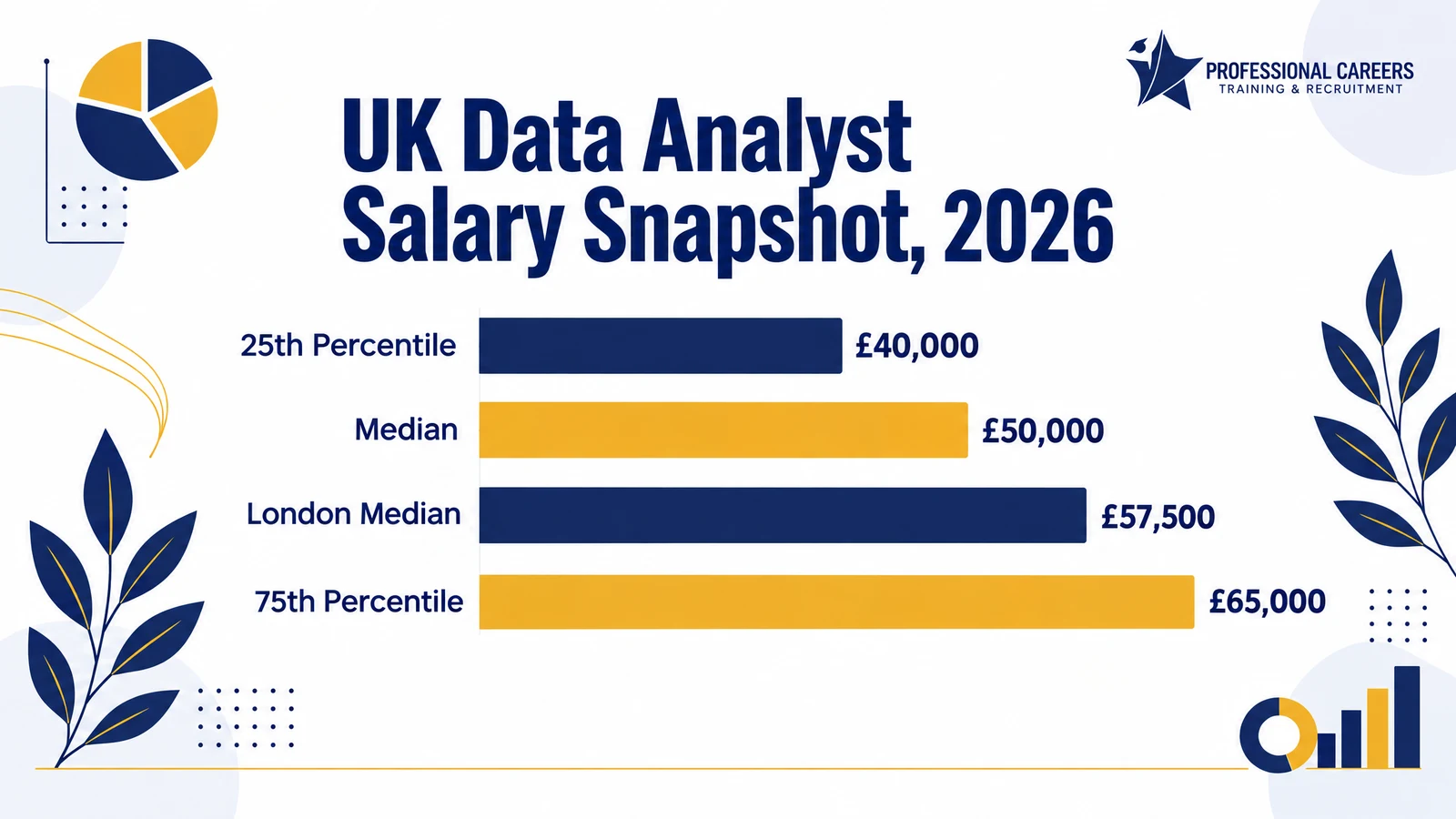
Data from IT Jobs Watch puts the median UK data analyst salary at £50,000 for the six months to October 2026, up 11.1% year on year. Permanent vacancies have climbed to 1,210, more than double the previous period’s figure.
| Measure | Figure |
|---|---|
| Median salary (UK) | £50,000 (+11.1% YoY) |
| 25th percentile | £40,000 |
| 75th percentile | £65,000 |
| Permanent vacancies | 1,210 (up from 455) |
| London median | £57,500 |
| Scotland median | £65,000 (+62.5% YoY) |
London remains the highest-paying UK region at a median £57,500, though that figure fell slightly year on year as demand spreads to other regions.
Scotland saw the sharpest rise, with median pay up 62.5% to £65,000, reflecting a smaller but fast-growing market.
Why the Skills Gap Is Still Wide Open
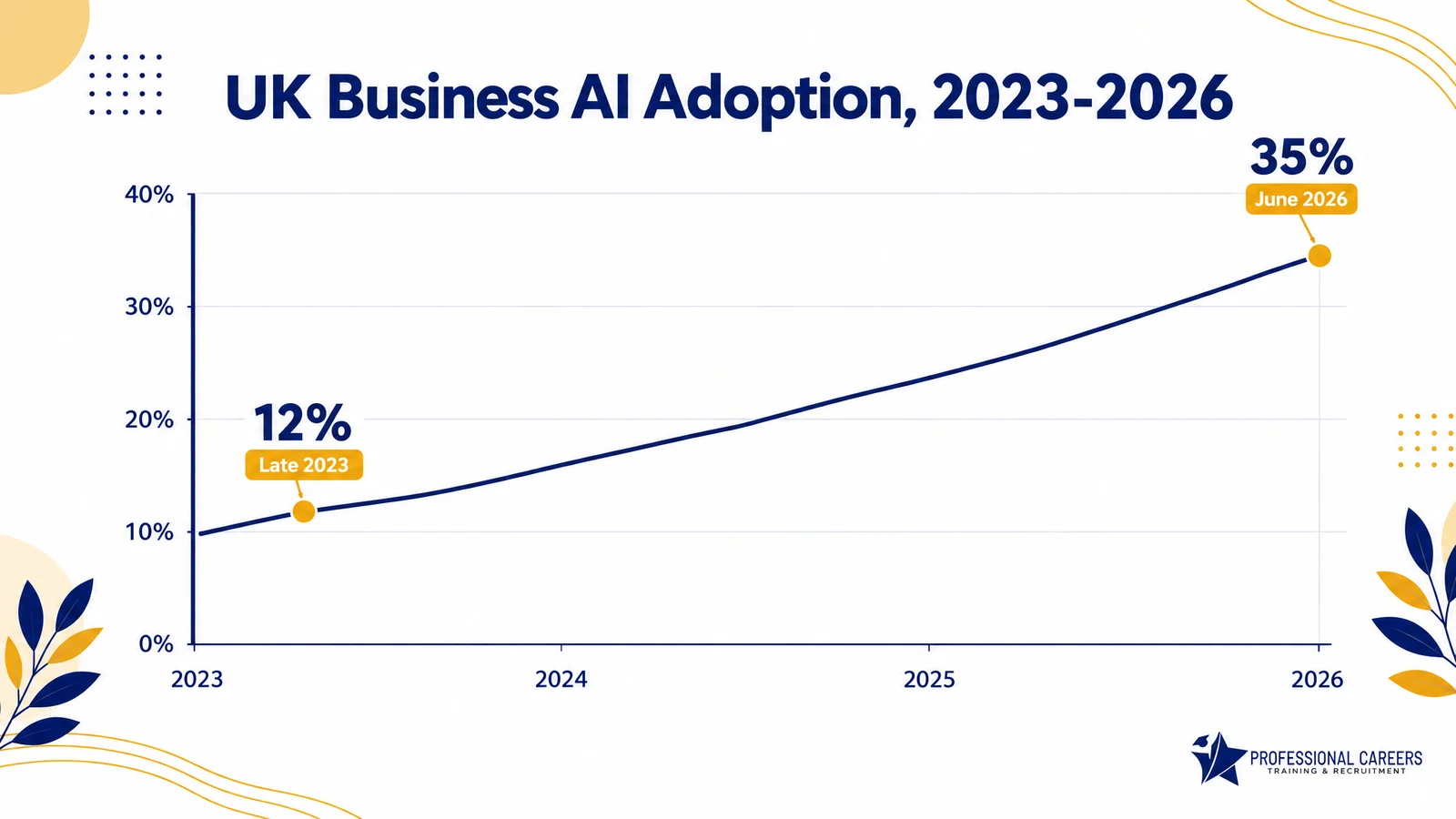
AI adoption among UK businesses has grown fast, but the people who can use it well haven’t caught up at the same pace. That gap is exactly where a trained data analyst becomes valuable.
The Office for National Statistics tracks this directly. AI use among UK businesses with 10 or more employees rose from around 12% in late 2023 to around 35% by June 2026, nearly a threefold increase in under three years.
But adoption is shallow in most cases. Only 10% of businesses using AI report using it extensively, and just 11% say more than half their workforce has received any AI training.
Lack of expertise is consistently named as one of the biggest barriers to getting more value out of it.
| Skill | Share of job adverts |
|---|---|
| SQL | 44.3% |
| Business Intelligence | 39.6% |
| Power BI & Power Platform | 38.1% |
| Python | 32.6% |
| Microsoft Excel | 31.0% |
| Data Analysis | 28.2% |
| AI | 25.6% |
| Azure AI | 18.3% |
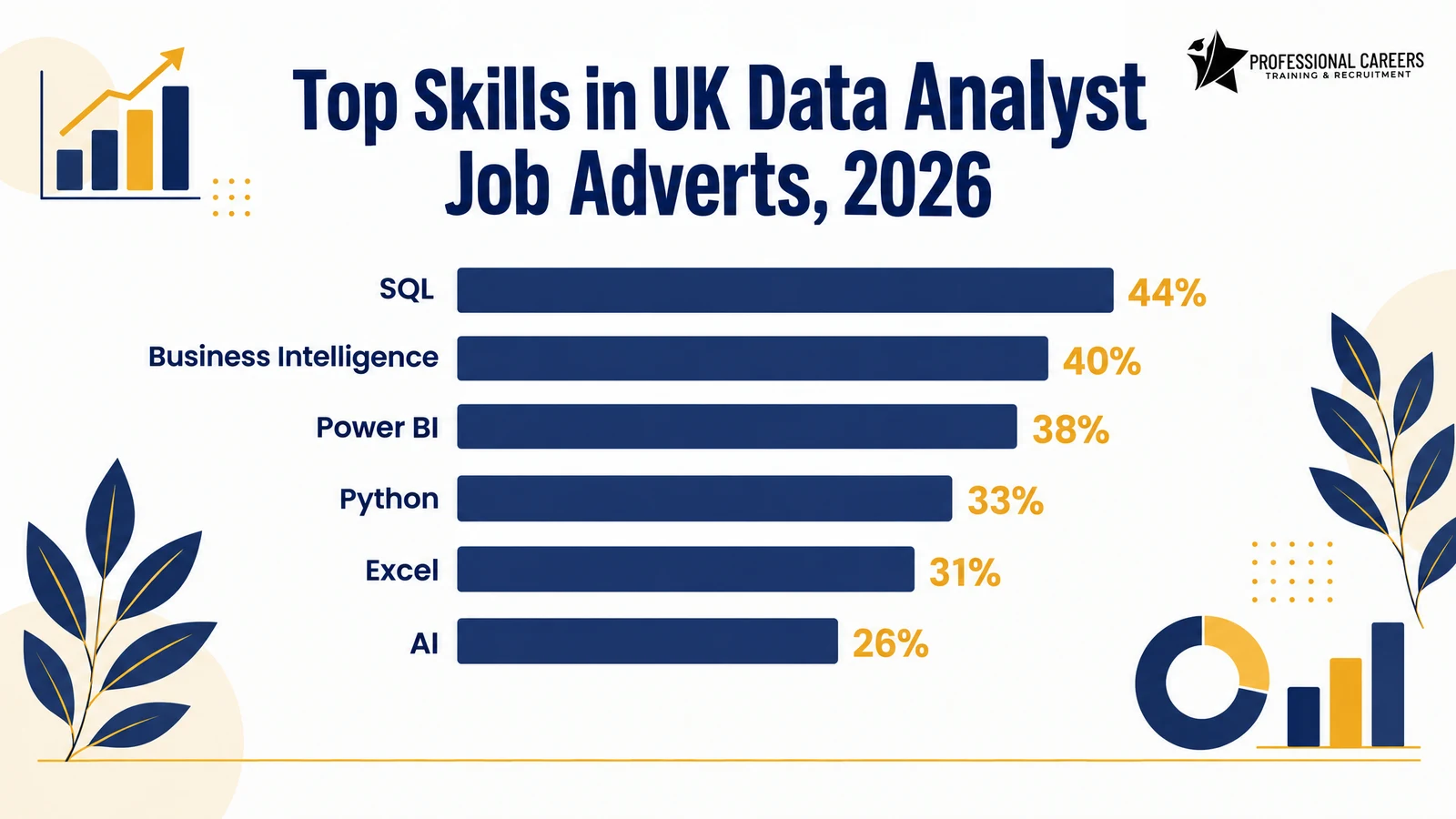
SQL, Power BI and Python remain the core of the role. AI hasn’t replaced them, it sits alongside them. But AI now appears in around a quarter of job adverts, and that share is only moving in one direction.
What Employers Actually Want From an AI-Literate Data Analyst
Core Data Skills Still Come First
Nobody is hiring a data analyst purely because they can prompt an AI tool well.
SQL, data modelling, Excel, and a genuine understanding of the business questions being asked are still the foundation, and AI sits on top of that rather than replacing it.
This matters for anyone choosing a training route. A course built entirely around one AI tool will date quickly. One built around the underlying data skills, with AI tools layered into the workflow, won’t.
AI-Tool Fluency, Not AI Engineering
Employers aren’t expecting data analysts to build AI models from scratch. That’s a different, more specialised role. What they want is someone who can use the AI features already built into everyday tools, confidently and critically.
In practice, that means knowing how to:
- Use Copilot-style natural-language querying in Excel and Power BI to speed up routine chart and formula building
- Use AI-assisted data cleaning and transformation tools without blindly trusting every suggested fix
- Spot when an AI-generated summary or chart has misread the underlying data
- Combine SQL and Python skills with AI tools rather than relying on AI as a substitute for either
The analysts getting the most value from AI aren’t the ones who trust it blindly. They’re the ones who already understand the data well enough to know when the AI has got it wrong.
Common Misconceptions About AI and Data Analyst Jobs
A few myths keep coming up when people consider training for a data career right now, and they’re worth addressing directly.
- “AI will replace data analysts.” Demand for the role is rising, not falling — IT Jobs Watch recorded a 118-rank jump in demand for UK data analysts over the past year, alongside an 11.1% salary increase.
- “You need to be a programmer to use AI tools.” Most AI features data analysts use day to day sit inside Excel, Power BI and similar tools, not in separate coding environments.
- “AI tools are always right.” AI-generated charts, summaries and formulas get things wrong often enough that checking the output is a core part of the job, not an optional extra.
- “Only senior analysts need AI skills.” AI now appears in around a quarter of UK data analyst job adverts across all experience levels, not just senior roles.
Building AI Skills Into Your Data Analyst Training
If you’re choosing or already on a data analyst training route, there are a few practical things worth checking that it actually covers.
- Confirm the course teaches SQL, Power BI and Excel properly first — AI tools are only useful once you understand what correct output looks like.
- Check whether AI-assisted features, such as Copilot in Excel and Power BI, are taught as part of the normal workflow, not as a bolt-on module.
- Look for practical, hands-on exercises rather than theory-only AI content — the skills that show up in job adverts are applied, not conceptual.
- Ask what support exists for turning the training into an actual job, not just a certificate.
Professional Careers Training’s Data Analyst Training course is built around this exact balance.
It covers SQL, Power BI, Excel and Python properly first, with AI-assisted tools taught as part of how the work actually gets done now. You can see the full breakdown on the course syllabus page.
That’s backed by 1-to-1 mentoring and guaranteed recruitment support once you’re ready for the job market.
What If You’re Already Working as a Data Analyst?
Not everyone reading this is training from scratch. If you’re already working as a data analyst, the practical question is usually where to start, not whether to bother.
Three places tend to pay off fastest:
- Learn the Copilot features inside whichever Microsoft tool you already use daily — it’s the lowest-effort, highest-visibility win
- Get comfortable checking AI-generated SQL or DAX against what you’d have written yourself, rather than trusting it blind
- Keep your core SQL, Python and data modelling skills sharp, since they’re what let you tell when an AI tool has got something wrong
None of this needs a separate AI qualification. It’s closer to picking up a new feature in software you already use, the same way analysts picked up Power Query or DAX a few years ago.
The data analysts who do well out of AI aren’t the ones who avoid it, or the ones who rely on it blindly. They’re the ones trained properly on the fundamentals, who then use AI to work faster.
Frequently Asked Questions
Will AI replace data analysts?
No, current UK job market data points the other way. Data analyst vacancies and salaries have both risen over the past year.
AI appears in around a quarter of job adverts as a skill employers want, not a replacement for the role.
Do I need to learn to code to use AI in data analysis?
Not for most entry-level and mid-level data analyst roles. Most AI tools analysts use day to day, including Copilot in Excel and Power BI and AI-assisted data cleaning, work through plain-English prompts rather than programming.
What AI skills do employers actually look for in a data analyst?
Confident, critical use of AI features already built into tools like Excel, Power BI and data-cleaning platforms, sitting alongside strong SQL, Python and Excel fundamentals, not instead of them.
Is SQL still worth learning if AI can write queries?
Yes. SQL remains the single most in-demand data analyst skill in the UK, listed in 44.3% of job adverts, and you need to understand SQL to check whether an AI-generated query is actually correct.
Does Professional Careers Training’s Data Analyst course cover AI tools?
Yes. The course covers SQL, Power BI, Excel and Python as its foundation, with AI-assisted tools taught as part of the real workflow, backed by 1-to-1 mentoring and guaranteed recruitment support.