If you're training to become a business analyst, or you already work as one, you've probably noticed AI tools turning up in more of your...
If you’re training to become a business analyst, or you already work as one, you’ve probably noticed AI tools turning up in more of your day-to-day work.
Drafting requirements. Summarising a messy meeting. Building a first-pass process map before anyone’s even asked for one.
The question most people actually want answered isn’t “will AI take my job.” It’s narrower and more useful than that.
What is AI actually changing for business analysts right now? And what should you be learning because of it?
This article pulls together current UK data on three things: AI adoption across UK business, how working business analysts say they use AI day to day, and what employers ask for in live job postings.
Together, they paint a clearer picture than either the hype or the panic you’ll find elsewhere online.
It’s a role-specific look, not a repeat of the broader case we’ve made elsewhere on this site in Technology for Accounting.
How Fast Is AI Actually Moving Through UK Business?
Start with the scale of the shift, because it explains why this matters for business analysts specifically.
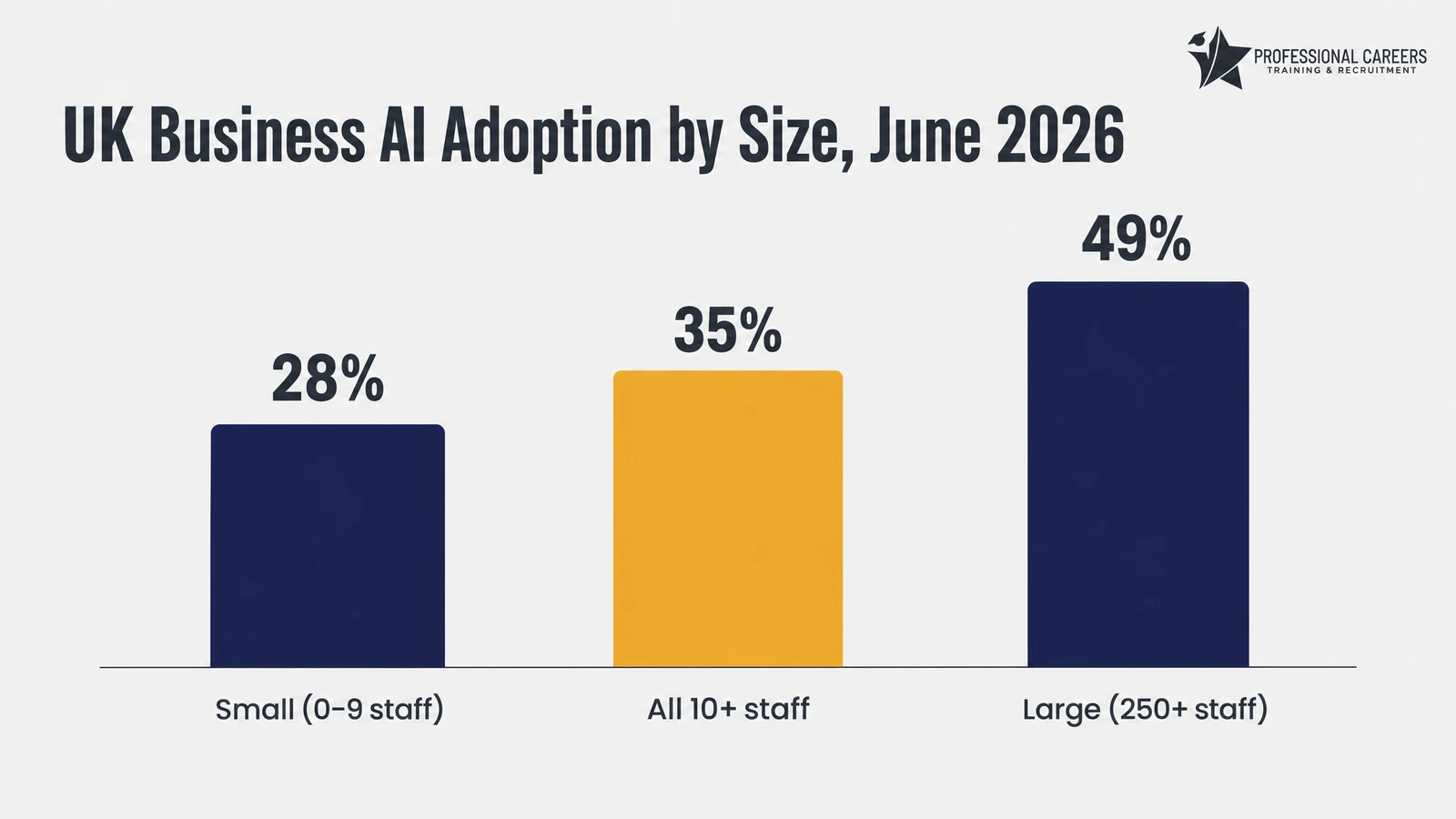
According to the Office for National Statistics, AI adoption among UK businesses with 10 or more employees rose from around 12% in September 2023 to around 35% by June 2026.
That’s nearly tripled in under three years. Adoption isn’t even across business sizes, either.
| Business size | Reporting AI use |
|---|---|
| Small (0–9 employees) | 28% |
| 10+ employees (overall) | 35% |
| Large (250+ employees) | 49% |
The ONS data also breaks down which roles are affected by which type of AI. Among businesses using machine learning for data processing, 39% reported an effect on data analysis roles specifically.
A further 41% reported an effect on administrative and clerical roles from the same technology.
That 39% figure is the one worth sitting with. It isn’t AI replacing analysts.
It’s AI changing a meaningful share of what the analysis part of the job actually involves.
AI adoption among UK businesses has nearly tripled since 2023, and data analysis roles are among those most directly affected by it. For business analysts, that’s a reason to get ahead of the change, not to panic about it.
What Business Analysts Are Actually Using AI For
The clearest picture of how working business analysts use AI comes from the International Institute of Business Analysis’s 2026 Global State of Business Analysis report.
It was published in June 2026, based on a global survey of the profession.
Speeding up drafting and formatting
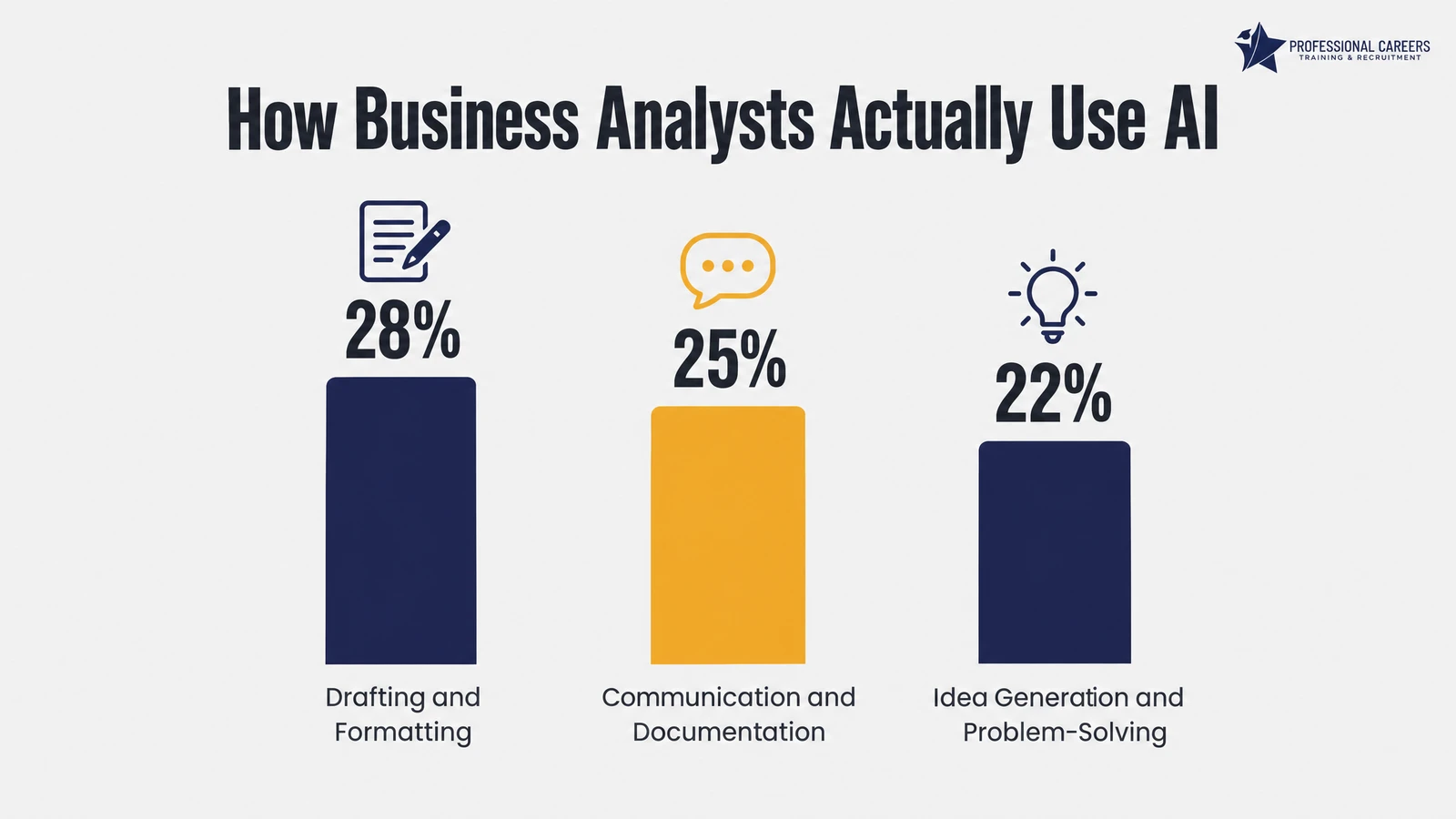
28% of respondents said their most common use of AI is speeding up tasks like drafting and formatting. That covers the unglamorous but time-hungry parts of the job.
- Turning rough meeting notes into a structured requirements document
- Drafting a first-pass user story or acceptance criteria for a reviewer to refine
- Formatting a process map or a stakeholder matrix into a consistent template
- Producing a first draft summary of a long discovery workshop
Supporting communication and documentation
25% said they use AI mainly to support communication and documentation.
Think status updates, stakeholder emails, and translating technical detail into plain English for a non-technical audience.
Idea generation and problem-solving
22% use AI mainly for idea generation or problem-solving. That’s using AI as a thinking partner, not a replacement for judgement.
Testing an approach. Generating alternative solutions to weigh up. Pressure-testing an assumption before taking it to stakeholders.
Sentiment towards AI among business analysts is positive, but it’s cooled slightly. 69% say AI is having a positive impact on their career.
That’s down from 74% the year before. Only 5% report a negative impact.
The report reads that dip as the profession settling into a more considered, practical relationship with AI. Not the initial hype wearing off into disappointment.
Business analysts are mostly using AI for the supporting work around analysis: drafting, formatting, communication. Not for the judgement calls at the centre of the role. That split is exactly why the skills below are becoming more valuable, not less.
The Skills That Are Becoming More Valuable, Not Less
The same IIBA report ranks which skills employers and practitioners say matter most as AI takes on more of the routine work.
The pattern is consistent. The more AI absorbs the drafting and formatting, the more weight falls on judgement, communication and stakeholder handling.
- Communication skills — ranked the single most important skill for business analysts for the third year running
- Critical thinking — climbed to second place in the 2026 report
- Problem-solving
- Active listening
- Stakeholder engagement
None of these are new skills invented because of AI. They were always at the core of good business analysis, long before any of this tooling existed.
What’s changed is how much they now matter, relative to the technical drafting work AI can increasingly do for you.
A business analyst who can write a clear requirements document was always valuable. That hasn’t stopped being true.
But the one who can also judge whether that requirement actually solves the business problem, and bring a sceptical stakeholder round to agreeing it does, is the one AI can’t replace.
What Employers Are Actually Asking For Right Now
Job postings tell a more concrete story than surveys about sentiment.
IT Jobs Watch tracks live UK vacancy data. Its business analysis figures for the six months to October 2026 show AI already well inside the core skill set employers list.
| Skill | Share of postings |
|---|---|
| SQL | 15.47% |
| Power BI | 10.48% |
| Power Platform | 12.08% |
| AI (general) | 20.76% |
| Microsoft Copilot | 2.59% |
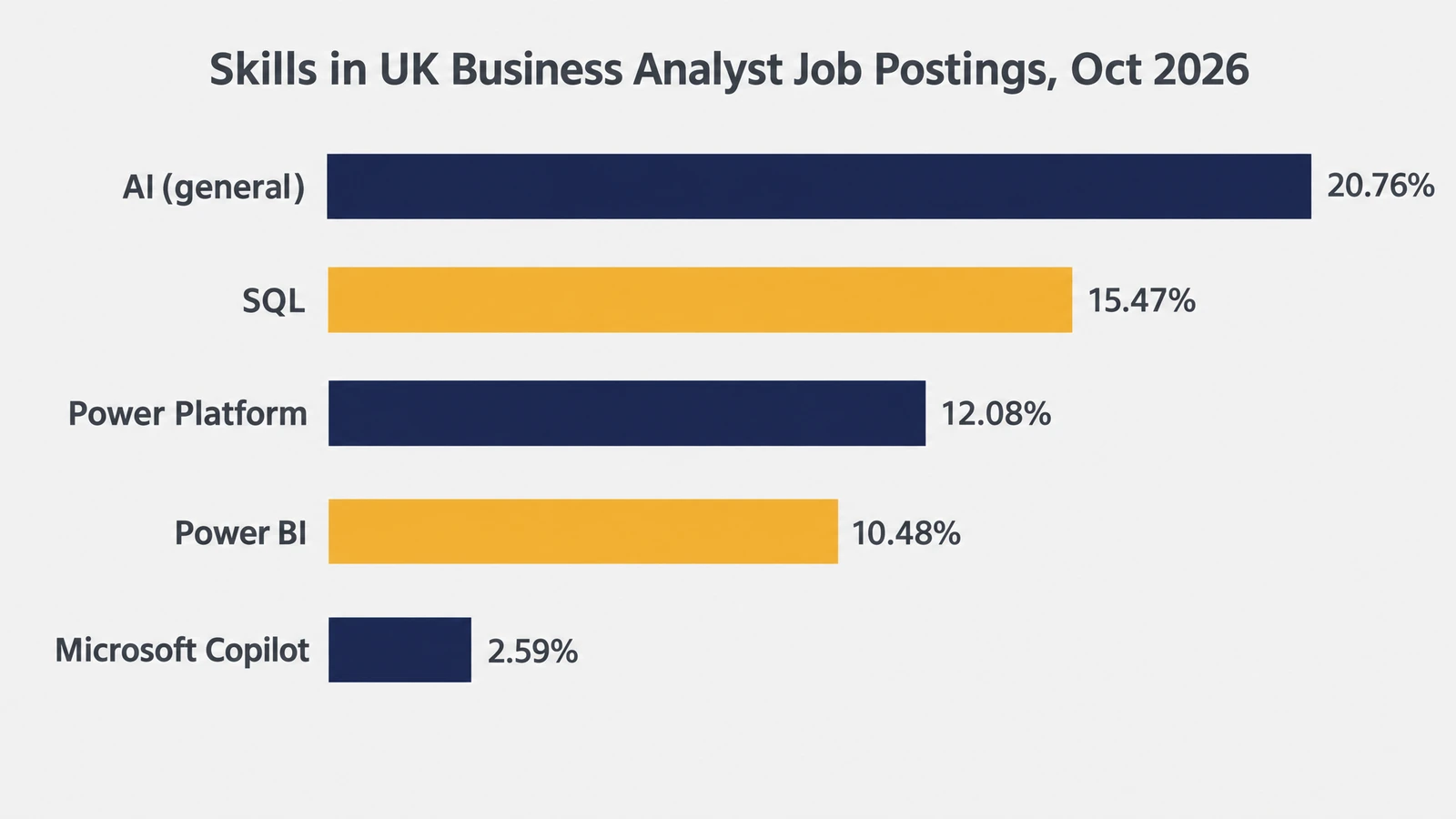
AI now appears in roughly one in five UK business analyst job postings. That’s higher than Power BI, and close behind SQL.
SQL has been a staple business analyst skill for well over a decade, so that’s real company for AI to be keeping.
Specific tool mentions like Microsoft Copilot sit lower for now, at around 2.6% of postings.
That suggests employers are asking for general AI familiarity more than a named tool. It tracks with how fast the AI tooling landscape itself is still moving.
For a full breakdown of what UK business analysts actually earn by experience and region, see our separate guide: Business Analyst Salary UK. This article sticks to the skills side of the picture.
AI now shows up in roughly 1 in 5 UK business analyst job adverts, more often than Power BI. Employers aren’t asking for an AI certificate, just analysts who can use it sensibly alongside the tools they already rely on.
Where AI Fits Into the Core Business Analyst Toolkit
SQL, Power BI and AI working together
AI isn’t replacing the core business analyst toolkit. It’s sitting alongside it.
Our guide to SQL for Business Analysts goes further into exactly this, from the analyst’s point of view rather than the adoption-statistics view this article takes.
A typical workflow now might start with SQL, to pull the right dataset in the first place.
From there it moves to Power BI or Excel, to shape and visualise what SQL pulled out.
AI tends to come in at specific points along that chain, rather than running the whole thing end to end.
A worked example
Say a stakeholder asks for a breakdown of customer churn by region, split by the last three quarters.
An analyst might ask an AI tool to draft the first version of the SQL query, including the right joins and date filters.
They’d then check that draft against the actual database structure, since AI can get a table or column name wrong with real confidence.
Once the data’s pulled and visualised, AI can help again, this time drafting a plain-English summary of what the dashboard shows, for a stakeholder who’d rather read three sentences than study a chart.
The analyst still owns both ends of that process: the question being asked, and the honesty of the answer given back.
The human check still matters
AI can speed up the first draft of almost any of these tasks. What it can’t do is judge whether the finished output actually answers the business question.
It also won’t reliably catch a number that looks plausible but is actually wrong.
That final check stays firmly a human responsibility. Training that treats AI as one tool among several, not a shortcut around understanding the fundamentals, is what prepares someone properly for this.
A data protection reminder
One practical point often missed in the excitement: public AI tools aren’t a safe place for confidential business data.
Customer records, unreleased financials, internal HR details. None of that belongs in a prompt box on a tool your employer hasn’t formally approved and risk-assessed.
This isn’t a minor footnote. UK GDPR and data protection obligations don’t pause just because the tool processing the data happens to be AI.
Good business analyst training covers this explicitly, not as an afterthought. Knowing which tools are approved for sensitive data, and which tasks should stay well away from any public AI tool, is now a genuine part of the job.
What This Means If You’re Training to Become a Business Analyst Now
None of this changes the fundamentals of what makes a good business analyst. It does change what good training should cover alongside them.
- Core analysis skills first: requirements gathering, process mapping, stakeholder management, and the structured thinking behind all three
- Working fluency with the tools employers actually list: SQL, Power BI or Excel, and general AI-assisted drafting and research tools
- Practice judging AI output critically, not just producing it, since that judgement is the part employers are explicitly paying for
- Real UK case studies and live tool practice, not theory alone, so the skills transfer straight into a job
Our guide to becoming a business analyst in the UK covers the wider career path in full, from entry routes through to building a portfolio.
We’ve also written separately about how business analyst training prepares you for tech-driven roles more broadly.
PC Training’s Business Analyst Training programme is built around this exact balance.
Practical, tool-based skills taught alongside real UK case studies, with guaranteed recruitment support once you’re ready for the job market.
CPD certified, and built to reflect what employers are actually asking for today, not a fixed syllabus from several years ago.
The business analysts who do best out of AI won’t be the ones who avoid it, or the ones who rely on it blindly. They’ll be the ones trained to know when to trust it, and when to check it.
Frequently Asked Questions
Will AI replace business analysts?
The evidence so far doesn’t support that. AI mainly takes on supporting tasks like drafting and documentation, not the judgement and stakeholder work at the core of the role. 69% of business analysts report a positive career effect.
Do I need to learn a specific AI tool to become a business analyst?
Not a named tool specifically. UK job postings mention general AI skills (20.76%) far more often than any single branded tool like Microsoft Copilot (2.59%). Employers want sensible AI use, not a certificate in one product.
What skills matter most for business analysts in the age of AI?
Communication skills, critical thinking, problem-solving, active listening and stakeholder engagement top the list, according to the IIBA’s 2026 Global State of Business Analysis report. These are the skills AI cannot do for you.
Is SQL still worth learning if AI can write queries?
Yes. SQL still appears in 15.47% of UK business analyst job postings, more than any other listed technical skill. AI can help draft a query, but you need to understand SQL yourself to judge whether that draft is right.
How is AI actually used by business analysts day to day?
Most commonly for speeding up drafting and formatting work (28%), supporting communication and documentation (25%), and idea generation or problem-solving (22%), according to the IIBA’s 2026 survey of the profession.