Payroll has always been work where a mistake gets noticed immediately, and getting it right barely gets noticed at all. That makes it exactly the...
Payroll has always been work where a mistake gets noticed immediately, and getting it right barely gets noticed at all.
That makes it exactly the kind of job AI tools are now being pointed at. Drafting an employee email, flagging a payslip that looks off, summarising a rule change: all tasks AI is already doing inside payroll teams.
If you work in payroll, or you’re training to move into it, you’ve probably seen an AI feature appear inside your payroll software already. This article looks at what AI is actually doing in UK payroll teams right now.
It also covers what AI still can’t do, and which skills matter more because of it, not less.
How Many UK Payroll Teams Are Already Using AI
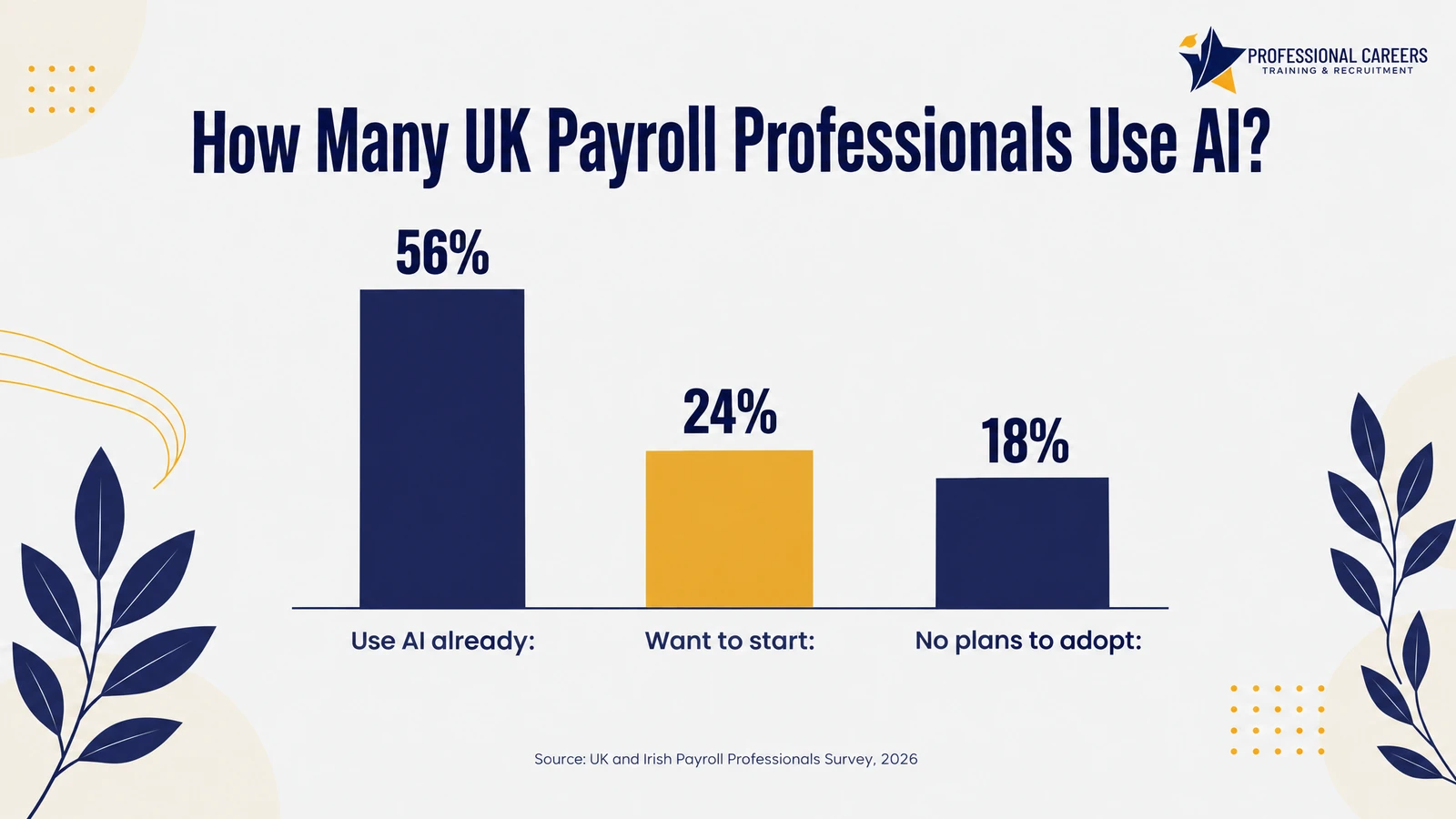
AI adoption in payroll isn’t a future prediction. A 2026 survey of 296 UK and Irish payroll practitioners found that 56% already use AI tools at least occasionally in their day-to-day work.
Another 24% said they want to start adopting AI. Only 18% said they had no intention of doing so, mostly citing scepticism about current platforms rather than job-security concerns.
This tracks with the wider UK business picture. Office for National Statistics data shows AI use among UK businesses with 10 or more employees rose from around 12% in September 2023 to roughly 35% by June 2026.
Why bigger payroll operations lead on adoption
Adoption varies sharply by business size. The ONS figures show 28% of small businesses with fewer than 10 staff using AI, against 49% of large employers with 250 or more staff.
Bigger payroll operations run more pay cycles and handle more employees per run. They also manage a wider range of deduction types.
Each of those multiplies the time a routine AI check can save, which is likely why larger employers have adopted faster.
Smaller payroll bureaus and in-house teams are catching up more slowly. Cost and unfamiliarity with the tools are plausible reasons, though the ONS data doesn’t break the cause down directly.
A smaller bureau handling five or six clients’ payrolls has less repetitive volume to automate. An in-house team running one payroll of several thousand people has far more.
That gap in scale, not a gap in willingness, likely explains much of the difference.
AI in payroll is already mainstream, not experimental. More than half of UK and Irish payroll professionals use it at least occasionally, and most of the rest plan to start.
What AI Actually Does for Payroll Right Now
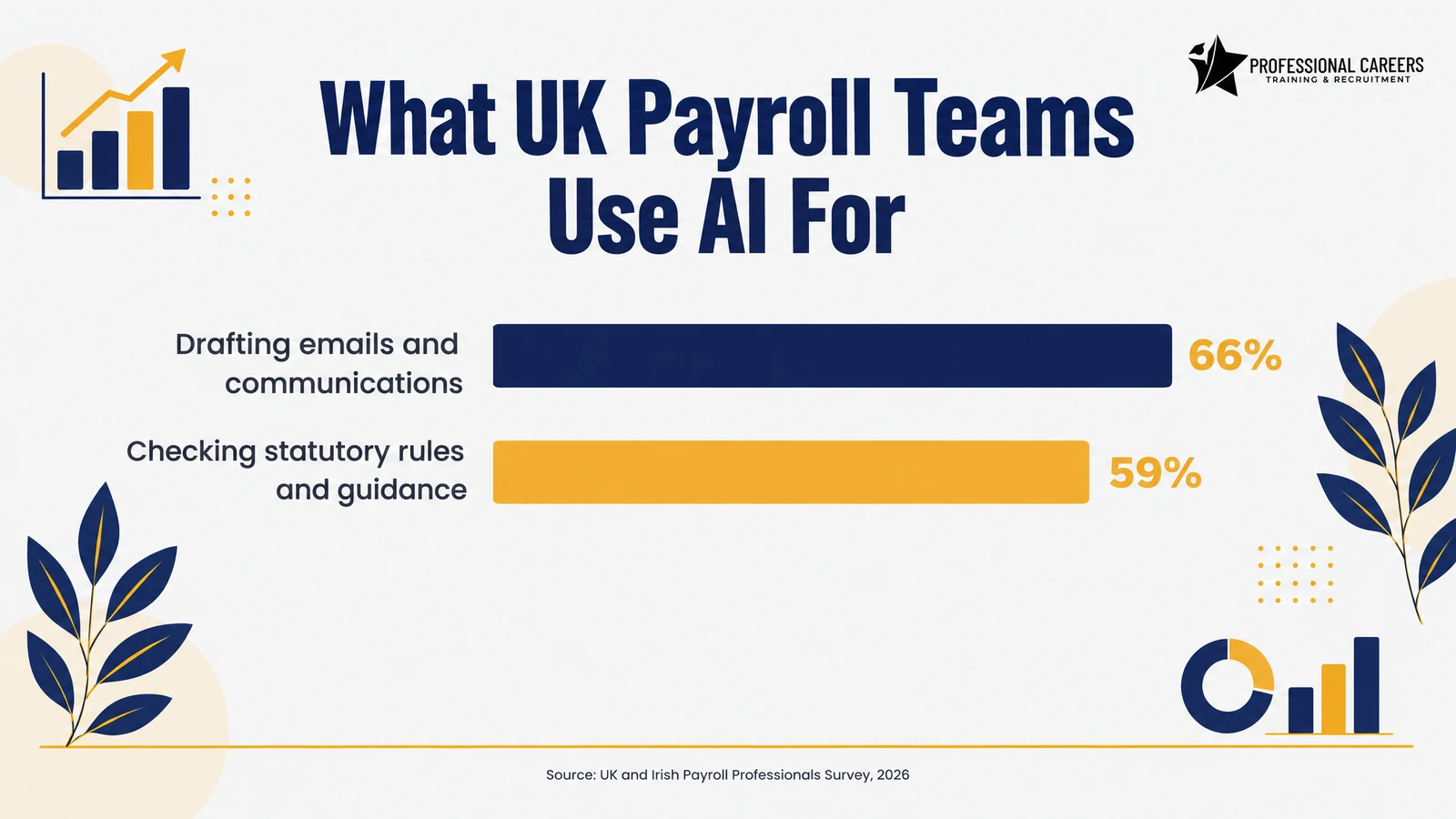
Among payroll professionals already using AI, two tasks dominate: drafting emails and communications, and checking statutory rules or revenue guidance. The tools are handling the repetitive parts of the job, not the decisions.
Drafting employee communications and queries
66% of AI users in payroll use it for drafting emails and written communications. Think a template response explaining why a deduction appeared, or a summary of a tax code change.
This saves time on wording, not on judgement. A payroll professional still decides what the email needs to say, and checks it’s accurate before it reaches an employee.
Checking statutory rules and guidance
59% use AI to help examine statutory rules or HMRC guidance. Payroll legislation changes often, covering tax bands, National Insurance thresholds, student loan rules and statutory payment rates.
An AI tool can summarise a long piece of guidance quickly, which genuinely helps. It’s a starting point for understanding, not a substitute for checking the actual rule against HMRC’s own published rates before applying it.
Spotting errors before they reach a payslip
Beyond what the survey measured directly, many modern payroll platforms now use AI-style anomaly detection. A sudden jump in hours, a missing deduction, or a tax code that doesn’t match HMRC’s notice can all trigger a flag.
Picture a weekly-paid warehouse worker whose hours jump from a normal 38 to 76 because a timesheet was entered twice. An anomaly check flags that before the payslip goes out.
Without it, the mistake only surfaces after a confused employee calls to ask why they’ve been paid double.
This doesn’t replace reconciliation. It adds a second check that catches the kind of mistake a payroll team, rushing to hit a deadline, might otherwise miss.
Right now, AI in payroll mostly handles drafting and first-pass checking. The two most common uses, by a clear margin, are communications and statutory-rule lookups, not calculating pay itself.
What AI Still Can’t Do, and Why the Human Check Stays
The same survey found real limits to how far payroll teams trust AI. 44% see it as a benefit to their routine responsibilities.
Only 44% expect it to enhance their effectiveness rather than displace skilled staff, not a majority either way. Trust in AI for payroll work is genuine, but it isn’t unconditional.
Regulatory updates (63%) and processing timelines (62%) were named as the biggest operational hurdles. Both sit well ahead of staff shortages (28%) or poor technology (17%).
AI hasn’t solved what payroll teams find hardest: keeping up with rule changes under deadline pressure. That’s worth knowing before assuming a new tool will fix it.
Payroll decisions are legal decisions
A wrong NI category, a missed student loan deduction, or an incorrect RTI submission is a compliance failure, not just an error. Someone qualified has to take responsibility for that figure, whatever software drafted it.
IR35 and other judgement calls stay human
Working out whether a contractor sits inside or outside IR35, or how to apply a court-ordered attachment of earnings correctly, involves weighing facts against rules that don’t reduce to a simple yes or no.
AI tools can surface the relevant guidance faster. They can’t take responsibility for the judgement call itself, and UK payroll law doesn’t let a business point at software when that call turns out wrong.
Data protection comes first
Payroll data includes salaries, bank details, tax codes, and sometimes health-related statutory pay information. Feeding this into a public, unvetted AI tool is a real UK GDPR risk, not a theoretical one.
Before using any AI tool on payroll data, check it’s built into your existing, approved payroll software. Confirm your employer has actually signed off on that specific use. Don’t paste employee data into a general-purpose chatbot to “check” a calculation.
What This Means for Payroll Pay in the UK
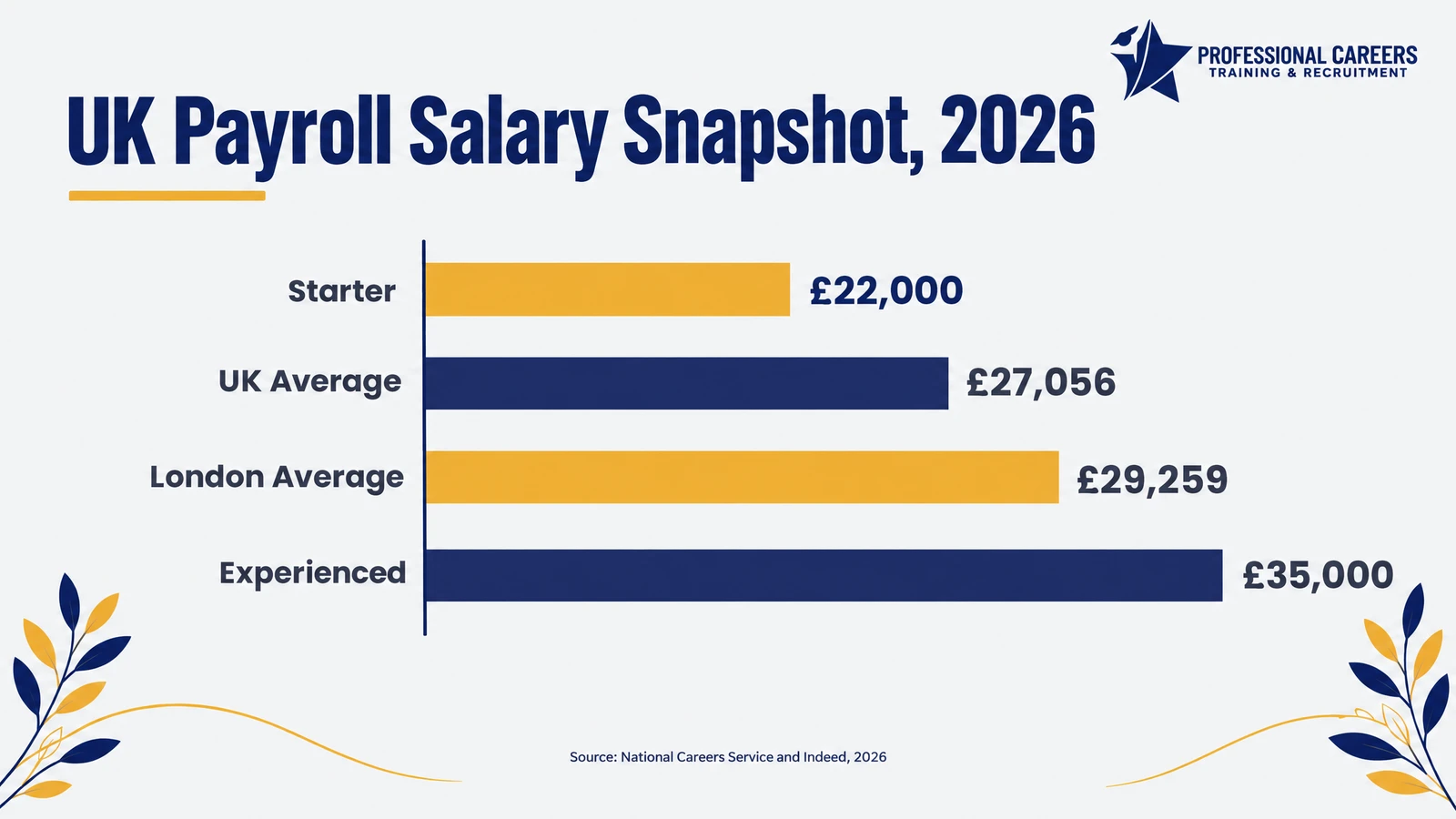
Payroll pay varies by seniority and location, but the AI-skills question doesn’t change its shape. Employers still pay more for people trusted to catch what the software misses, not less.
| Level | Typical UK Salary |
|---|---|
| Payroll Administrator, starter | £22,000 |
| Payroll Administrator, UK average | £27,056 |
| Payroll Administrator, London average | £29,259 |
| Payroll Administrator, experienced | £35,000 |
The Skills That Matter More Because of AI, Not Less
None of this makes payroll knowledge less valuable. It shifts what the knowledge is used for, from manual calculation towards checking, judgement, and explaining decisions clearly.
- PAYE and National Insurance fundamentals — you need to know what a correct figure looks like to spot an incorrect one.
- Statutory payments — sick pay, maternity and paternity pay rules, so you can sense-check an AI-drafted summary against the real rule.
- RTI reporting accuracy — understanding what HMRC actually needs from a Full Payment Submission, not just that software sends one.
- Plain-English communication — the skill AI tools are drafting around, but someone still has to check the tone and the facts.
AI is taking over drafting and first-pass checking in payroll. It isn’t taking over the judgement calls, and those are exactly the skills proper training still needs to cover.
Common Myths About AI and Payroll Jobs
A few misconceptions come up often when people consider a career in payroll. The survey data above helps answer them directly.
“AI will replace payroll jobs”
Only 18% of payroll professionals have no intention of adopting AI, largely over trust, not redundancy fears. The clearer pattern is AI changing which tasks a payroll person spends time on, not removing the role.
“You don’t need to learn the rules if the software does it”
59% of AI users rely on it to help examine statutory guidance. That means they still need enough grounding to judge whether that guidance has actually been applied correctly.
“AI tools are ready to run payroll unsupervised”
Regulatory complexity remains the single biggest hurdle UK payroll teams report, named by 63% of respondents, ahead of every other challenge including staff shortages. Current AI tools haven’t solved that problem.
“All AI payroll tools do the same thing”
They don’t. Some payroll software has mature, built-in anomaly detection. Others have bolted on a basic chatbot for FAQs and little else.
Judge an employer’s or a software provider’s AI claims by what the tool actually checks, not by whether it uses the word “AI” in its marketing.
How to Make Sure Your Payroll Skills Keep Up
70% of UK and Irish payroll professionals said they’d welcome more training on integrating AI into their roles. That appetite is a good sign, not a gap to worry about.
What good payroll training should cover now
- Get properly grounded in PAYE, National Insurance and statutory payments before leaning on any AI summary of them.
- Learn how your specific payroll software’s AI features actually work, rather than assuming every AI tool behaves the same way.
- Build the habit of checking an AI-drafted communication or summary against the primary HMRC source before it goes out.
- Treat data protection as a live, everyday decision, not a policy you read once during induction.
- Keep building the judgement skills, reconciliation, anomaly-spotting and clear explanation, that AI tools consistently can’t replace.
Where PC Training’s payroll course fits in
This is exactly the gap PC Training’s Advanced Payroll Training course is built to close. It gives you proper grounding in how payroll actually works.
That grounding comes with CPD certification and guaranteed recruitment support once you’re trained, rather than a crash course in which buttons to press on one piece of software.
70% of UK and Irish payroll professionals want more AI training, not less involvement in AI tools. The right training builds the judgement to use them well, not a reason to avoid them.
Building on the fundamentals
If you want the fundamentals this article assumes, start with our guide to PAYE and National Insurance.
Our guides to workplace pension auto-enrolment, statutory sick and parental pay, and National Minimum Wage and National Living Wage rules cover the other fundamentals AI tools get asked about most.
For the bigger picture of AI across UK finance careers, see our guide to technology for accounting.
The survey findings in this article are drawn from reporting on BrightPay’s 2026 Payroll Professionals Survey, which polled 296 UK and Irish payroll practitioners.
Will AI replace payroll jobs in the UK?
No evidence points that way yet. Most UK payroll professionals already use AI for drafting and first-pass checking, but the judgement, compliance and data-protection decisions still need a trained person.
What tasks do payroll teams actually use AI for?
Mainly drafting emails and communications, and checking statutory rules or HMRC guidance. These are the two most common uses reported by UK and Irish payroll professionals already using AI.
Is it safe to use AI tools with payroll data?
Only within tools your employer has approved for that purpose, ideally built into your existing payroll software. Payroll data includes salaries and bank details, so pasting it into a general-purpose AI chatbot is a real GDPR risk.
Do I still need to learn PAYE and National Insurance if AI can check the rules?
Yes. You need enough grounding to judge whether an AI-drafted summary of the rules is actually correct, not just to use the summary at face value.
What should payroll training cover now that AI tools are common?
The statutory fundamentals (PAYE, NI, statutory payments, RTI), plus how to check AI-drafted output against HMRC’s own guidance, and when payroll data can and can’t be put into an AI tool.