
If you have ever looked at a payslip and wondered how the numbers were worked out, you are not alone. Payroll touches almost everyone who...
If you have ever looked at a payslip and wondered how the numbers were worked out, you are not alone. Payroll touches almost everyone who has had a job in the UK.
Yet most people only see the finished result: a net figure landing in their bank account each month. Behind that figure sits a process with its own calendar and its own legal requirements.
This guide is for anyone starting from zero. That might be a small business owner about to pay their first member of staff, or someone weighing up a career in payroll.
It walks through what payroll actually involves, step by step, without assuming you already know the jargon. By the end, the terms on your own payslip should make a lot more sense.
Payroll is not just about income tax and National Insurance either. Statutory payments like sick pay and parental pay run through the same system, and a beginner needs to know these exist first.
What Is Payroll, Exactly?
Payroll is the process of calculating and paying employees correctly, then reporting those payments to HMRC. It covers gross pay, the right deductions, and the net figure an employee actually receives.
PAYE, which stands for Pay As You Earn, is the system HMRC uses to collect tax and National Insurance through payroll. It exists so employees do not have to settle their own tax bill each year.
Running payroll means running PAYE correctly, every single pay period, for every person on the books. There is no “quiet month” where the rules relax.
Payroll is not just “paying people.” It is a recurring legal process with deadlines, and the employer, not the employee, carries the responsibility if it goes wrong.
The Payroll Cycle: How It Actually Works
Pay Reference Periods
Every employee is paid against a set pay reference period, most commonly monthly or weekly. Monthly is often the last working day of the month.
The period you choose shapes almost everything else. It affects when tax and National Insurance thresholds apply, when reports are due, and when statutory payments need calculating.
Most UK businesses run monthly payroll for salaried staff, since it is simpler to administer. Weekly or four-weekly cycles are still common in sectors with hourly or shift-based pay.
From Gross Pay to Net Pay
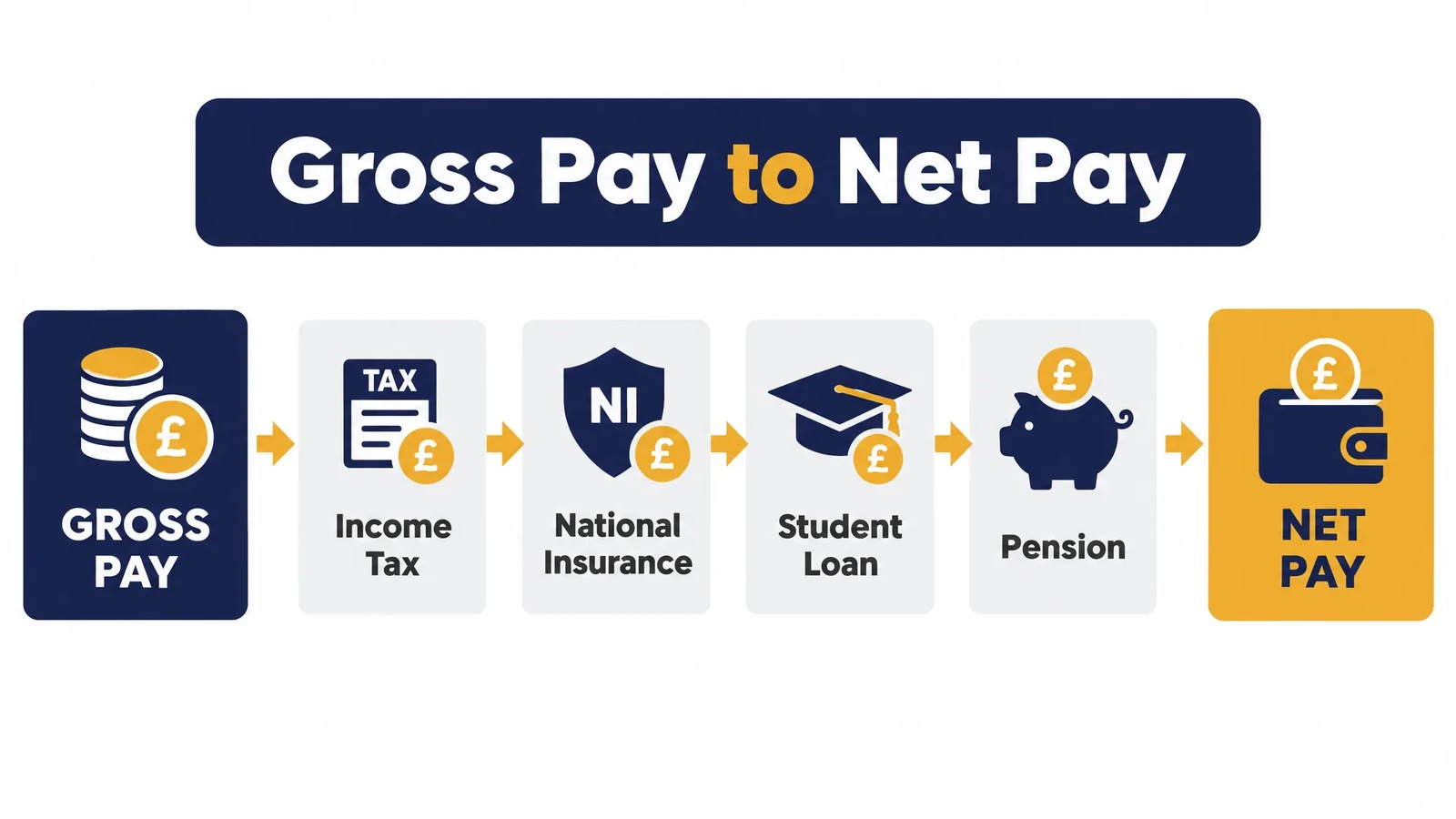
Once a pay period ends, the calculation runs in a fixed order. Gross pay comes first: basic salary or hours worked, plus any overtime, bonuses, or commission.
From there, deductions are applied one by one until you reach the net figure that actually gets paid. Each deduction has its own rules for what counts as earnings.
Income tax is calculated using the employee’s tax code against that year’s bands, starting with the £12,570 tax-free Personal Allowance. National Insurance is calculated separately, using its own threshold.
Employees pay 8% National Insurance on earnings between £242 and £967 a week, and 2% above that. Student loan repayments and pension contributions follow a similar pattern, each with their own earnings definition.
What Must Legally Appear on a Payslip
Employees have a legal right to a written or electronic payslip on or before payday. It has to show specific information, not just a final total.
Acas’s payslip guidance sets out exactly what belongs on it. Getting this wrong is one of the quickest ways a new payroll setup falls foul of basic employment law.
- Gross pay for the period, before any deductions.
- Net pay, the amount actually paid.
- Variable deductions itemised separately, such as tax, National Insurance, student loan repayments, and pension contributions.
- Fixed deductions, which can either be itemised each time or covered by a separate standing statement issued at least once a year.
- Hours worked, where pay varies according to time worked (for example, hourly or shift-based staff).
- Payment method breakdown, if pay is split across more than one method.
A payslip that only shows a lump net figure, with no breakdown, does not meet these requirements. This is one of the first things a new payroll administrator learns to check.
A payslip is a legal document, not just a courtesy. Every figure on it has to be traceable back to a specific calculation.
Registering as an Employer and Setting Up PAYE
Before anyone can be paid through payroll, the business itself has to register as an employer with HMRC. This step is often underestimated by first-time employers.
When to Register
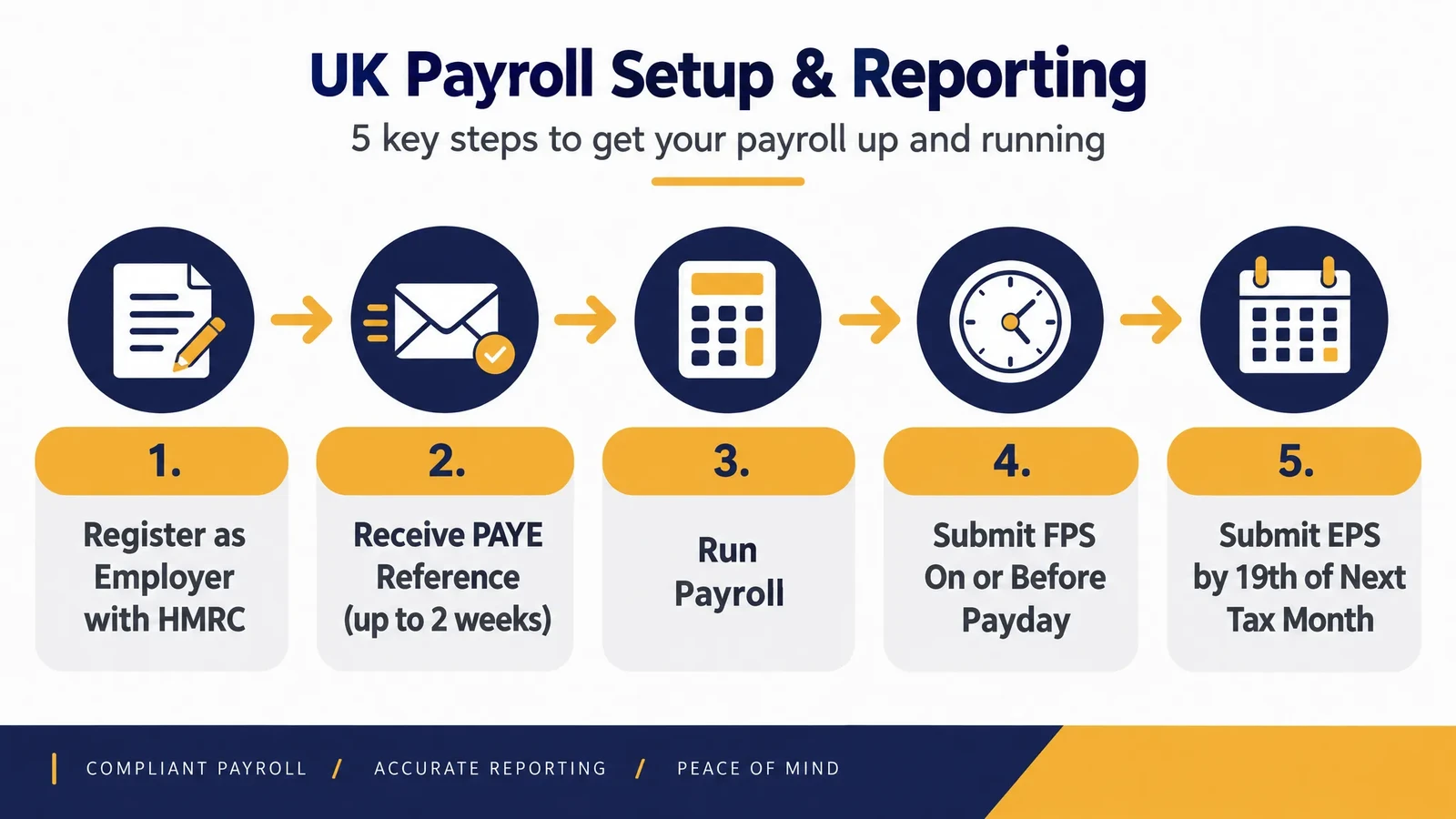
- Register as an employer with HMRC before your first payday. You cannot register more than two months before you start paying staff, so timing matters.
- HMRC issues a PAYE reference number once registration is processed, which can take up to two weeks to arrive.
- If you need to pay someone before the reference arrives, run payroll as normal and keep the records. The submission is sent on as soon as the reference comes through.
- This requirement applies even to a company with a single director and no other staff, which often surprises first-time business owners.
Once registered, the employer is responsible for running PAYE correctly every pay period. That obligation lasts for as long as they have staff, not just during the initial setup.
RTI Reporting: FPS and EPS Explained
Real Time Information, or RTI, is how HMRC finds out what has actually been paid and deducted, as it happens. Two submission types sit at the centre of this.
| Submission | What it reports | When it is due |
|---|---|---|
| Full Payment Submission (FPS) | Pay and deductions for everyone paid in that period | On or before each payday |
| Employer Payment Summary (EPS) | Adjustments such as statutory pay recovery, or confirming no one was paid in a tax month | By the 19th of the following tax month |
Tax months run from the 6th of one calendar month to the 5th of the next. This catches a lot of beginners out when they are working out EPS deadlines.
Full detail on both submissions, including how corrections work, is set out on gov.uk’s own running payroll guidance.
Missing an FPS deadline can trigger a late filing penalty, even if the actual pay was correct. This is a genuinely high-stakes part of the process to get right from day one.
RTI turns payroll into a rolling reporting obligation, not a once-a-year job. Every pay period has its own deadline attached.
The Key 2026/27 Figures Every Payroll Beginner Should Know
Payroll figures change every tax year, so working from out-of-date numbers is a common and avoidable mistake. These are the core figures for the current 2026/27 tax year.
| Figure | Amount | Applies to |
|---|---|---|
| Personal Allowance | £12,570 a year | Tax-free income before Income Tax applies |
| Employee NI threshold | £242 a week (£1,048 a month) | 8% employee NI applies above this, up to £967 a week |
| Employer NI threshold | £96 a week (around £5,000 a year) | 15% employer NI applies above this |
| Employment Allowance | Up to £10,500 a year | Reduces an eligible employer’s National Insurance bill |
| National Living Wage (21+) | £12.71 an hour | Minimum hourly rate from 1 April 2026 |
Minimum wage compliance sits alongside payroll rather than inside it, but the two are closely linked. Paying someone below the correct rate for their age band is a payroll error with serious consequences.
Our National Minimum Wage and National Living Wage guide covers every age band and the common ways employers get this wrong.
These figures only tell part of the story. A competent payroll administrator also needs to know which rules apply to which employee, since tax codes and NI categories vary from one payslip to the next.
Where Workplace Pensions Fit Into Payroll
Auto-Enrolment Basics
Most UK employees must be automatically enrolled into a workplace pension once they meet certain age and earnings criteria. Payroll is where that duty actually gets carried out.
The minimum total contribution is 8% of qualifying earnings. At least 3% of that comes from the employer, with the rest from the employee.
Payroll software typically assesses each employee automatically every pay period. It flags anyone who newly qualifies and calculates the correct contribution alongside tax and National Insurance.
Getting a new starter’s assessment wrong, or missing a scheduled re-enrolment date, is one of the more common compliance gaps in a first payroll setup. Our workplace pension auto-enrolment guide covers the thresholds and exemptions in full.
Common Payroll Software Used by UK Businesses
Very few UK businesses run payroll on paper, or in a plain spreadsheet, once they have more than a handful of staff. Dedicated software handles the calculations and RTI submissions automatically.
- Xero and QuickBooks, both widely used for small business accounting with payroll modules built in.
- Sage, long established in UK payroll and still common in larger small and medium-sized businesses.
- BrightPay and Moneysoft, dedicated payroll packages often used by bookkeepers and accountants running payroll for several clients at once.
Software does not remove the need to understand what it is doing. An administrator who does not understand tax codes or NI categories can still enter the wrong information.
The result is a confidently wrong payslip that looks correct on screen. Software speeds up the process; it does not replace the knowledge behind it.
Common Mistakes People Make When They Are New to Payroll
- Missing an FPS deadline, even by a day, which can trigger an automatic HMRC penalty.
- Applying the wrong tax code, often by not updating it after a change like a second job or an HMRC tax code notice.
- Misclassifying workers as self-employed when they should legally be treated as employees for tax and NI purposes.
- Missing auto-enrolment duties, including assessing new starters correctly and re-enrolling eligible staff on time.
- Poor record-keeping, since payroll records generally need to be kept for several years and HMRC can ask to see them.
None of these mistakes are unusual for someone new to the role. They are also exactly the kind of thing structured, practical training is built to prevent.
Most payroll mistakes are not caused by carelessness. They happen because nobody has sat down and explained how the pieces connect.
Building a Career in Payroll
Payroll is one of the more stable, in-demand parts of UK finance. Every employer, in every sector, needs it done correctly, which keeps demand for the skill steady.
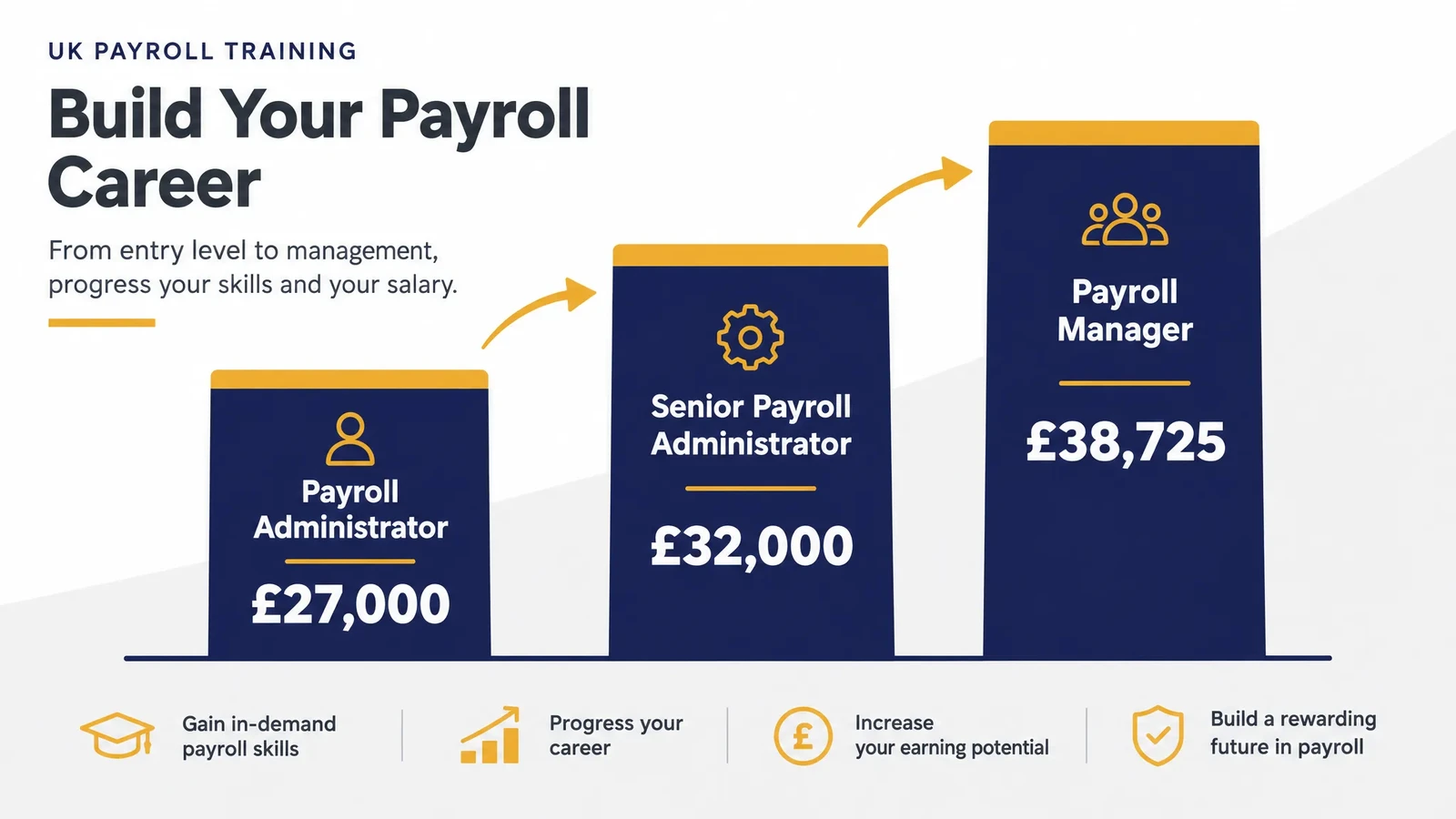
According to Indeed, the average payroll administrator salary in the UK sits at around £27,000 a year, with London roles averaging closer to £29,000.
The National Careers Service puts the realistic range wider still, from around £22,000 starting out to £35,000 or more with experience.
Progression tends to follow a clear path: payroll administrator (around £27,000), then senior payroll administrator or payroll officer (around £32,000), then payroll manager (averaging £38,725, per PayScale). Each step brings more compliance responsibility, not just more transactions to process.
Structured training closes the gap between knowing payroll theory and being able to run it under real deadlines. Our Advanced Payroll Training course is built for exactly that.
It is practical, mentor-led learning covering PAYE, RTI, auto-enrolment, and statutory payments in depth, with CPD certification and guaranteed job placement support once you finish. It is the natural next step once the basics in this guide make sense.
If you want to go deeper on the tax and National Insurance mechanics specifically, our guide to PAYE and National Insurance explained covers the bands, rates, and tax codes in more detail than this introduction does.
Frequently Asked Questions
Do I need special software to run payroll?
You do not legally need software, but almost every UK business uses it once they have more than one or two employees. HMRC does offer free basic PAYE tools for very small employers, but dedicated software like Xero, Sage, or BrightPay handles RTI submissions and tax code changes automatically, which reduces the risk of error.
How often does payroll need to run?
That depends on the pay reference period you set, most commonly monthly or weekly. Whatever period you choose, it needs an FPS submission on or before every single payday, so the frequency of your payroll cycle directly sets your reporting workload.
What happens if I make a mistake on payroll?
Minor errors can usually be corrected in the next FPS submission, but missed deadlines or persistent errors can lead to HMRC penalties. Keeping clear records and understanding the rules from the start, rather than fixing problems after the fact, is far cheaper in both time and money.
Can a one-person limited company skip registering for PAYE?
No. Even a sole director paying themselves a salary through their own limited company has to register as an employer and run PAYE correctly, in exactly the same way as a business with dozens of staff.
Is payroll a good career to move into?
Yes, for people who like process-driven, detail-focused work with genuine job security. Every employer needs payroll run correctly, which keeps demand steady, and there is a clear progression path from administrator through to payroll manager as experience builds.