The Chancellor delivered the Autumn Budget on 28 October 2026. For anyone working in or training for UK payroll or bookkeeping, it is a Budget...
The Chancellor delivered the Autumn Budget on 28 October 2026. For anyone working in or training for UK payroll or bookkeeping, it is a Budget with a lot of small print.
There is no headline tax rise. No shock to income tax rates, and no change to employer National Insurance. What it does contain is a long list of threshold freezes, rate rises and new effective dates.
These will land on payroll desks across the country between now and 2029. This guide pulls together everything that actually affects how payroll is run and how bookkeepers prepare accounts, with the real effective dates attached.
What actually changed, at a glance
Before the detail, here is the full list of payroll-relevant Budget 2026 measures in one place. Each comes with when it actually takes effect, since several dates are easy to mix up.
| Change | Effective date | What’s happening |
|---|---|---|
| Income tax and NI thresholds | Frozen through 2030/31 | No change for 2027/28 — fiscal drag continues |
| National Minimum/Living Wage | From April 2027 | Rises 3.9% across every age band |
| Employer National Insurance | No change | Stays at 15% above the £5,000 secondary threshold |
| Mileage allowance (first 10,000 miles) | Already in force, made permanent | 55p a mile confirmed as a lasting rate |
| Mileage allowance (above 10,000 miles) | From 6 April 2027 | Rises from 25p to 35p a mile |
| Salary sacrifice pension cap | From 6 April 2029 | NI exemption capped at the first £2,000 a year |
| Mandatory payrolling of benefits in kind | From 6 April 2027 | Cars, fuel, vans and medical/dental benefits move through payroll in real time |
| Pensioner income tax allowance | 6 April 2027 to 5 April 2030 | New relief for pensioners on low incomes |
Nothing in this Budget changes payroll mechanics overnight. The real story is a cluster of changes landing in April 2027, with a second wave in 2029.
Income tax and National Insurance thresholds: still frozen
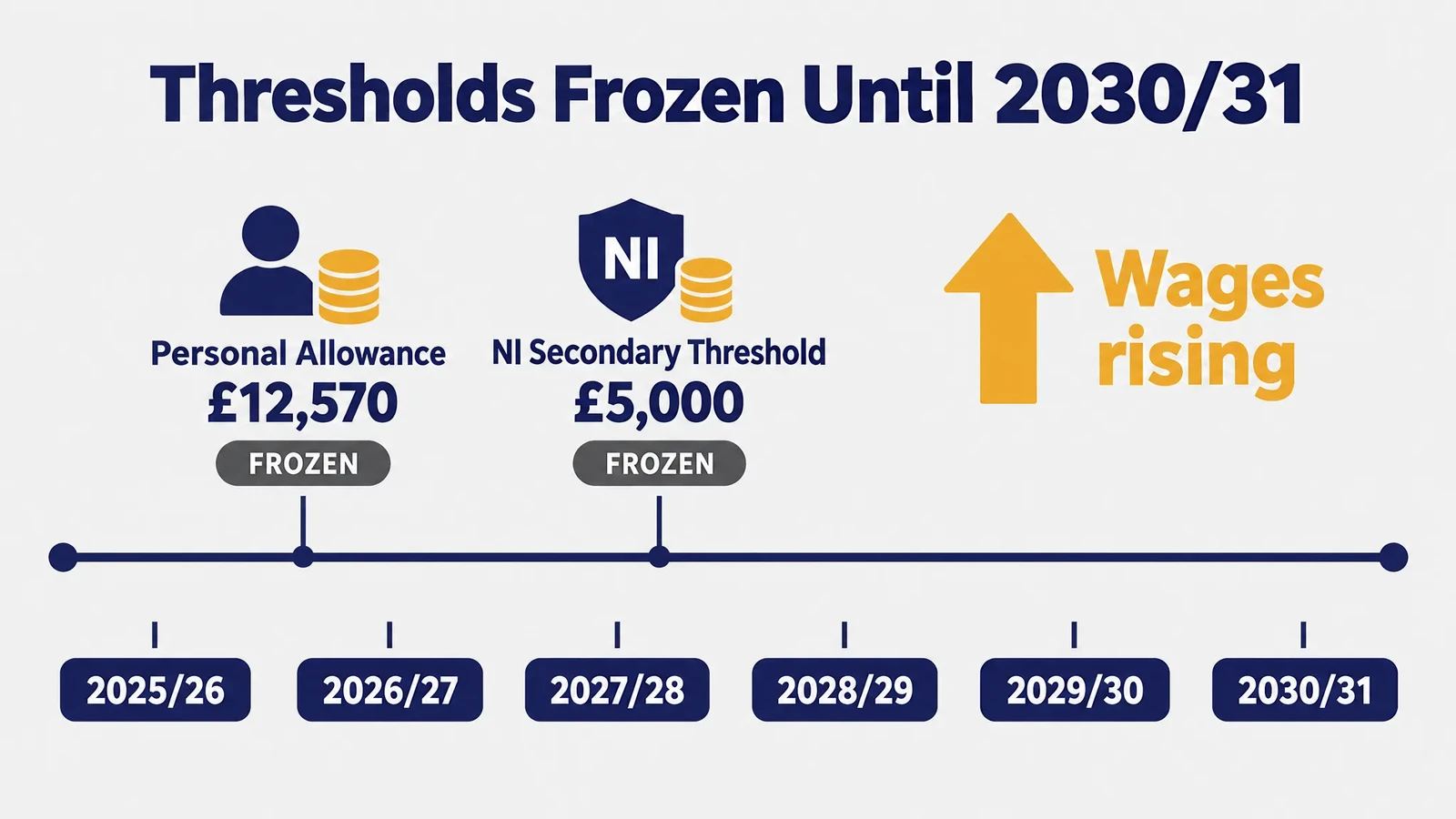
The Personal Allowance stays at £12,570. The basic rate band stays at up to £37,700, taking the higher rate threshold to £37,701–£125,140 for 2027/28. The additional rate still starts above £125,140.
None of these figures have moved. None are due to move before the end of 2030/31.
The same freeze applies to National Insurance. The employee Primary Threshold stays at £12,570, the Upper Earnings Limit at £50,270, and the employer Secondary Threshold at £5,000.
The Lower Earnings Limit rises slightly to £133 a week (£6,916 a year) for 2027/28. The Small Profits Threshold for the self-employed rises to £7,355 a year. Both are standard CPI uprating, not a policy change.
Why a frozen threshold still matters for payroll
A frozen threshold sounds like no change, but it is not neutral. Wages rise each year through ordinary pay increases, so more pay sits above a threshold that has not moved.
This effect is called fiscal drag, and it is now continuing into its sixth consecutive year. More of each employee’s pay becomes taxable or NI-liable than the year before.
For a payroll professional, tax codes and NI category letters will not look dramatically different from April 2027. What changes, quietly, is how many employees cross a threshold for the first time, simply because their pay has grown.
For a bookkeeper preparing year-end figures, the freeze is one small mercy. PAYE and NI liabilities calculated against static bands stay predictable to model, which is rare in an otherwise complicated Budget.
Our guide to PAYE and National Insurance breaks down how these thresholds interact with tax codes, if you need the fundamentals refreshed.
National Minimum Wage and National Living Wage: another real rise
The Low Pay Commission’s recommendations were accepted in full. Every National Minimum Wage and National Living Wage rate rises by 3.9% from April 2027.
This is the headline employee-facing announcement in the whole Budget. It affects an estimated 2.3 million workers directly.
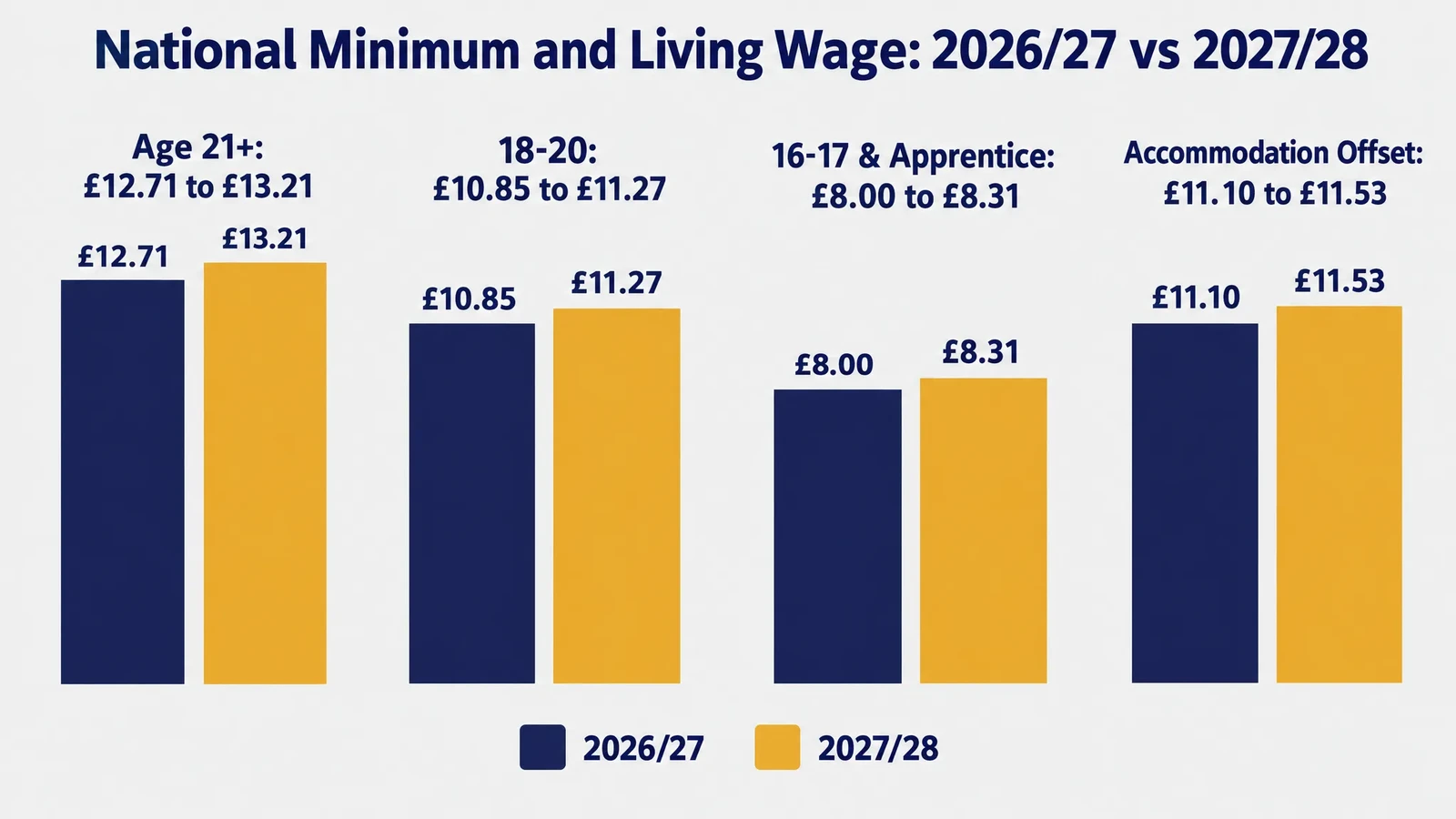
| Rate | Current (2026/27) | From April 2027 | Increase |
|---|---|---|---|
| National Living Wage (21 and over) | £12.71 | £13.21 | +50p (3.9%) |
| 18 to 20 Year Old Rate | £10.85 | £11.27 | +42p (3.9%) |
| 16 to 17 Year Old Rate | £8.00 | £8.31 | +31p (3.9%) |
| Apprentice Rate | £8.00 | £8.31 | +31p (3.9%) |
| Accommodation Offset | £11.10 | £11.53 | +43p (3.9%) |
For the full picture of how these rates work, including who qualifies for which band, our National Minimum Wage and National Living Wage guide covers it in depth. This Budget simply confirms the next uprating on the same structure.
Every rise needs to be in place from the first pay run after 1 April 2027, not phased in gradually. It is exactly the kind of deadline-driven update that makes payroll software testing a genuine, ongoing skill.
A Minimum Wage rise is not a one-line software update. It needs testing against every pay rate, every age band and every accommodation deduction before the first April pay run goes out.
Mileage allowances: a permanent change and a fresh rise
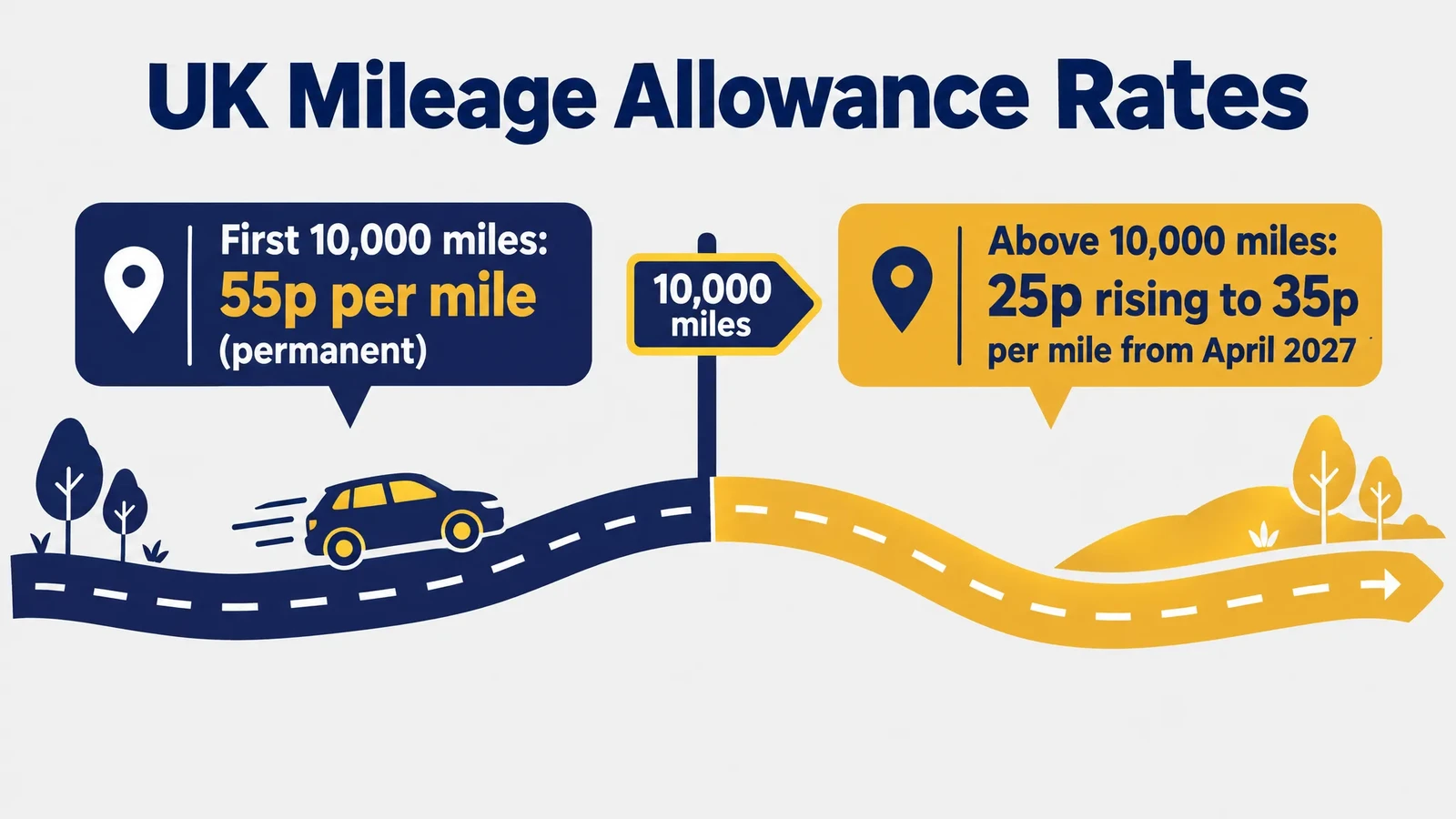
One of the more practically useful changes concerns mileage. The Approved Mileage Allowance Payment rate for the first 10,000 business miles had stood at 45p a mile for fifteen years.
It rose to 55p a mile earlier in 2026, backdated to 6 April 2026. This Budget confirms that 55p rate as permanent, rather than a temporary adjustment.
The rate for miles driven above that 10,000-mile threshold is also rising, from 25p to 35p a mile. That change does not start until 6 April 2027.
Employers reimbursing mileage, or processing claims through payroll, need both figures correct. The two rates now take effect on different timelines, so the dates are easy to mix up.
- 55p a mile for the first 10,000 business miles — already in force since 6 April 2026, now made permanent rather than temporary.
- 35p a mile for business miles above 10,000 in the same tax year — not in force yet, starting 6 April 2027.
- Rates apply equally to cars and vans; motorcycle and bicycle mileage rates are unaffected by this Budget.
Two mileage rates with two different start dates is an easy detail to get wrong on a spreadsheet. Build both dates into payroll or expenses software now.
Pension salary sacrifice: a new cap from 2029
Salary sacrifice pension arrangements let an employee give up part of their salary for a higher employer pension contribution. This usually saves both employer and employee National Insurance on the sacrificed amount.
From 6 April 2029, that NI exemption will be capped at the first £2,000 sacrificed each year. Anything above that stays NI-exempt no longer.
The sacrificed amount above £2,000 still goes into the pension as normal. Only the NI treatment changes, and only above the cap.
Ordinary employer pension contributions, made without any salary sacrifice arrangement, are not affected by this change at all.
Why 2029, not 2027
The salary sacrifice cap has a longer lead time than most of this Budget’s measures. Employers get roughly two and a half years to review existing arrangements.
HMRC has acknowledged it has not yet fully clarified how the cap interacts with relief-at-source pension schemes or existing contracts. More detailed guidance is expected before 2029.
Our guide to workplace pension auto-enrolment is a useful companion read if pensions administration is new to you.
Mandatory payrolling of benefits in kind from April 2027
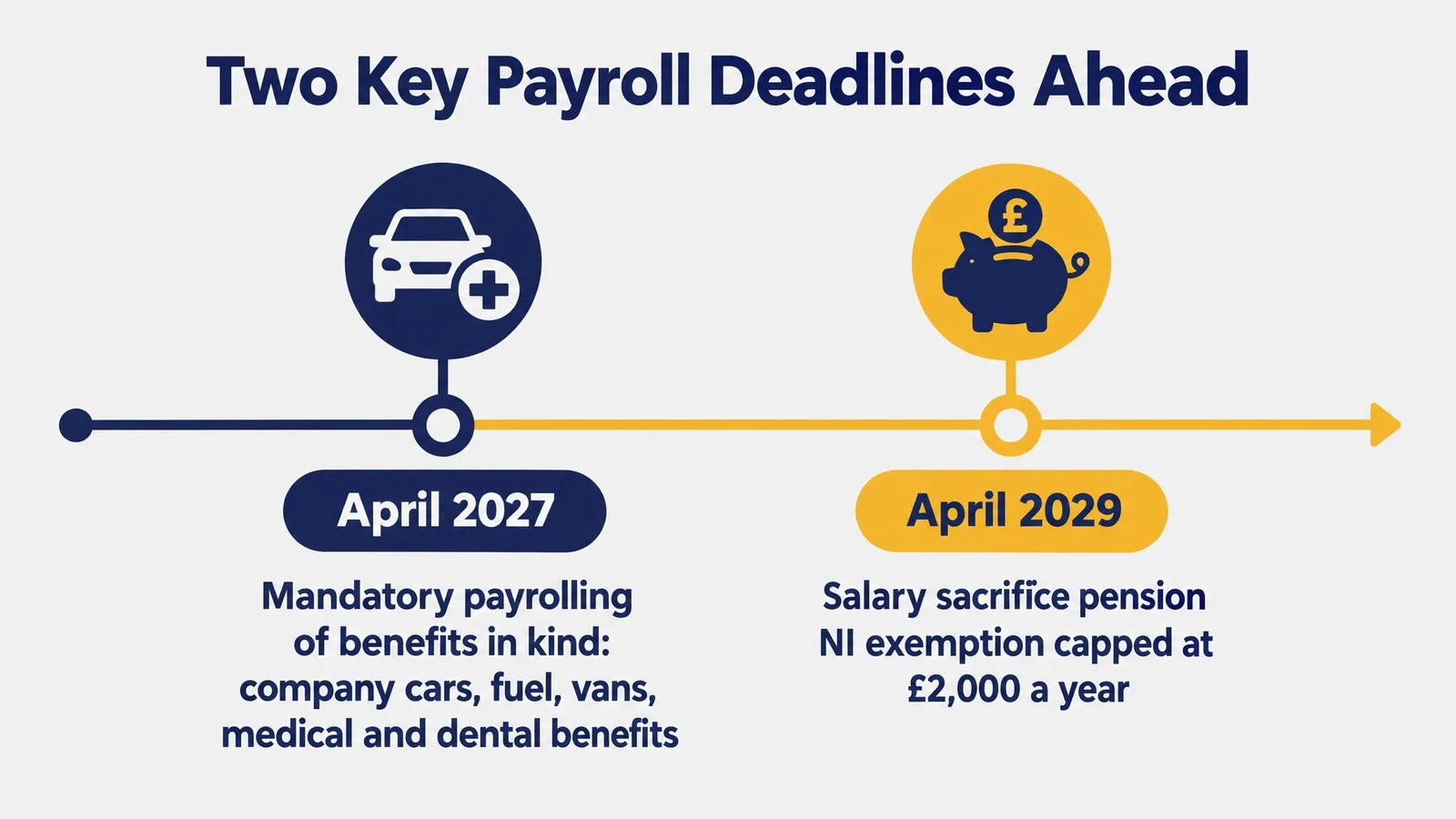
From 6 April 2027, payrolling becomes mandatory, not optional, for a defined set of benefits in kind. That set covers company cars, car fuel, vans, van fuel, and medical and dental benefits.
Instead of reporting these on a P11D after the tax year ends, employers calculate the taxable value and deduct tax through payroll in real time. This happens pay period by pay period, not retrospectively.
This is a genuine process change for any payroll team that has relied on year-end P11D reporting. Benefit values need to be known and loaded into payroll software before the tax year starts.
Van and fuel benefit charge figures for 2027/28 have also been confirmed alongside this change. Employers should check their own payroll software provider for the exact scale figures once published.
For anyone training in payroll, this is worth understanding now rather than in 2027. What Is Payroll? covers how real time reporting already works through RTI — the same underlying mechanism this change now extends to benefits in kind.
P11D reporting gave payroll teams a full year to find and fix mistakes. Real-time payrolling of benefits removes that buffer, which makes accurate benefit values matter from day one.
A handful of smaller announcements worth knowing
Several further measures from the Budget are less likely to affect day-to-day payroll processing. They are still worth having on your radar, particularly if you are asked about them at work or in an interview.
- A new income tax allowance applies from 6 April 2027 to 5 April 2030 for pensioners whose total income does not exceed the full new State Pension, tapered away gradually for those just above that level.
- Eligible self-employed parents and adopters in Great Britain will get access to parental pay for the first time, starting from April 2029.
- Non-compete clauses in employment contracts are being reformed, though the detail of the new rules has not yet been published in full.
- The Union Learning Fund is being re-established in England, backed by £15 million a year in funding from 2027/28.
- Travel and subsistence expense rates are due to be modernised from April 2028, with further detail expected closer to that date.
None of these require action today. A trainee or junior payroll professional who can speak to them confidently stands out as someone who follows the profession properly, not just someone who processes numbers.
What this means if you are training for a payroll or bookkeeping career
A Budget like this one is a reminder that payroll and bookkeeping are not static skills you learn once. Thresholds, rates and reporting obligations shift every year.
Sometimes there are years of lead time. Sometimes there are only months. Staying current is part of the job, not an occasional inconvenience.
Why this is a practical skill, not just theory
If you are weighing up a move into payroll, understanding how a Budget ripples through real payslips, P11Ds and RTI submissions is a genuinely practical skill. Employers value it.
The same applies to bookkeeping. Frozen thresholds and new mandatory reporting requirements directly affect how year-end accounts and tax liabilities get prepared for clients.
Employers do not need someone who read one Budget headline. They need someone who can trace a Budget change through to the correct line on a payslip or a set of accounts.
Our Advanced Payroll Training course and Bookkeeping & VAT Training course both build this kind of current, practical knowledge in from day one. Both come with guaranteed recruitment support once you qualify.
When do the Autumn Budget 2026 payroll changes actually take effect?
Most take effect from 6 April 2027, including the National Minimum Wage rise, the higher mileage rate above 10,000 miles, and mandatory payrolling of benefits in kind. The salary sacrifice pension cap does not start until 6 April 2029.
Did employer National Insurance go up in this Budget?
No. Employer National Insurance stays at 15% on earnings above the £5,000 secondary threshold, unchanged from the rate introduced in April 2025. This Budget made no change to it either way.
What is the new National Living Wage rate from April 2027?
£13.21 an hour for workers aged 21 and over, a 3.9% rise on the current £12.71 rate. Every other age band and the accommodation offset rise by the same 3.9%.
Is the 55p mileage rate from this Budget or an earlier change?
The 55p rate for the first 10,000 business miles was introduced earlier in 2026, backdated to 6 April 2026. This Budget confirms it as a permanent rate rather than a temporary one.
Does the salary sacrifice pension cap affect all employer pension contributions?
No. It only affects contributions made through salary sacrifice above £2,000 a year, from 6 April 2029. Ordinary employer pension contributions made outside a salary sacrifice arrangement are not affected.
What is mandatory payrolling of benefits in kind?
From 6 April 2027, employers must deduct tax on company cars, car fuel, vans, van fuel, and medical and dental benefits through payroll in real time, rather than reporting them on a P11D after the tax year ends.