If you work in construction, or you're training to handle the books for a building business, you've probably come across the VAT domestic reverse charge....
If you work in construction, or you’re training to handle the books for a building business, you’ve probably come across the VAT domestic reverse charge. It changed how VAT is invoiced across the construction supply chain.
It still trips people up five years after it started. This guide explains what the reverse charge is, who it applies to, and how it changes an invoice.
It also covers the two VAT schemes it clashes with, the cash flow problem it creates for subcontractors, and the mistakes that cause the most grief with HMRC.
What is the VAT domestic reverse charge?
The VAT domestic reverse charge for building and construction services is an anti-fraud rule. Instead of the supplier charging VAT and the customer paying it over, the customer accounts for the VAT directly to HMRC on their own return.
HMRC brought the rule in to stop a specific type of fraud running through construction supply chains, sometimes called missing trader fraud.
A business would charge VAT on labour, collect it from the customer, and then disappear before paying it to HMRC.
HMRC has put the scale of this fraud at over £100 million a year before the reverse charge was introduced.
The reverse charge closes that gap by removing cash from the equation. If the supplier never collects the VAT, there’s nothing for them to run off with.
The customer declares the VAT instead, as both a sale and a purchase on the same return. The money never physically changes hands between the two businesses.
The rule has applied to specified construction services since 1 March 2021, after two delays from an original 2019 start date.
It’s still fully in force for the 2026/27 tax year. HMRC’s own guidance (VAT Notice 735) was last updated in March 2026, with no sign of it being withdrawn.
The reverse charge doesn’t change how much VAT is due. It changes who tells HMRC about it, moving that job from supplier to customer.
The aim is to stop VAT ever sitting with a business that might vanish before paying it over.
Who the reverse charge applies to
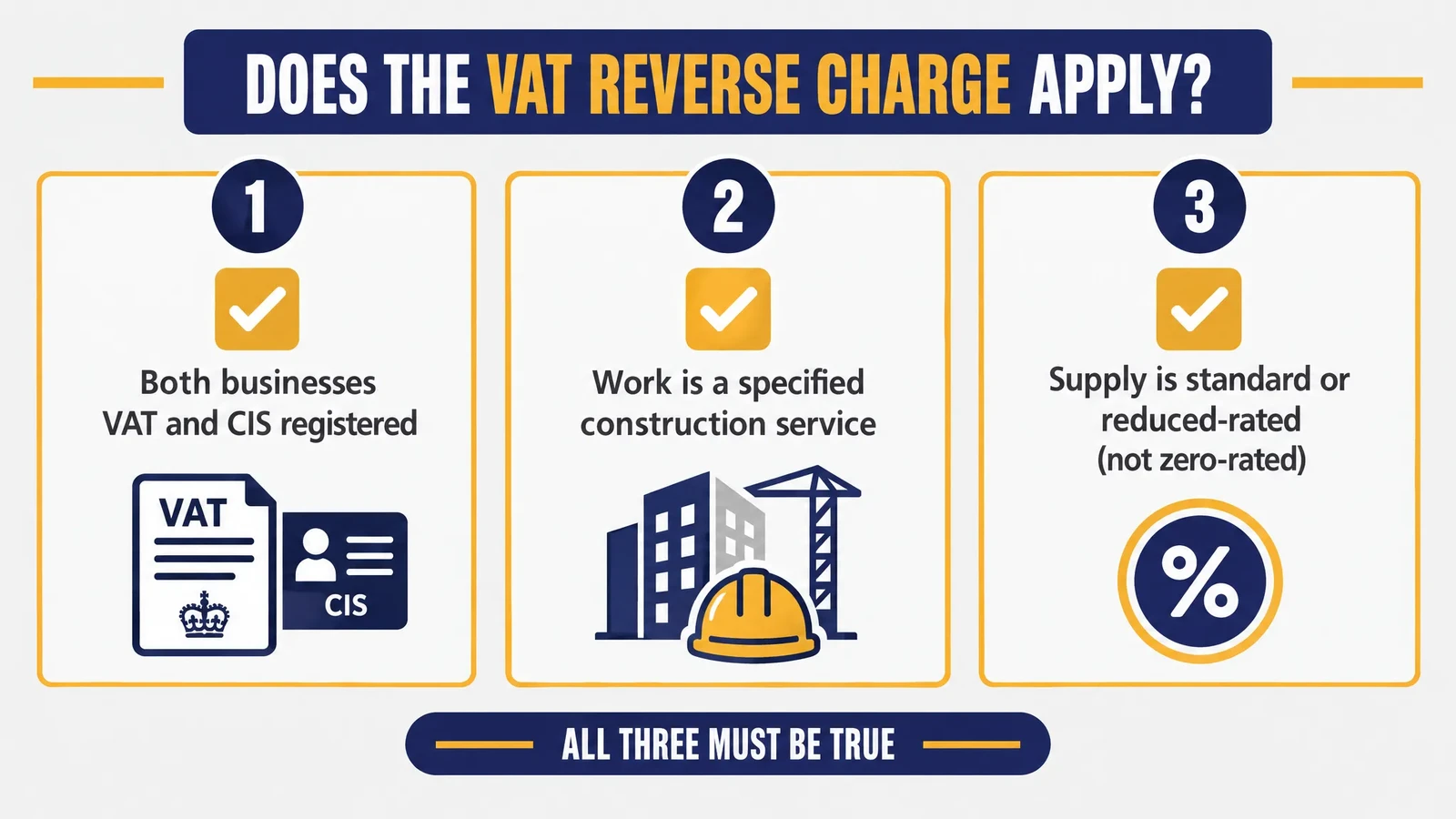
Three conditions all need to be true before the reverse charge kicks in on a sale. Get any one of them wrong and you’ll either charge VAT when you shouldn’t, or leave it off when you should have charged it.
1. Both businesses must be VAT and CIS registered
The reverse charge only applies between two businesses that are both VAT-registered and both report payments under the Construction Industry Scheme (CIS).
If your customer isn’t VAT-registered, check your VAT registration obligations before invoicing, since you’d charge VAT normally in that case.
2. The work must be a “specified service”
Specified services cover most hands-on building and civil engineering work: constructing, altering, repairing, extending, or demolishing buildings and structures, plus related site work like excavation, scaffolding, and landscaping.
Installing heating, power, drainage, water, fire protection, and internal cleaning during a build or refurb are also included.
A short but important list of services is excluded even though they sit close to construction work. These don’t trigger the reverse charge, so get flagged separately on an invoice as normal, VAT-charged sales.
- Professional and consultancy work by architects, surveyors, and engineers
- Manufacturing or delivering materials, components, plant, or machinery, where there’s no installation work attached
- Drilling for or extracting oil, gas, or minerals, or tunnelling purely for that purpose
- Installing security systems such as alarms, CCTV, or access control
- Making or installing signboards and artistic works like murals or sculptures
- Supplying staff or workers through an employment business, rather than supplying the construction work itself
3. The supply must be standard or reduced-rated
The reverse charge doesn’t apply to zero-rated work, such as some new residential construction. If the whole supply is zero-rated, you invoice it as zero-rated VAT in the normal way, not under the reverse charge.
All three conditions have to be met together: VAT and CIS registration on both sides, a genuinely specified construction service, and a standard or reduced VAT rate. Miss one and the reverse charge doesn’t apply.
The end user and intermediary supplier exclusion
There’s one more exception that catches people out: the end user rule. An “end user” is a VAT and CIS-registered business that receives construction services for its own use, rather than to sell on as part of a bigger supply.
A property developer building offices for its own staff, for example, is an end user for that work.
An “intermediary supplier” is similar: a business that buys in construction services and resupplies them to a connected end user, such as a landlord passing building work through to a linked tenant company, without materially changing what was supplied.
Both end users and intermediary suppliers can opt out of the reverse charge, but only if they tell their supplier in writing. Without that notification, the supplier has no way of knowing the exclusion applies.
The supplier must then treat the sale as a normal reverse charge supply.
How to give the end user notification
HMRC doesn’t require a specific form. A simple written statement in a letter, email, or the contract itself is enough. HMRC’s suggested wording is:
“We are an end user for the purposes of section 55A VAT Act 1994 reverse charge for building and construction services.” HMRC sets this out in full in its guidance on when you must use the reverse charge.
If a customer fails to give this notification correctly, and the supplier reasonably treats the sale as a reverse charge supply, the customer stays responsible for the VAT that should have been charged normally.
Get this in writing before the first invoice, not after a dispute starts.
How invoicing changes under the reverse charge
This is the part that causes the most confusion in practice, because the paperwork looks unfamiliar even once you understand the rule. Under the reverse charge, the supplier doesn’t charge or collect any VAT at all.
Instead, the invoice must clearly state that the reverse charge applies, show the VAT rate, and show the amount of VAT due under the reverse charge (or at least the rate, if the amount genuinely can’t be shown).
HMRC accepts wording such as “VAT Act 1994 Section 55A applies,” “S55A VATA 94 applies,” or plainly “Customer to pay the VAT to HMRC.”
A worked invoice example
Here’s how a straightforward invoice changes once the reverse charge applies, using a £10,000 job charged at the standard 20% rate.
If you need a refresher on how VAT normally gets totted up and filed, see our guide to completing a VAT return first.
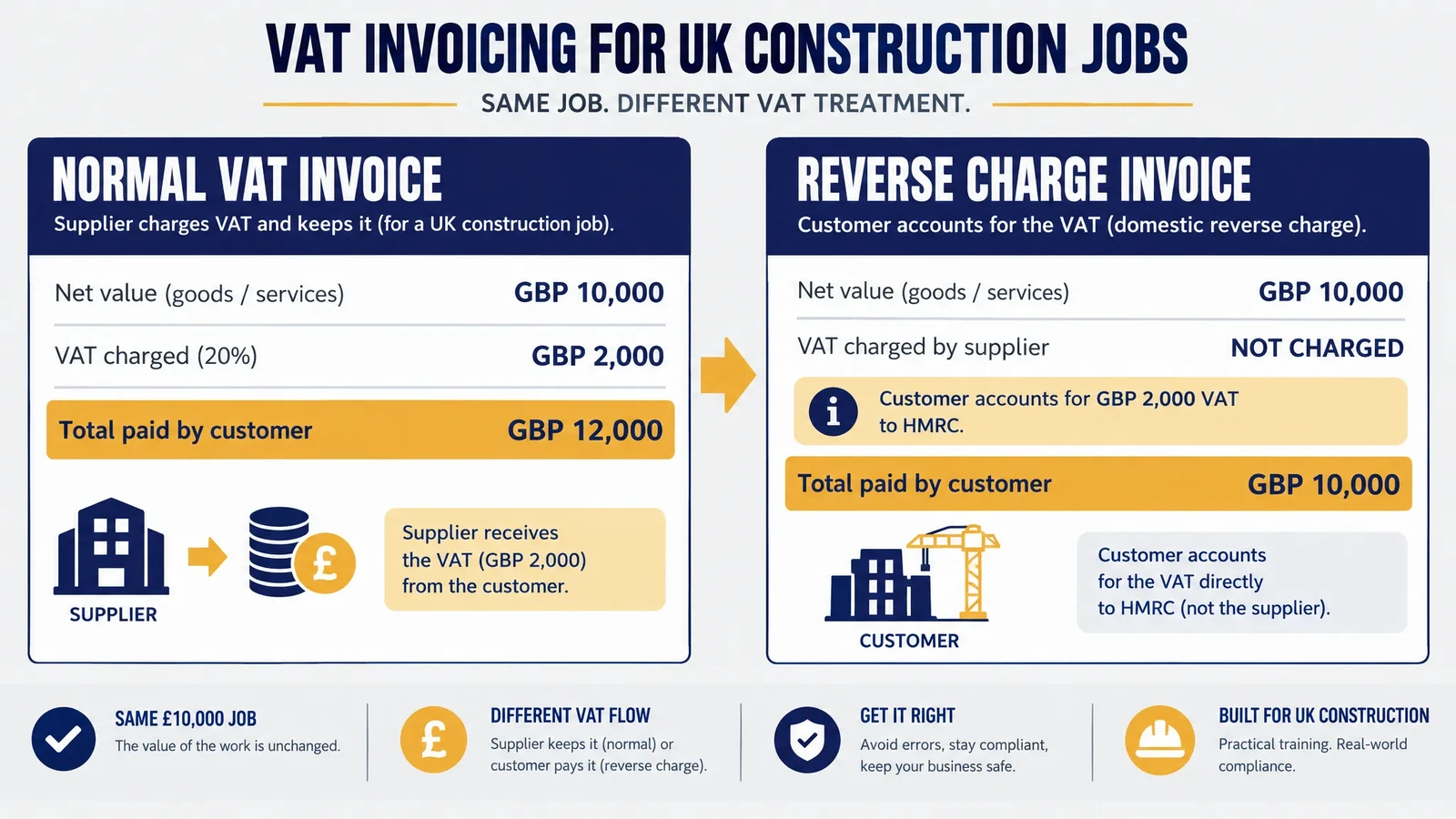
| Invoice line | Normal VAT invoice | Reverse charge invoice |
|---|---|---|
| Net value of work | £10,000 | £10,000 |
| VAT charged by supplier | £2,000 (20%) | £0 — not charged |
| Total the customer pays the supplier | £12,000 | £10,000 |
| VAT shown on the invoice | As a charge, added to the total | As a reference only, stating the reverse charge applies and the rate/amount due |
| Who declares the £2,000 VAT to HMRC | The supplier, after collecting it from the customer | The customer, directly on their own VAT return |
In the reverse charge version, the subcontractor records a £10,000 net sale with no output VAT at all. The contractor records the £2,000 as output tax.
Assuming the work is for a fully taxable purpose, the contractor then reclaims that same £2,000 as input tax. The net effect for the contractor is nil, and no VAT ever physically changes hands between the two businesses.
Under the reverse charge, the invoice total the customer pays is lower than a normal VAT invoice for the same job, because the VAT never gets added on. That’s the detail that catches people out the first time.
How the reverse charge affects your VAT return
Beyond the invoice itself, the reverse charge changes how two common VAT schemes work, and anyone training in bookkeeping or VAT should understand both before they come up in practice.
The Flat Rate Scheme
A business can stay on the VAT Flat Rate Scheme after the reverse charge applies to some of its sales, but reverse charge supplies must be excluded from the flat-rate calculation entirely.
They’re worked out separately under normal reverse charge rules, then added to the return alongside the flat-rate figures.
For a subcontractor whose work is heavily affected, HMRC’s own internal guidance on the Flat Rate Scheme flags that it may no longer suit them well.
It doesn’t let a business reclaim VAT on materials and overheads the way standard VAT accounting does.
The Cash Accounting Scheme
Reverse charge sales and purchases must be left out of the Cash Accounting Scheme completely. That scheme is built around VAT being paid and reclaimed when cash actually changes hands.
Reverse charge supplies never involve a VAT payment passing between the two businesses in the first place, so they simply don’t fit the model.
The cash flow problem for subcontractors
This is the change that actually affects a subcontractor’s bank balance, not just their paperwork. Before the reverse charge, a subcontractor collected VAT from each customer and held it, often for weeks, before paying it to HMRC.
That gap acted as a short-term float.
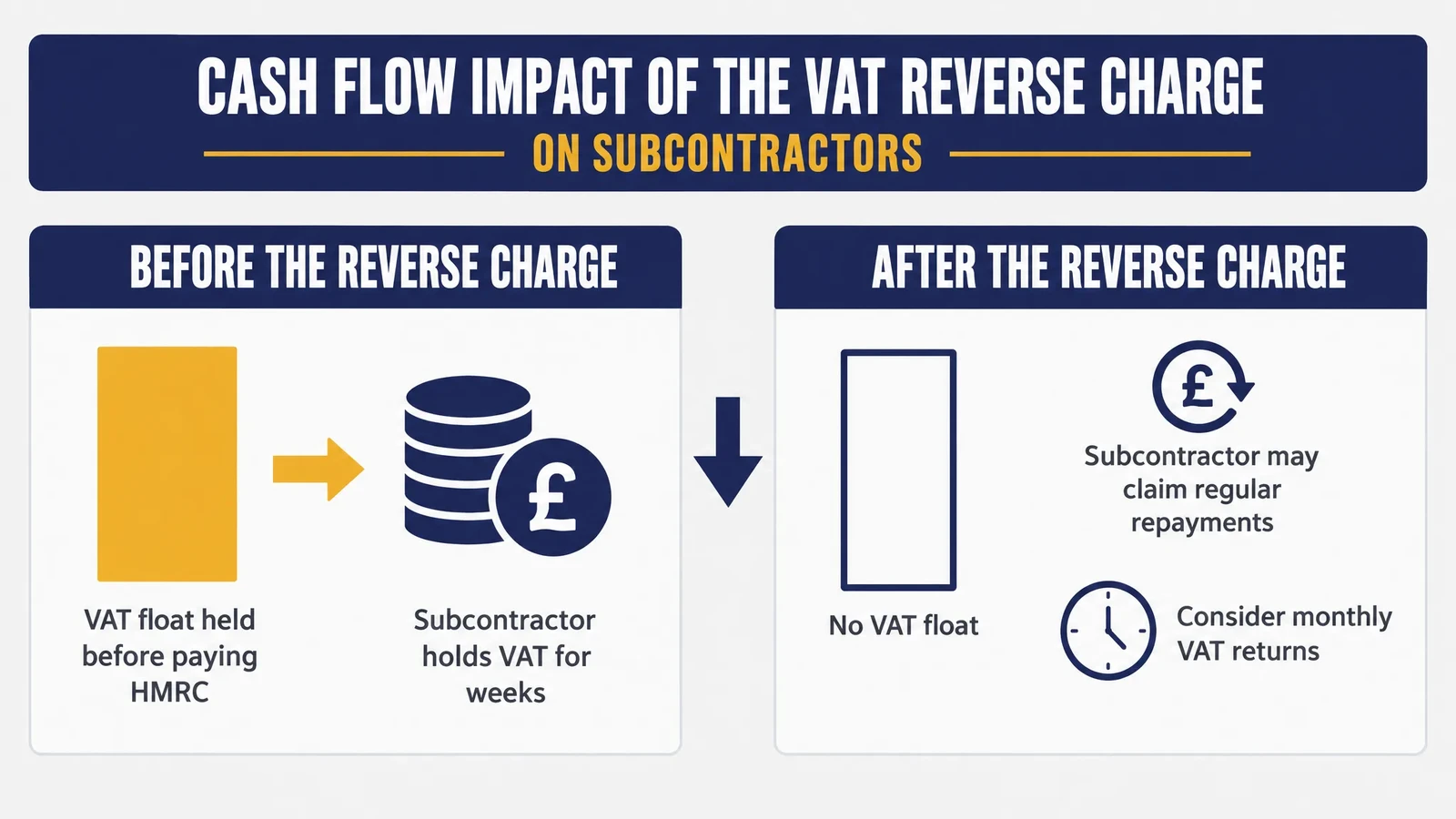
Under the reverse charge, subcontractors never collect that VAT at all. They still pay VAT on their own purchases, like materials, tools, and subcontracted labour.
But they no longer bring in matching output VAT from sales to offset it. Many end up in a regular net repayment position, owed money by HMRC rather than owing it.
- Work out how much of your turnover is now reverse-charged, so you can see the scale of the cash flow gap before it becomes a problem.
- Apply to move from quarterly to monthly VAT returns through your online VAT account, so repayments come through roughly three times faster.
- Build the lost VAT float into your cash flow forecasting rather than treating a HMRC repayment as a bonus when it lands.
- Review whether staying on the Flat Rate Scheme still makes sense once reverse charge sales are stripped out of the calculation.
Moving to monthly returns is the single change HMRC itself points to most often, and it’s usually the quickest way to get a subcontractor’s cash flow back on an even footing.
The reverse charge is VAT-neutral for the supply chain as a whole, but it isn’t cash-flow-neutral for the subcontractor who used to hold the VAT float. Monthly returns are the most practical fix available right now.
Common mistakes to avoid
Most reverse charge errors come down to the same handful of causes, and they show up repeatedly in HMRC’s own compliance activity and professional body guidance for bookkeepers and accountants.
Getting a sale wrong here carries real consequences, the same way any VAT mistake can trigger VAT penalties under HMRC’s points-based system.
- Charging VAT on a sale that should have been reverse charged, or leaving VAT off a sale that should have been charged normally
- Not checking a customer’s VAT and CIS registration status before deciding how to invoice
- Accepting a verbal end user claim without getting it in writing before the first invoice goes out
- Staying on the Flat Rate Scheme without separating out reverse charge supplies, and understating VAT as a result
- Including reverse charge transactions in the Cash Accounting Scheme by mistake
- Treating excluded services, such as architects’ fees or materials-only supplies, as if the reverse charge applies to them
- Not adjusting cash flow planning for the loss of the VAT float, then being caught short when a VAT bill on purchases falls due
Domestic reverse charge vs postponed VAT accounting
It’s easy to mix these two up because both involve VAT being declared rather than paid upfront, but they solve completely different problems.
The domestic reverse charge applies to UK construction supply chains. It moves responsibility for declaring VAT from a UK supplier to a UK customer, specifically to stop fraud within that industry.
Either way, the VAT figures involved still have to be filed digitally under Making Tax Digital for VAT.
Postponed VAT accounting (PVA) is about imports. It lets any VAT-registered UK business account for import VAT on goods brought in from outside the UK on their own VAT return, instead of paying it upfront at the border.
No construction link and no CIS registration is needed to use PVA.
If you’re studying for AAT, ACCA, or a similar qualification, it’s worth keeping these two firmly separate in your notes. They appear in different parts of the VAT syllabus and get tested differently.
Frequently asked questions
Does the VAT domestic reverse charge apply to all construction work?
No. It only applies to specified construction services between two VAT and CIS-registered businesses, where the supply is standard or reduced-rated. Zero-rated work, and services like architecture, surveying, or materials-only supply, are excluded.
What happens if I charge VAT when the reverse charge should have applied?
The invoice is wrong and will need correcting, usually with a credit note and a reissued reverse charge invoice. HMRC expects businesses to correct genuine errors like this once they’re spotted.
Can I still use the Flat Rate Scheme if I do reverse charge work?
Yes, but reverse charge sales must be worked out separately and added to your flat-rate figures rather than included in the flat-rate calculation itself. For some subcontractors, leaving the scheme altogether works out better once this is accounted for.
How do I know if my customer counts as an end user?
You can’t assume it. An end user has to tell you in writing, confirming they’re an end user under section 55A VAT Act 1994.
Without that written notification, treat the sale as a normal reverse charge supply.
Why does the reverse charge cause cash flow problems for subcontractors?
Subcontractors no longer collect VAT from customers on reverse-charged sales, but they still pay VAT on their own purchases. That removes the short-term VAT float many relied on and can push a business into a regular HMRC repayment position.
Is the VAT domestic reverse charge still in force in 2026?
Yes. It has applied since 1 March 2021 and remains fully in force for the 2026/27 tax year, with HMRC’s guidance updated as recently as March 2026 and no indication it’s being withdrawn.
Getting VAT right in construction is one of the trickier corners of UK bookkeeping. The reverse charge is exactly the kind of real-world detail that separates someone who’s memorised the theory from someone who can do the job.
PC Training’s Bookkeeping & VAT Training course covers rules like this in full, alongside the guaranteed recruitment support that helps you put the qualification to work once you’re trained.