If your business earns income from both VAT-taxable and VAT-exempt activities, you are what HMRC calls "partly exempt". That one word changes how much VAT...
If your business earns income from both VAT-taxable and VAT-exempt activities, you are what HMRC calls "partly exempt". That one word changes how much VAT you can reclaim on your costs.
It catches out a lot of otherwise careful bookkeepers, because the rules are easy to misread and rarely explained in plain English.
Partial exemption is not a niche topic. It affects landlords who let commercial property, insurance brokers, training providers, and dentists.
It affects any business that mixes standard-rated sales with exempt income. Get it wrong and you either overclaim VAT and face a correction with interest, or underclaim and quietly lose money every quarter.
This guide explains what partial exemption means, how the standard method works, and when the de minimis limit lets you reclaim everything anyway. It draws on HMRC’s own Partial Exemption (VAT Notice 706).
It is written for anyone studying bookkeeping and VAT, or anyone running the books for a partly exempt business who wants to understand the mechanics, not just follow a spreadsheet template.
What does "partly exempt" mean for VAT?
A business is partly exempt if it is VAT-registered and makes both taxable supplies (standard, reduced or zero-rated) and exempt supplies, and incurs VAT on costs that relate to both.
The legal basis sits in sections 24 to 26 of the Value Added Tax Act 1994 and regulations 99 to 110 of the VAT Regulations 1995. HMRC’s own working definition is set out in its internal Partial Exemption guidance manual.
The practical effect is simple to state and harder to apply. You can only reclaim the VAT on costs that relate to your taxable supplies.
VAT on costs used purely for exempt supplies cannot be reclaimed at all. VAT on costs used for both has to be split.
Common examples of partly exempt businesses
Exempt supplies include insurance, most finance and credit, education provided by an eligible body, health and welfare services, and the letting of land or buildings (unless the owner has opted to tax it).
A business becomes partly exempt the moment it incurs VAT on costs linked to any of these alongside its normal taxable trading. A few examples make this concrete.
- A bookkeeping firm that also earns commission as an insurance intermediary, since insurance commission is exempt but bookkeeping fees are standard-rated.
- A landlord who rents out a mix of opted-to-tax commercial units and residential flats.
- A training provider that runs some standard-rated commercial courses alongside education that qualifies for the exemption.
- A dental or medical practice that supplies exempt health services alongside standard-rated cosmetic treatments.
Once a business incurs exempt input tax, it stays partly exempt until it goes a full tax year without any. It does not need to apply to HMRC or tick a box.
Being partly exempt is not a choice or a registration status. It happens automatically the moment a VAT-registered business incurs input tax linked to exempt income, and it carries on until a full tax year passes with none.
The three-step process HMRC expects you to follow
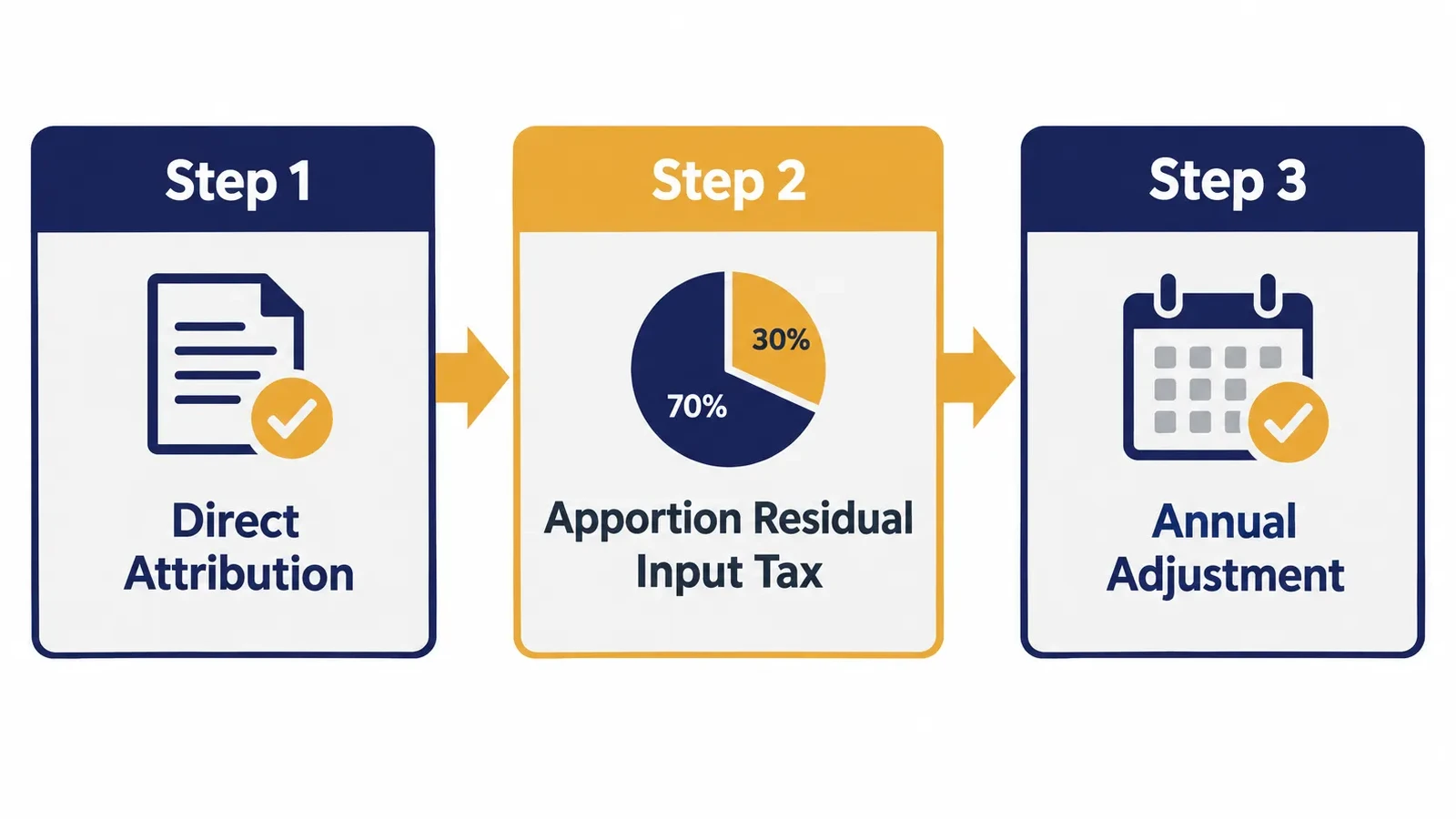
VAT Notice 706 sets out partial exemption as a three-step process, run every VAT period and then checked again at the year end.
- Direct attribution. Identify any input tax used wholly for taxable supplies (reclaim it in full) or wholly for exempt supplies (block it entirely).
- Apportion the residual input tax. Split VAT on costs used for both taxable and exempt supplies, using an agreed method — normally the standard method described below.
- Complete the annual adjustment. At the end of the longer period, recalculate using full-year figures and correct any difference from what was claimed quarter by quarter.
Direct attribution first, apportionment second
Direct attribution always comes before apportionment. Many partly exempt businesses skip straight to a blanket percentage and apply it to everything.
That both overcomplicates the sums and usually understates what can legitimately be reclaimed in full. A general ledger that tags purchase invoices by supply type at the point of entry makes this step far less painful at quarter end.
The standard method: working out your recovery percentage
Once direct attribution is done, residual input tax has to be apportioned. This is VAT on costs like rent, utilities, accountancy fees and general overheads that support the whole business.
Unless HMRC has approved a special method, that means the standard method.
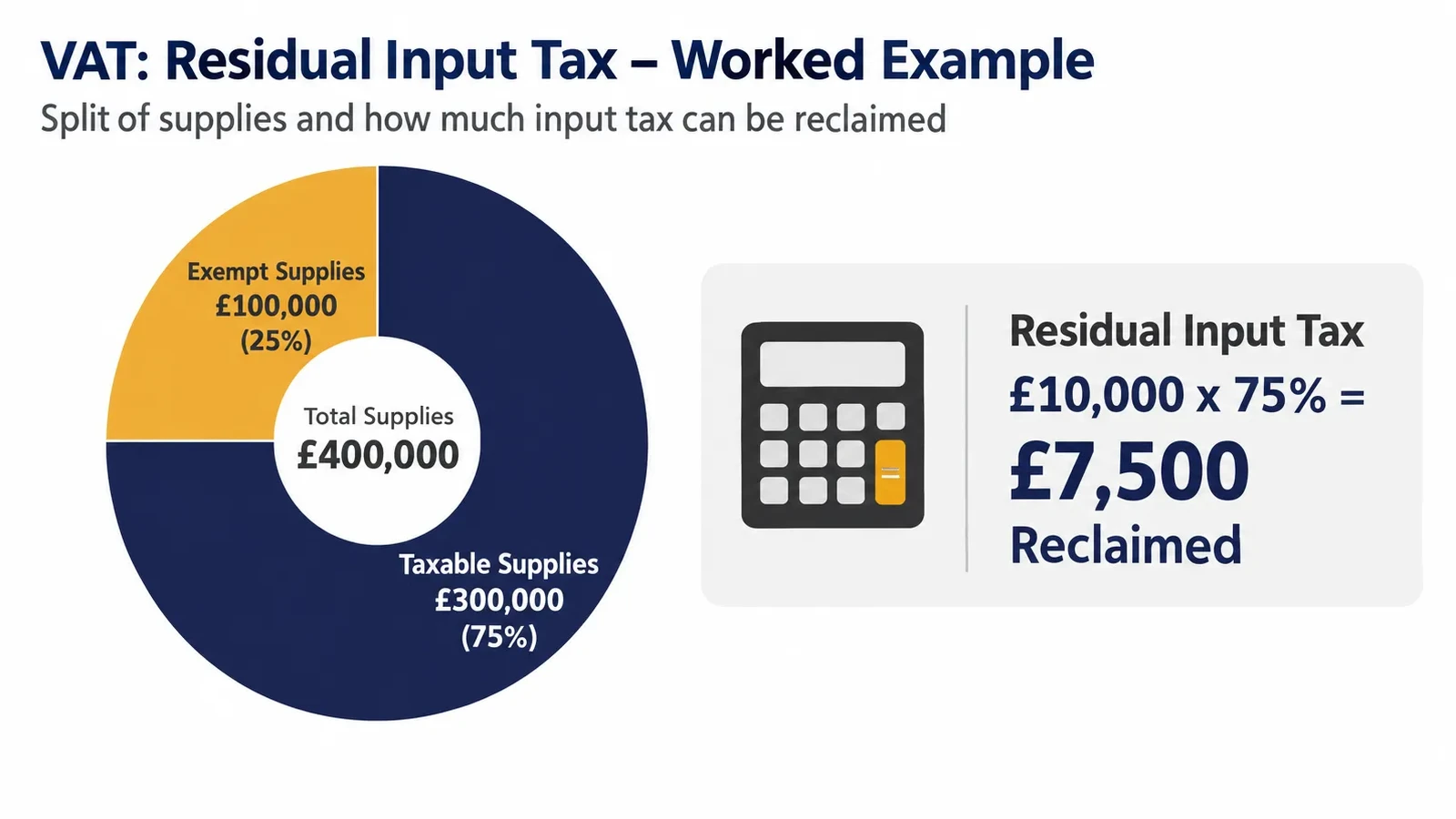
| Figure | Amount |
|---|---|
| Taxable supplies (excl. VAT) | £300,000 |
| Exempt supplies (excl. VAT) | £100,000 |
| Total supplies (excl. VAT) | £400,000 |
| Recoverable percentage (300,000 ÷ 400,000 × 100) | 75% |
| Residual input tax for the quarter | £10,000 |
| Residual input tax reclaimed (75% of £10,000) | £7,500 |
The formula is value of taxable supplies divided by total value of supplies, both excluding VAT, multiplied by 100.
The result is rounded up to the next whole number. If residual input tax averages more than £400,000 a month, it is rounded to two decimal places instead.
A handful of transactions are excluded from both sides of this calculation: capital goods, incidental financial or property transactions, self-supplies, transfers of a going concern, and share issues.
Including these by mistake is one of the most common standard-method errors.
The standard method compares the value of taxable supplies to total supplies, excluding VAT, and applies the resulting percentage to residual input tax. Capital goods and a short list of incidental transactions are excluded from the calculation entirely.
When the standard method override applies
If the standard method produces a result that does not fairly reflect how costs are actually used, the standard method override can require a different calculation.
It is triggered by a substantial difference, defined as more than £50,000, or more than 50% of residual input tax and £25,000.
It only applies where residual input tax for the business exceeds £50,000 a year (£25,000 for group undertakings outside the same VAT group). Most small and medium-sized partly exempt businesses will never trigger this.
The de minimis test: when you can reclaim everything anyway
Not every partly exempt business actually loses any input tax. HMRC’s de minimis rule lets a business reclaim exempt input tax in full if it is small enough relative to the rest of the business.
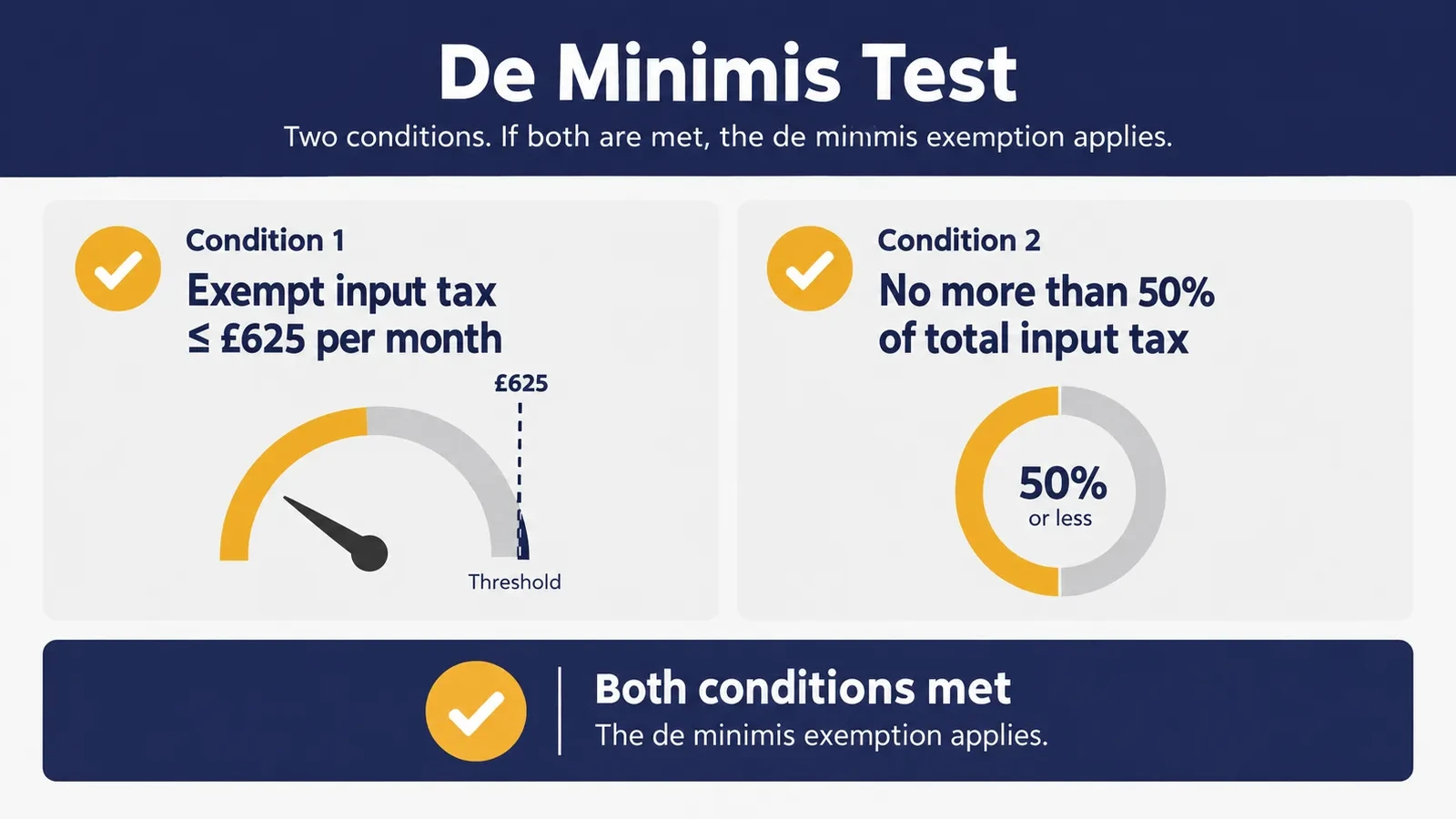
Exempt input tax is recoverable in full if, on average per month, it is no more than £625 and no more than half of total input tax for that period.
Both conditions have to be met, not just one.
| Test | What it checks |
|---|---|
| Main de minimis test | Exempt input tax averages £625 a month or less, and is no more than half of total input tax |
| Simplified test one | Total input tax averages £625 a month or less, and exempt supplies are 50% or less of all supplies |
| Simplified test two | Input tax minus tax directly attributed to taxable supplies averages £625 a month or less, and exempt supplies are 50% or less of all supplies |
There is also an annual test. It is available once a business has passed the de minimis test in the previous longer period, applied it consistently, and reasonably expects total input tax to stay under £1 million.
It lets a qualifying business apply the de minimis conclusion provisionally through the year, rather than testing every single quarter.
A simple de minimis example
Say a firm’s exempt input tax averages £500 a month, and its total input tax averages £1,200 a month.
£500 is under the £625 limit, and £500 is less than half of £1,200. Both conditions pass, so the whole £500 a month can be reclaimed, with no apportionment needed at all.
De minimis relief is not available if the business uses a combined partial exemption and business/non-business apportionment method. There is no separate de minimis limit for non-business VAT.
The de minimis test exists so that a business with only a small amount of exempt income does not have to run a full apportionment calculation every quarter. Both the cash limit and the percentage limit have to be met.
The annual adjustment: squaring everything up at year end
Partial exemption is worked out provisionally every VAT period, using that period’s own figures. Those figures can be skewed by one-off costs, seasonal trading, or a new contract that only started partway through the year.
The annual adjustment corrects for that.
The tax year for partial exemption normally runs for 12 months, ending on 31 March, 30 April or 31 May, depending on the business’s VAT return stagger.
At the end of that year, the business recalculates attribution and recovery using the full year’s figures. It reapplies the de minimis test against the annual numbers, and checks whether the standard method override applies.
The difference between what was actually claimed and what the annual figures say should have been claimed is the annual adjustment. It is usually declared on the last VAT return of the longer period.
That figure feeds into the same VAT return as the rest of the business’s normal quarterly reporting.
Why the annual adjustment catches people out
It is easy to treat the annual adjustment as an afterthought. It is a genuine VAT return entry with its own deadline, and HMRC expects it whether the correction favours the business or HMRC.
Missing it, or applying it inconsistently year to year, is one of the more common partial exemption errors picked up on inspection, and the kind of thing that can lead straight into VAT penalties if it is left uncorrected.
Other rules worth knowing
A few related rules sit alongside the core partial exemption calculation, worth understanding even if they do not come up every quarter.
- The Capital Goods Scheme applies to computers costing £50,000 or more, and to land, buildings, civil engineering works and refurbishments costing £250,000 or more, spreading the VAT adjustment over several years as use changes.
- Clawback and payback adjustments apply if the intended or actual use of goods or services changes within six years of the period in which the original intention was formed.
- Blocked input tax, such as VAT on most business entertainment, is never recoverable regardless of how the partial exemption calculation comes out.
- Belated claims for input tax missed in an earlier period can generally still be made within four years of the due date of the return for that period.
How this differs from VAT registration, MTD and the domestic reverse charge
Partial exemption is sometimes confused with other VAT obligations covered elsewhere in this course’s reading list, so it is worth being clear about where each one sits.
VAT registration decides whether a business needs to charge and account for VAT at all. Making Tax Digital for VAT governs how VAT records are kept and filed, regardless of whether the business is partly exempt.
The domestic reverse charge for construction changes who accounts for the VAT on certain building services.
Partial exemption, by contrast, only comes into play once a VAT-registered business has exempt income and needs to work out how much input tax it can reclaim.
A business can be affected by more than one of these at once, but each answers a different question.
Frequently asked questions
What is the difference between exempt and zero-rated supplies?
Zero-rated supplies are taxable supplies charged at 0%, so the VAT on related costs can still be reclaimed in full. Exempt supplies are not taxable at all.
VAT on costs linked to exempt supplies is blocked unless the de minimis test is met.
Do I need HMRC’s permission to use the standard method?
No. The standard method is the default and does not need prior approval. A special method does need HMRC’s written agreement before it can be used, along with a signed declaration that it is fair and reasonable.
What happens if I get my partial exemption calculation wrong?
An error is corrected the same way as any other VAT error, usually through the annual adjustment or an error correction to HMRC. Interest can apply if VAT was overclaimed, so keeping clear records of attribution decisions matters.
Can a small business avoid partial exemption altogether?
A business cannot opt out of the rules, but many small partly exempt businesses never actually lose any input tax because they pass the de minimis test every period. The mechanics still apply, but everything stays reclaimable.
Does partial exemption affect sole traders as well as limited companies?
Yes. Partial exemption applies to any VAT-registered taxable person, including sole traders, partnerships, and limited companies. The legal test is about the mix of supplies made, not the business’s legal structure.
Partial exemption is one of the more technical corners of UK VAT. It is exactly the kind of detail that separates a confident, job-ready bookkeeper from someone who can only follow a template.
If you want to build this level of VAT knowledge properly, alongside the practical bookkeeping skills employers actually test for, our Bookkeeping & VAT Training course covers it in full.
It is a CPD-certified programme with guaranteed job placement support once you qualify.