
If you're training to become a business analyst, or you already work as one, you've probably noticed AI tools turning up in more of your...
Your Next Step in a Rewarding Accounting Career
If you’ve hit a ceiling with entry-level finance work, staying where you are won’t fix it. Employers promote people who can handle more than data entry. They look for people who understand ledgers, VAT, payroll, final accounts, and the wider business context behind the numbers.
That’s why the AAT Level 3 course is such a smart move. It gives you practical finance skills that connect directly to real jobs. You’re not learning accounting for the sake of theory. You’re learning the parts of accounting that businesses rely on every day.
Why Level 3 changes your position in the job market
At this stage, employers start seeing you differently. Instead of someone who can only follow a process, you become someone who can apply judgement, prepare financial information properly, and support reporting with confidence.
That matters in roles such as:
- Accounts Assistant, where accuracy in bookkeeping and final accounts support is essential
- Payroll Administrator, where payroll processing and compliance knowledge can’t be guessed
- Bookkeeper, where VAT handling and ledger maintenance sit at the centre of the role
- Finance Assistant, where you’re expected to support month-end and financial control work
- Business or data-focused support roles, where financial accuracy and commercial awareness strengthen your value
Career advice: If you want a better finance job, train for the tasks that appear in job adverts. AAT Level 3 does that far better than generic business study.
There’s also a wider benefit. Strong accounting skills make you more useful across departments. Even if you move towards business analysis or data analysis later, understanding how money flows through a business gives your work more credibility. If you want a broader commercial perspective, this guide to managing New Zealand business finances is a useful example of the kind of practical financial thinking employers value.
Who should take it seriously
The best candidates for AAT Level 3 usually fall into a few groups:
- Career changers who want a structured route into accounting
- Recent graduates who need job-ready finance skills, not just academic theory
- Junior finance staff ready to move beyond basic transactional work
- Bookkeepers who want deeper VAT, final accounts, and business awareness skills
- Payroll professionals who want stronger accounting foundations
If that sounds like you, don’t overcomplicate the decision. The AAT Level 3 course is a practical qualification with a direct employability payoff.
What Is the AAT Level 3 Diploma in Accounting
The AAT Level 3 Diploma in Accounting is the point where accounting starts to feel professional. It’s no longer about learning the alphabet of bookkeeping. It’s about using that language properly, building full financial meaning from it, and understanding why each figure matters.
Where it sits in the AAT pathway
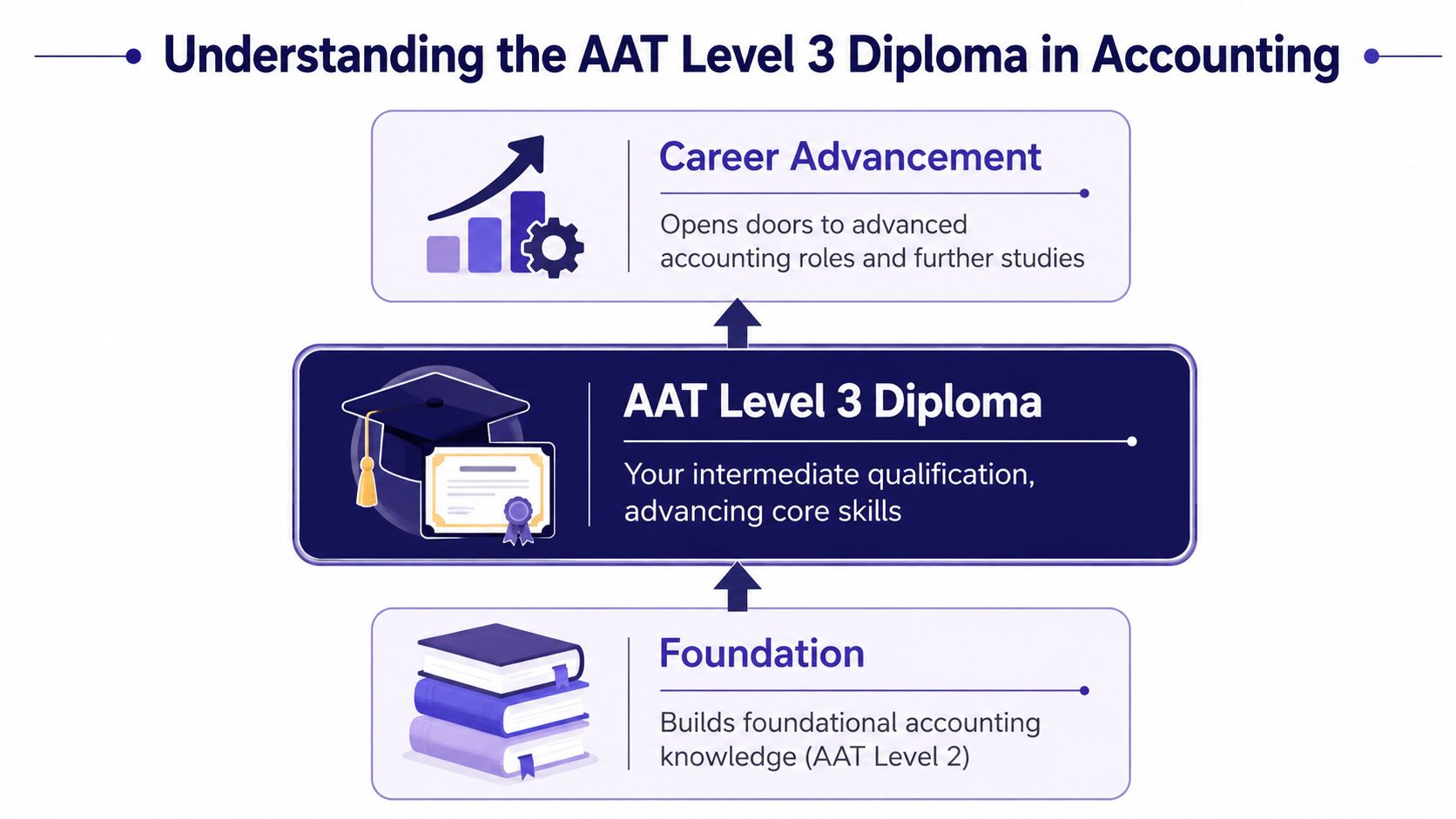
Level 3 is an intermediate qualification. It builds on the basics usually associated with Level 2 and prepares you for higher study later on. That’s why it has real career weight. It proves you can handle more complex accounting tasks, not just basic processing.
According to AAT, the qualification is a four-assessment course that develops higher accounting skills including advanced bookkeeping, financial statements for sole traders and partnerships, VAT, payroll, and management accounting. AAT also states that it usually takes around one year to complete, though it can be completed in as little as six months depending on your study mode and timetable. It’s offered through distance learning, blended learning, classroom study, and part-time or full-time options. AAT also notes that successful completion can qualify you for AAT bookkeeping membership (AATQB) through the AAT Level 3 Diploma in Accounting qualification page.
What the qualification is really doing for you
This is the important part. AAT Level 3 doesn’t just add knowledge. It changes the kind of work you can do.
You build capability in areas employers recognise immediately:
- Advanced bookkeeping, so you can maintain records properly rather than just input figures
- Final accounts preparation, so you can support reporting for sole traders and partnerships
- VAT and payroll, which are core operational responsibilities in many finance teams
- Management accounting, which starts pushing you towards internal reporting and decision support
- Business awareness, which helps you understand the environment behind the numbers
A strong finance career starts when you can explain what the numbers mean, not just where they came from.
Why it’s a strategic qualification
A lot of learners make the mistake of choosing a course because it sounds useful. That’s not enough. You should choose a course because it puts you closer to a specific job.
AAT Level 3 does exactly that. It supports progression into bookkeeping, payroll, accounts support, and assistant-level finance roles. It also gives you a credible platform for AAT Level 4 if you want to keep climbing.
If your long-term goal is technician-level accounting, or even a route towards chartered study later, Level 3 is one of the clearest stepping stones.
Core Modules and Assessments Explained
This is where the AAT Level 3 course proves its value. The modules are closely tied to the work employers need done inside real businesses. You’re not memorising theory for its own sake. You’re training for daily finance tasks, compliance work, and reporting support.
In the UK, the qualification is built around four core units: Preparing Financial Statements, Management Accounting Techniques, Tax Processes for Businesses, and Business Awareness. The curriculum requires learners to prepare financial statements for sole traders and partnerships and to calculate VAT and payroll processes, which are key statutory obligations for UK businesses, as outlined in this overview of training to be a bookkeeper.
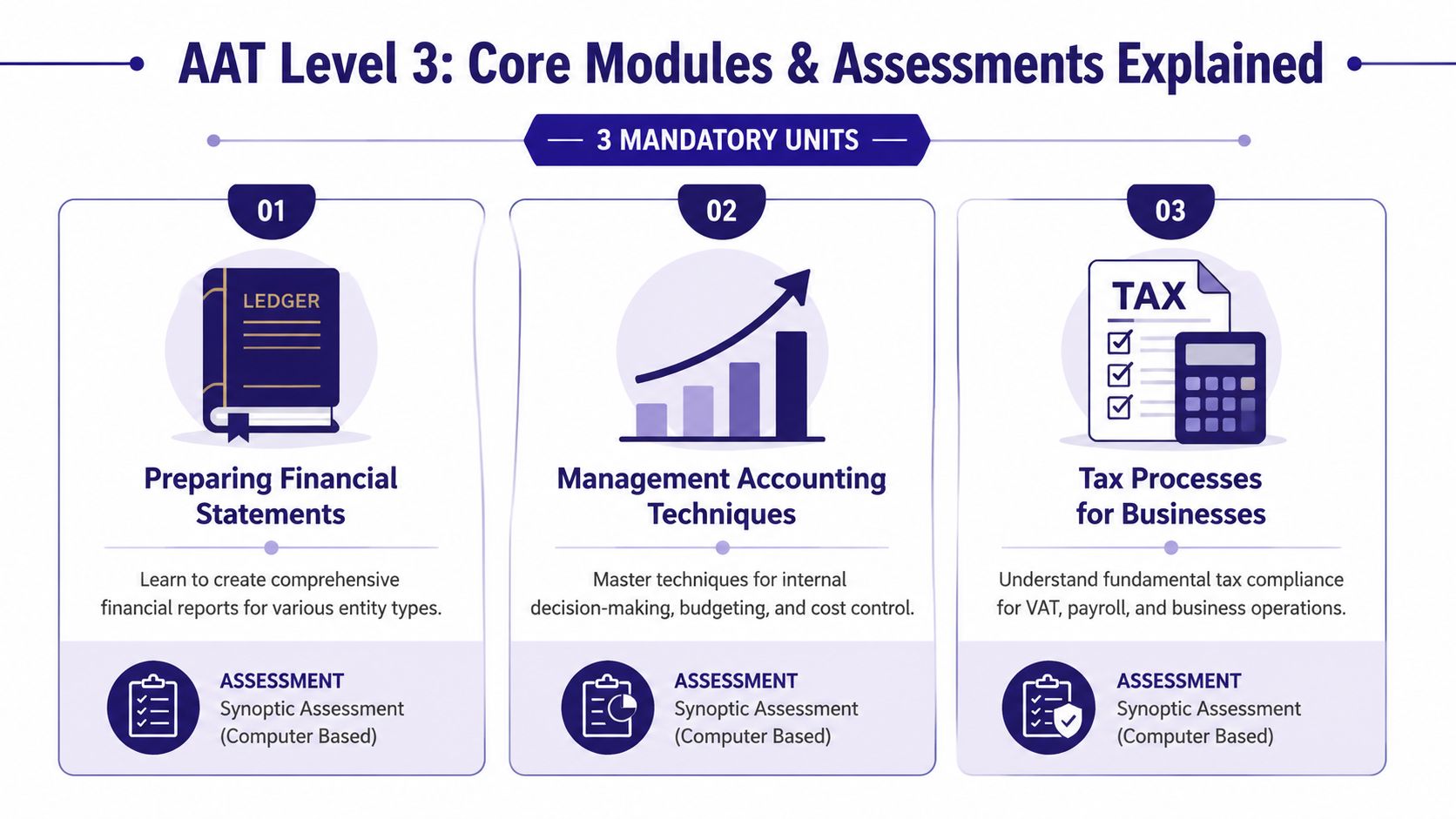
Preparing Financial Statements
This unit matters if you want to work in accounts support, final accounts, or assistant accountant roles. You learn how to prepare financial statements for sole traders and partnerships. That’s practical, employable work.
In a job, this translates into tasks such as:
- Supporting year-end accounts work
- Checking ledger accuracy before reports are prepared
- Helping produce financial statements for review
- Handling adjustments with a clearer understanding of why they matter
A candidate who can support final accounts work is far more useful than one who can only process transactions.
Management Accounting Techniques
This is the unit that starts shifting you towards internal decision support. It develops your understanding of costing, budgeting, and the financial information managers use to run the business.
That makes it especially relevant if you want to move towards:
- Assistant Accountant
- Finance Analyst support
- Business analyst roles with financial exposure
- Operational finance positions
You won’t become a full management accountant from one unit. But you will become much stronger at interpreting internal financial information, and that’s valuable.
Practical rule: If you want your career to move beyond bookkeeping alone, take management accounting seriously. It’s one of the clearest signals that you can contribute to decision-making.
Tax Processes for Businesses
This unit has immediate relevance in the workplace. VAT and payroll are not optional extras in business. They are routine responsibilities with real compliance consequences.
That’s why this unit is strong preparation for:
- Bookkeeping and VAT work
- Advanced payroll support
- Accounts assistant roles with tax processing duties
- Small business finance roles where one person handles several finance functions
If you want to become the person a business can trust with VAT returns and payroll-related processes, this is one of the most useful parts of the qualification.
Business Awareness
Some learners underestimate this unit. That’s a mistake.
Employers don’t just want someone who can post journals. They want someone who understands the organisation they work in. Business Awareness helps you connect accounting work to business context, ethics, governance, and the internal and external environment.
That makes you more credible in interviews and more effective at work. It’s also one reason the AAT Level 3 course suits people who may later move into business analyst or data analyst pathways. Commercial awareness improves your judgement.
How the assessments work
The qualification is assessed through four Computer-Based Exams. There’s one point you need to plan for early. The Management Accounting Techniques unit must be sat at an official AAT exam centre near you in the UK, while other specified units can be remotely invigilated. If you want to plan your location and logistics properly, check these AAT exam centres.
One core assessment detail is especially worth respecting. The Preparing Financial Statements exam lasts 2.5 hours, so you need more than subject knowledge. You need speed, structure, and exam discipline.
How to Fit AAT Level 3 Into Your Life
Individuals pursuing AAT Level 3 aren’t sitting around with empty calendars. They’re working, managing family life, dealing with commuting, or trying to retrain while holding everything else together. That’s normal. It’s also why study mode matters almost as much as course content.
The good news is that AAT Level 3 isn’t locked into one format. You can study in ways that fit around your life rather than wrecking it.
Choose the study pattern that you’ll actually sustain
Some learners like a classroom routine. Others need distance learning because work shifts or family commitments make fixed attendance unrealistic. The right choice is the one you can keep doing consistently.
Typical options include:
- Distance learning, which suits independent learners who need flexibility
- Blended learning, which gives you a mix of structure and freedom
- Classroom study, which works well if you learn best through live teaching
- Part-time study, ideal if you’re working and need a manageable pace
- Full-time study, better for those who want faster progression
If you’re serious about finishing, don’t pick the most ambitious timetable. Pick the timetable you can maintain when life gets busy.
The best study plan isn’t the one that looks impressive. It’s the one you’ll still follow on a tired Wednesday evening.
Build your week around energy, not wishful thinking
AAT Level 3 requires concentration. Advanced bookkeeping, VAT, payroll, and management accounting all need focused study. If you tell yourself you’ll study every night after an exhausting day, you’re setting yourself up to struggle.
A better approach is simple:
- Set fixed study slots you can protect each week.
- Use shorter sessions for review and longer sessions for technical topics.
- Leave space for exam practice, not just reading notes.
- Treat assessments as deadlines, not distant events.
This matters even more if you’re balancing work. A realistic part-time plan beats an unrealistic intensive plan every time.
Support matters more than people admit
A lot of learners think flexibility means studying alone. It doesn’t have to. In fact, if you’ve been out of education for a while, proper tutor support can make the difference between drifting and progressing.
You should look for training that gives you:
- Clear guidance on difficult topics such as final accounts and management accounting
- Practical feedback, not vague encouragement
- Help with exam technique
- A timetable model that works around evenings or weekends if needed
That’s especially important if you’re coming from a non-accounting background, changing career, or entering the UK job market for the first time. The AAT Level 3 course is manageable, but only if you approach it like a professional commitment rather than a side hobby.
Your Career and Salary After AAT Level 3
You don’t take the AAT Level 3 course just to feel more qualified. You take it because you want better work, better responsibility, and a stronger career direction.
That outcome is realistic because the qualification maps closely to tasks used in finance jobs. Employers need people who can support bookkeeping, handle VAT processes, work with payroll, assist with final accounts, and understand the wider business environment. Level 3 targets that combination well.
Early in your search, it helps to see the range of roles this can support. This video gives a useful overview of the kind of opportunities learners often explore after qualification.
Roles that become more realistic
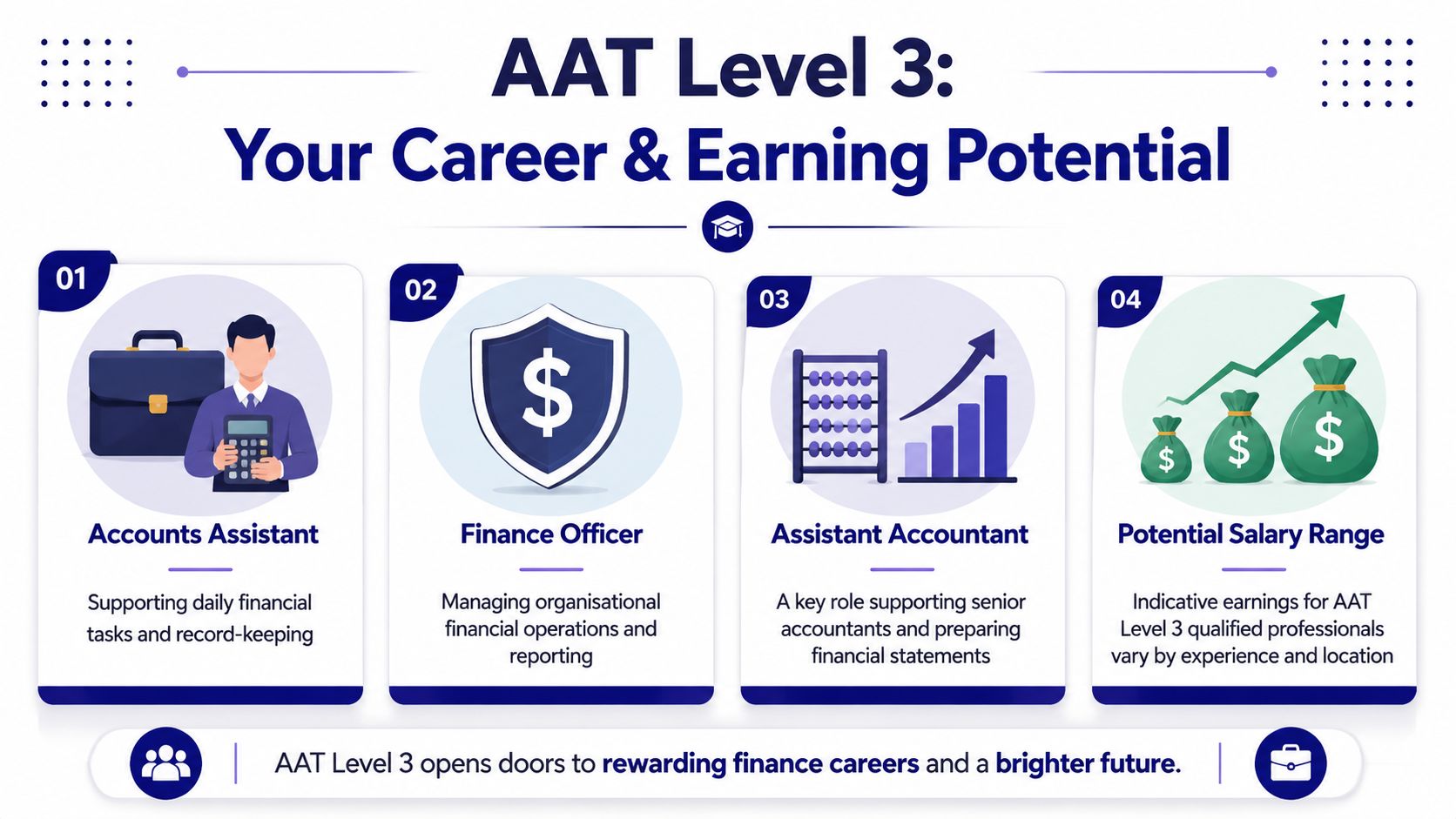
After AAT Level 3, you’re in a much stronger position for roles such as:
- Accounts Assistant, where you support day-to-day finance operations and help maintain accurate records
- Finance Assistant, where you assist with reconciliations, reporting support, and transactional finance
- Bookkeeper, especially where VAT and ledger control sit at the centre of the role
- Payroll Administrator, where payroll processing and accuracy matter every pay cycle
- Assistant Accountant, particularly in businesses that value practical AAT training
- Business support roles with finance exposure, where reporting and commercial understanding overlap
Why employers respond to this qualification
AAT Level 3 is attractive because it signals practical usefulness. An employer can look at the qualification and understand what you’ve covered. That’s helpful in hiring.
Here’s the direct link between modules and jobs:
| Module area | Employer need | Typical job fit |
|---|---|---|
| Final accounts and financial statements | Accurate reporting support | Accounts Assistant, Assistant Accountant |
| VAT and payroll | Compliance and routine processing | Bookkeeper, Payroll Administrator |
| Management accounting | Internal reporting and cost awareness | Finance Assistant, Assistant Accountant |
| Business awareness | Commercial understanding and ethics | Finance support, analyst-support roles |
That’s also why the qualification can support people with broader ambitions. If you want to move towards business analyst or data analyst work later, finance knowledge improves the quality of your reporting and analysis. You understand what the numbers represent, not just how to display them.
A clear route, not a vague hope
If you want to explore role types in more detail, these jobs for AAT Level 3 show how the qualification connects to real career outcomes.
One point on salary. Earnings vary by role, employer, region, software skills, and previous experience. That’s why you shouldn’t obsess over generic salary claims online. Focus on employability first. When you qualify for better roles, salary progression follows from stronger responsibility and better positioning in the market.
Better qualifications don’t guarantee a job on their own. Better qualifications plus job-ready skills give you a much stronger chance.
AAT Level 3 Versus Other Qualifications
Not every finance qualification serves the same purpose. Some are too basic for your current stage. Others are too advanced if you still need practical grounding. AAT Level 3 sits in the middle, and that’s exactly why it works so well for employability.
Where Level 3 stands
Compared with Level 2, Level 3 is a real step up. Level 2 gives you fundamentals. Level 3 develops technical depth and more independent understanding. It moves you from following finance processes to understanding why those processes work.
Compared with Level 4, Level 3 is more immediate and accessible. It gives you strong employable skills without requiring you to jump straight into a more advanced technical level before you’re ready.
A practical comparison
| Level | Focus | Typical Job Roles | Best For |
|---|---|---|---|
| AAT Level 2 | Foundation accounting and bookkeeping knowledge | Junior finance support, entry-level accounts roles | Beginners and career changers starting from scratch |
| AAT Level 3 | Advanced bookkeeping, VAT, payroll, final accounts, business awareness | Accounts Assistant, Finance Assistant, Bookkeeper, Payroll Administrator, Assistant Accountant support | Learners who want job-ready accounting skills and stronger employability |
| AAT Level 4 | Higher-level accounting and technician progression | More advanced accounting and finance roles | Learners aiming for technician status and further progression |
What about ACCA and CIMA
If your long-term goal is chartered accountancy or a broader professional finance route, qualifications like ACCA and CIMA may sit further ahead in your plan. But for many people, starting there is the wrong move.
AAT Level 3 is more practical for your current stage if you need:
- Hands-on accounting ability
- Credibility for junior to mid-level finance roles
- A structured route into more advanced study later
- A qualification that employers in operational finance understand quickly
That’s the key point. Don’t choose the qualification with the biggest name. Choose the one that fits the job you want next. For a huge number of learners, that makes AAT Level 3 the right decision.
Start Your AAT Journey with Professional Careers Training
If you want a qualification that leads to practical finance work, the AAT Level 3 course is one of the strongest choices available. It builds real capability in bookkeeping, VAT, payroll, final accounts, management accounting, and business awareness. Those aren’t abstract topics. They are the daily tools of employable finance staff.
The course also demands proper planning. One important detail is that the Management Accounting Techniques unit must be sat at an official AAT exam centre near the candidate in the UK, because AAT requires physical oversight for that unit’s assessment through its remote invigilation guidance. That’s exactly why serious learners benefit from structured support and clear exam preparation.

Why the right provider makes a difference
A qualification can open the door, but support affects how quickly and confidently you walk through it. Strong training should help you master the technical content, stay consistent, prepare for exams, and build confidence for the job market after study.
That matters even more if you’re starting from the beginning. If you need a foundation before Level 3, this AAT Level 2 distance learning option can help you map the right starting point.
The best time to act is when you’re clear about what you want next. If that next step is a better accounting role, stronger bookkeeping capability, or a route into payroll and accounts support, AAT Level 3 deserves your full attention.
Professional Careers Training helps learners turn accounting ambition into job-ready skills with Professional Careers Training. If you want flexible study, 1 to 1 support from ACCA-qualified trainers, software training in Sage, Xero and QuickBooks, and practical recruitment support including CV preparation and job search guidance, this is a strong place to start.