A letter arrives from a local council, the Child Maintenance Service, or the Department for Work and Pensions. It instructs you to deduct money from...
A letter arrives from a local council, the Child Maintenance Service, or the Department for Work and Pensions.
It instructs you to deduct money from an employee’s pay and send it on. This is an attachment of earnings order, and getting it wrong carries real consequences for both employer and employee.
These orders are more common than most payroll teams expect. Each type has its own rules for how much to deduct, when to start, and who to tell.
This guide covers the three you’re most likely to receive, with the current 2026/27 rate tables and a worked example.
What Is an Attachment of Earnings Order?
An attachment of earnings order is a legal instruction requiring an employer to deduct a set amount from an employee’s wages. That amount is paid to a third party, such as a council, a court, or a government department.
The employee has no say in whether it happens.
The employer’s role is purely administrative: calculate the deduction correctly, take it from the right pay run, and send it to the right place by the right date.
Refusing, delaying, or getting the sum wrong can result in a fine, regardless of intent. There’s no discretion to skip a deduction because it feels awkward to apply.
The Three Orders Payroll Teams Handle Most Often
Several different bodies can issue an attachment order, each under its own legislation and its own rules. In everyday UK payroll, three types come up far more often than the rest.
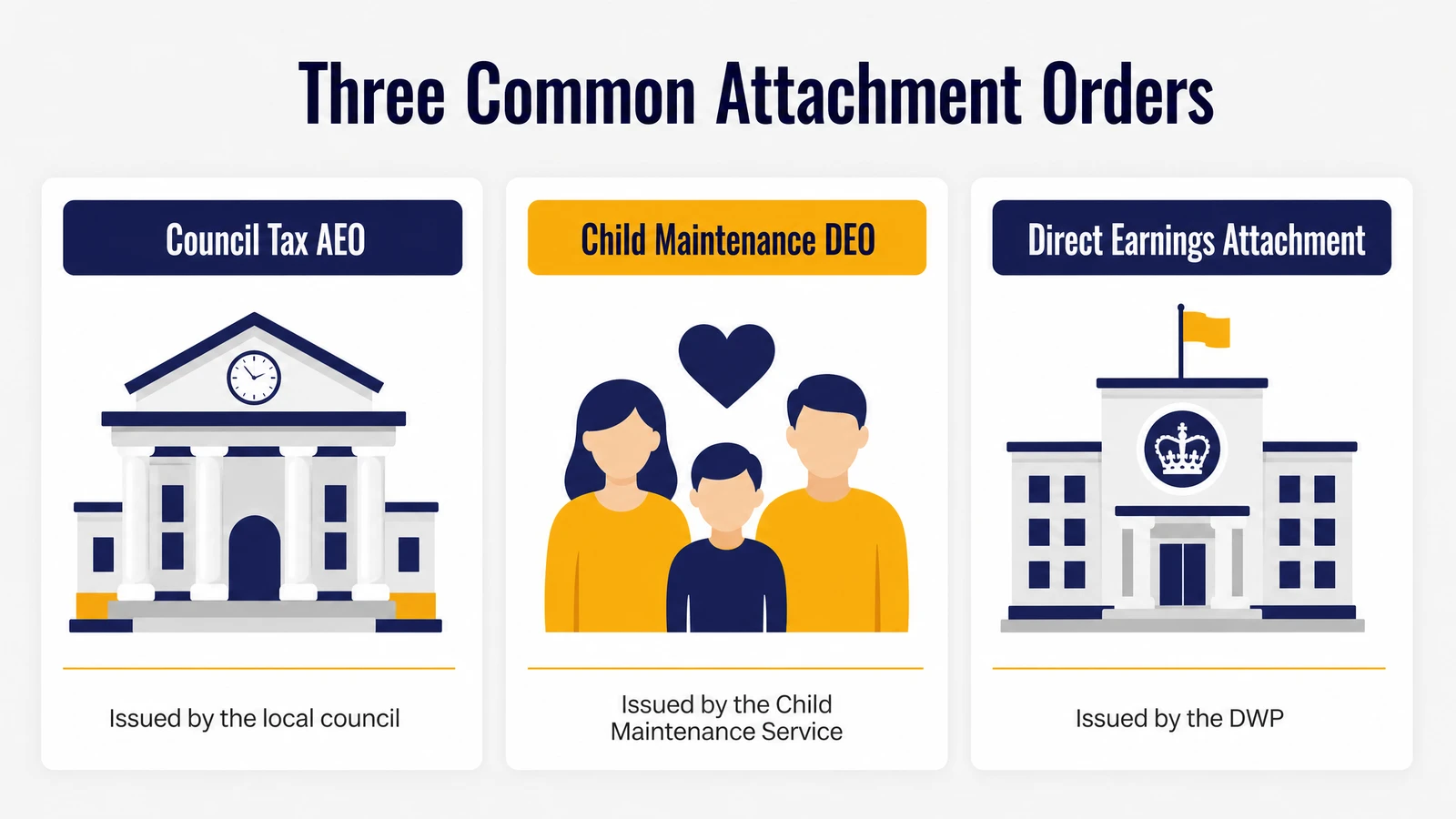
Council Tax Attachment of Earnings Order (CTAEO)
Local councils use a CTAEO to recover unpaid council tax once other recovery steps have failed. It’s issued under the Council Tax (Administration and Enforcement) Regulations 1992.
A CTAEO uses a fixed percentage table based on the employee’s net earnings, covered in full below.
Child Maintenance Deduction from Earnings Order (DEO)
The Child Maintenance Service issues a DEO when a paying parent falls behind on child maintenance, or as the default collection method on some cases from the outset.
Instead of a banded percentage table, a DEO sets a normal deduction rate and a protected earnings proportion, specific to that individual case.
Direct Earnings Attachment (DEA) for Benefit Overpayments
The DWP uses a DEA to recover an overpaid benefit directly from wages, most often Universal Credit.
Like the CTAEO, it uses a banded percentage table. Unlike the CTAEO, the DWP sets two separate tables, a standard rate and a higher rate, chosen case by case.
The DWP’s own Direct Earnings Attachment guide for employers sets out both tables in full, along with the notification and payment deadlines covered later in this guide.
A Fourth Type: Fines and Compensation Orders
Magistrates’ courts can also issue an attachment of earnings order to recover an unpaid fine or compensation order, under the Attachment of Earnings Act 1971.
It works the same way in principle as a CTAEO, deducting a set percentage of net earnings.
It uses its own separate rate table, set out on the notice itself rather than the council tax table above. Always work from the specific figures on the document you’ve actually received, never a table from a different order type.
Four different bodies, four different rulebooks: a council uses the CTAEO tables, a court uses its own fines table, the Child Maintenance Service uses a protected earnings proportion, and the DWP chooses between a standard and a higher DEA rate.
How Much You Must Deduct: The Rate Tables
Both the CTAEO and the DEA calculate the deduction from a percentage table based on the employee’s net earnings for that pay period.
Net earnings means pay after tax, National Insurance, and any workplace pension contribution, not gross salary.
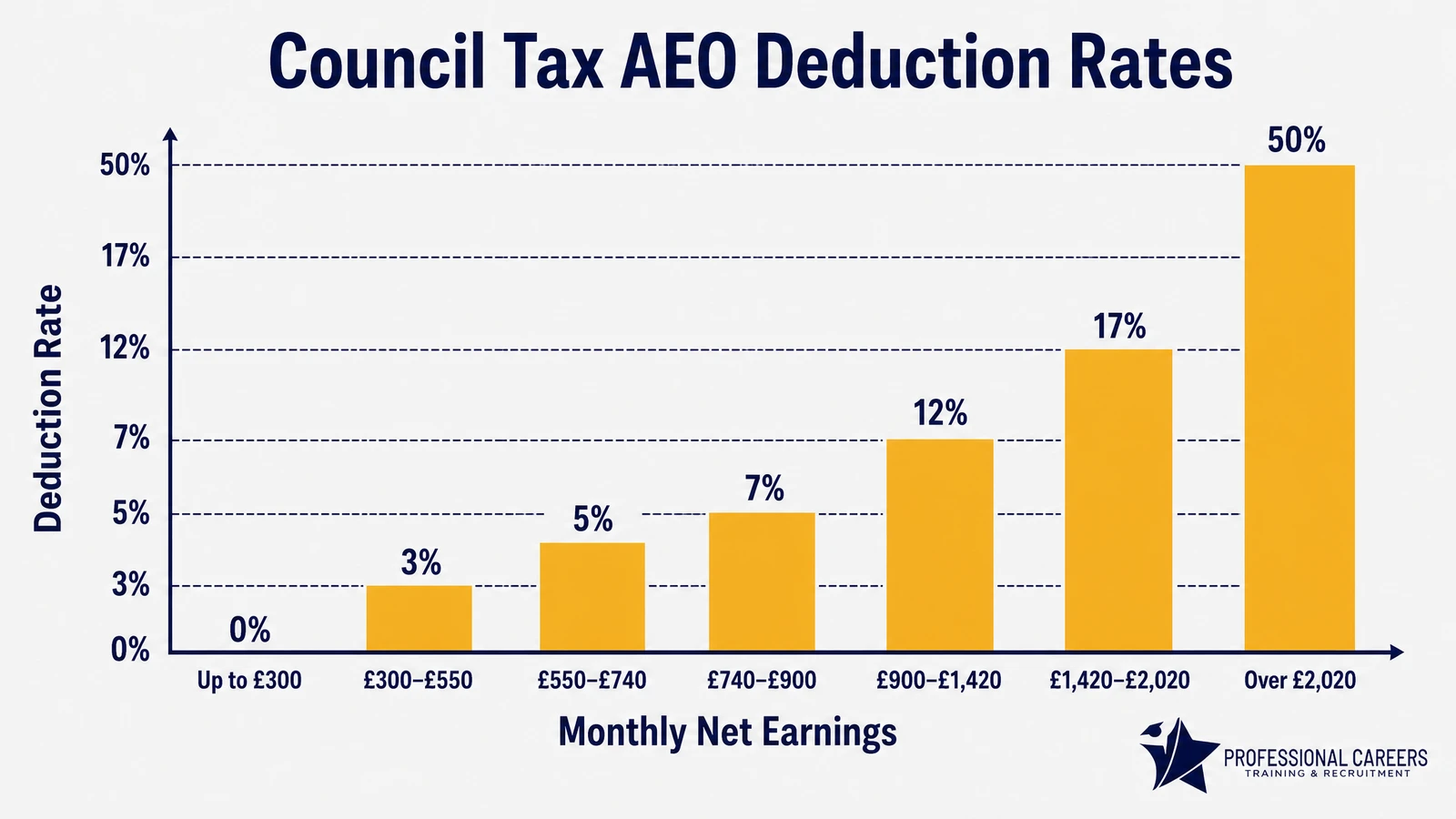
Council Tax AEO Deduction Rates
| Weekly net earnings | Monthly net earnings | Deduction rate |
|---|---|---|
| Up to £75 | Up to £300 | 0% |
| £75.01–£135 | £300.01–£550 | 3% |
| £135.01–£185 | £550.01–£740 | 5% |
| £185.01–£225 | £740.01–£900 | 7% |
| £225.01–£355 | £900.01–£1,420 | 12% |
| £355.01–£505 | £1,420.01–£2,020 | 17% |
| Over £505 | Over £2,020 | 17% up to the threshold, then 50% on the rest |
Each council tax debt can trigger its own separate CTAEO, and a single employee can have more than one running at once.
Every order is calculated and applied independently, using this same table each time, not combined into one single deduction.
Direct Earnings Attachment Rates
| Monthly net earnings | Standard rate | Higher rate |
|---|---|---|
| Up to £430 | 0% | 5% |
| £430.01–£690 | 3% | 6% |
| £690.01–£950 | 5% | 10% |
| £950.01–£1,160 | 7% | 14% |
| £1,160.01–£1,615 | 11% | 22% |
| £1,615.01–£2,240 | 15% | 30% |
| £2,240.01 or more | 20% | 40% |
The DWP’s notice tells you which rate to use, standard or higher. It’s usually the higher rate for a more serious or repeated overpayment.
Weekly-paid employees use the equivalent weekly bands, also set out on the same notice, rather than the monthly figures above.
A DEO works differently again. Rather than a banded table, the Child Maintenance Service sets a normal deduction rate specific to that case, calculated as a proportion of the paying parent’s net income.
Where Attachment Orders Sit in Your Deduction Order
Payroll software doesn’t apply every deduction in one go. There’s a set order, and getting it wrong changes the net earnings figure an attachment order is calculated against.
Tax and National Insurance come off first, followed by any workplace pension contribution taken before tax under a net pay arrangement. Student loan and postgraduate loan repayments come next, calculated on their own separate threshold.
Only once those are all applied do you arrive at the net earnings figure a CTAEO, DEA, or fines order is actually calculated against.
Running an attachment order before a student loan deduction, or the other way around, produces the wrong figure for both.
Protecting Your Employee’s Take-Home Pay
Every one of these order types includes a protected earnings safeguard, so a deduction can never leave an employee with too little to live on.
For a DEA and a DEO, that floor is set at 60% of net earnings.
If the calculated deduction would take an employee below that 60% floor, you deduct less than the table says, down to whatever keeps them at the floor.
You never deduct nothing without instruction from the issuing body, and you never breach the floor just to hit the full table percentage.
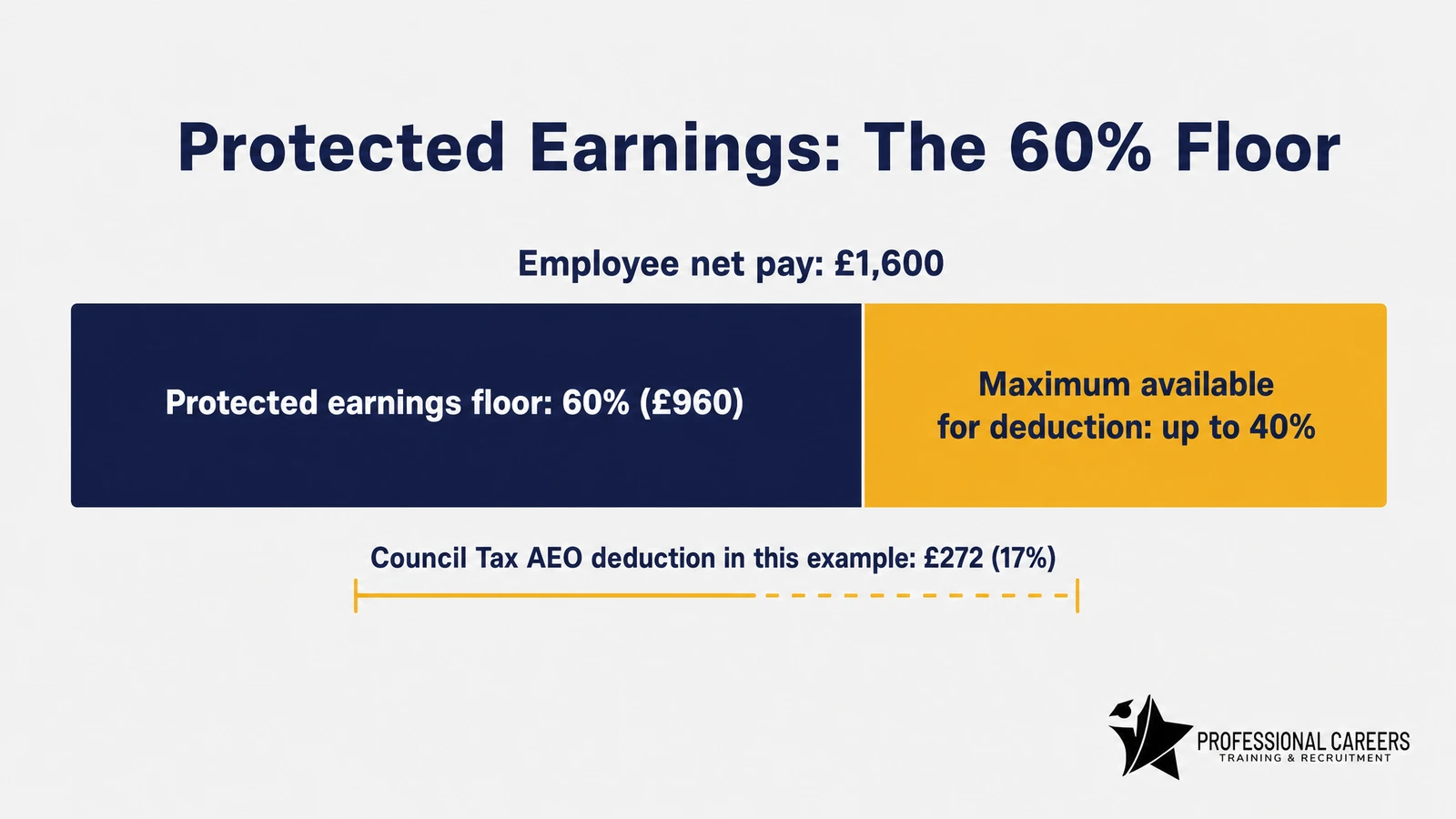
The 60% protected earnings floor overrides the rate table on a DEA or a DEO. If the standard calculation would leave an employee with less than 60% of net pay, reduce the deduction rather than skip the pay period entirely.
Worked Example: Calculating a Council Tax AEO Deduction
Take an employee paid monthly with net earnings of £1,600, who receives a single CTAEO. Here’s how payroll works out the deduction for that pay period.
- Check net earnings after tax, National Insurance, and pension contributions: £1,600.
- Find the matching band in the monthly table above: £1,420.01–£2,020 falls in the 17% band.
- Calculate the deduction: £1,600 × 17% = £272.
- Deduct £272 from the employee’s pay and record it separately on their payslip.
- Add the £1 administration fee if you choose to charge it, covered below.
- Pay the £272 to the council by the deadline set out in the order.
If that same employee already had another priority deduction running, you’d need to check the combined effect against the protected earnings rules for that second order before finalising the figure.
When Deductions Must Start, and Where the Money Goes
Starting Deductions
A CTAEO should start “as soon as reasonably practicable” after you receive it, generally the next available pay run.
A DEA notice takes effect from the first pay day falling on or after 22 days from the date on the letter.
Paying It Over
Deductions under a CTAEO are normally due to the council by the 18th of the month following the deduction.
DEA payments to the DWP are due by the 19th of the following month. A DEO’s payment deadline is set out in the Child Maintenance Service’s own notice.
The £1 Administration Fee
For a CTAEO, a DEA, or a DEO, you’re allowed to deduct an extra £1 from the employee’s pay each time you make a deduction, to cover your own administrative cost.
It’s optional, not compulsory, and it comes out of the employee’s pay, not your budget.
If charging the £1 fee would push a deduction below the protected earnings floor, or below the National Minimum Wage for that period, don’t charge it.
The statutory deduction always takes priority over the administration fee, every time.
If You Receive More Than One Order
Multiple CTAEOs against the same employee are dealt with in the order they were made, applying each in turn to whatever earnings remain after the previous one.
Ordinary civil debt orders, known as non-priority orders, rank below priority orders like a CTAEO.
A DEO generally takes priority over a DEA and most other deductions, unless a priority attachment of earnings order was already in place before the DEO arrived.
Scotland has its own separate ranking rules for a DEO, so always check the notice for your employee’s nation before assuming the England and Wales order applies.
When several orders land on the same employee, don’t guess the priority order yourself. Check each notice’s own instructions, and contact the issuing body if two orders genuinely conflict on what’s left to deduct from.
When an Employee Leaves While Under an Order
You must tell the issuing body as soon as an employee under an order leaves your employment, or was never actually employed by you.
For a DEA, the DWP needs telling within 10 days. For a CTAEO, most councils require notice within 14 days.
- Confirm the employee’s leaving date and their new employer’s details, if known.
- State clearly that deductions will stop from your side once they leave.
- Keep a record of the notification date and method, in case of a later dispute.
- Pass on any final part-period deduction you’ve already withheld before they left.
A DEO works the same way in principle. Notify the Child Maintenance Service promptly, so the case isn’t left showing payments that have actually stopped.
Getting It Wrong: The Penalties for Non-Compliance
Ignoring a DEA notice, or failing to make the deductions it requires, can result in a fine of up to £1,000 per notice on conviction.
A CTAEO carries its own separate penalty for non-compliance, or for giving false information to the council.
Beyond the direct fine, an employer who under-deducts, over-deducts, or misses payment deadlines repeatedly risks a formal compliance visit from the issuing body. That costs far more staff time than getting the calculation right first time.
Keeping Your Records Straight
Every attachment order needs its own audit trail: the original notice, the calculation for each pay period, the amount actually deducted, and confirmation the payment reached the issuing body.
Show each deduction as a separate, clearly labelled line on the employee’s payslip, never folded into a single generic “deductions” figure.
If HMRC, the council, or the DWP ever queries a specific pay period, that per-period record is what lets you answer quickly and correctly, rather than reconstructing the calculation from scratch.
Common Mistakes Payroll Teams Make with Attachment Orders
- Applying the deduction to gross pay instead of net earnings after tax, National Insurance, and pension contributions.
- Forgetting to check the protected earnings floor before finalising a DEA or DEO deduction.
- Charging the £1 administration fee even when it would breach the protected earnings or minimum wage floor.
- Missing the notification deadline when an employee under an order leaves the business.
- Assuming every order uses the same rate table, when a CTAEO, a DEA, and a DEO each work differently.
- Not keeping a clear, separate audit trail of each order’s deductions on the employee’s payslip.
How Advanced Payroll Training Covers This
Attachment of earnings orders sit alongside statutory deductions like student loan repayments and pension auto-enrolment, as one of the areas that catches out payroll staff who’ve only learned the basics of payroll.
PC Training’s Advanced Payroll Training course covers court and statutory deduction orders as standard, alongside the wider legislative detail employers are expected to get right without a second guess.
If you’re building a payroll career and want to be confident handling a CTAEO, a DEO, or a DEA correctly from day one, that grounding matters.
It’s exactly what separates a basic payroll qualification from one that prepares you for real employer responsibilities.
Can an employee ask their employer to stop an attachment of earnings order?
No. Once an employer receives a valid order, they must comply with it. Only the issuing body, such as the council, the court, or the Child Maintenance Service, can cancel or vary it.
What happens if I deduct the wrong amount by mistake?
Correct it in the next available pay run and notify the issuing body of the error. Most bodies expect an honest correction rather than a perfect first attempt, but repeated errors can trigger a compliance check.
Do attachment of earnings orders apply to self-employed contractors?
No. These orders apply to employees paid through PAYE. A self-employed person is pursued directly by the issuing body rather than through a deduction from an employer’s payroll.
Can more than one attachment order run against the same employee at once?
Yes. It’s common for an employee to have more than one order in place, for example a CTAEO and a DEO together. Each notice explains how it should be prioritised against others.
Is the £1 administration fee compulsory?
No, it’s optional. Employers can choose to deduct it to cover their own administrative cost, but only where doing so doesn’t take the employee below the protected earnings or minimum wage floor.