If you're training to become a business analyst, or you already work as one, you've probably noticed AI tools turning up in more of your...
Search “will AI replace bookkeepers” and you will find two completely different answers. One says bookkeeping is finished within five years. The other says nothing has really changed.
Neither is accurate.
AI has already moved into day-to-day bookkeeping work: reading receipts, matching bank transactions, flagging odd-looking entries before a human sees them. What it has not done is remove the need for a bookkeeper who understands what the numbers mean.
This article sets out what AI actually does in bookkeeping right now, what the real UK data says about adoption, and what it means if you are training for this career or already working in it.
For the wider picture of AI across accounting roles, see our guide to technology for accounting. This article goes deeper specifically on bookkeeping.
What AI Actually Does in Bookkeeping Right Now
Most of the AI a working bookkeeper encounters is not a standalone “AI tool” with its own name. It is a feature built quietly into software already on the client’s desk.
That usually means Xero, QuickBooks, Sage, or an app that plugs into one of them.
It works in the background on three main jobs.
Reading and Matching Bank Transactions
Modern bookkeeping software learns from how a business has coded transactions before. Once it has seen coffee-shop card payments coded to “subsistence” a few times, it starts suggesting the same code automatically.
The bookkeeper’s job shifts from typing every line to checking the suggestions and correcting the ones that are wrong.
Reading Receipts and Invoices
Tools such as Dext Prepare let a client photograph a paper receipt on their phone. The software reads the supplier, date and amount straight off the image, rather than someone typing it in by hand.
Dext’s “Fetch” feature goes further, checking a list of approved suppliers every week and pulling in new invoices automatically.
Invoice-chasing tools work from the other direction. Chaser connects to Xero or QuickBooks and automates reminder emails for unpaid invoices. The company reports customers get paid 16 days faster on average, saving roughly 15 hours a week.
Flagging Errors Before a Human Catches Them
Dashboard tools such as Xenon Connect sit across a bookkeeper’s whole client list on Xero, QuickBooks, FreeAgent or Sage. They flag mistakes that used to surface only at year-end: duplicate supplier accounts, wrongly-coded transactions, VAT that does not add up.
Catching these in the month they happen, rather than in March, is one of the most genuinely useful changes AI has brought to the job.
None of this removes the bookkeeper from the process. It moves them from typing the data in to checking that the data is right, which is a different skill, not a smaller one.
How Many UK Bookkeepers and Businesses Are Really Using This
It is easy to assume AI adoption is further along than it actually is.
What the Official UK Data Shows
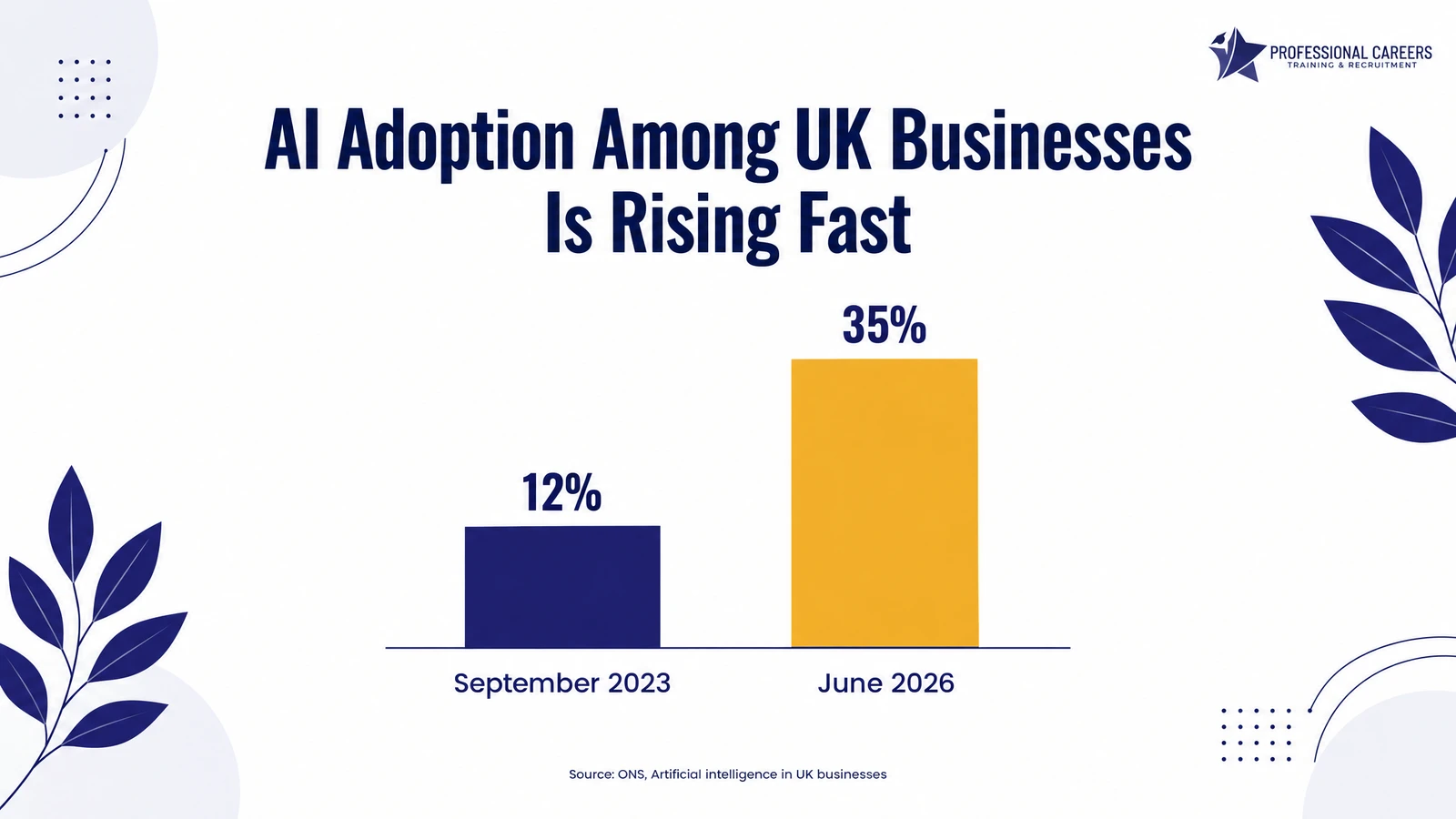
Figures from the Office for National Statistics’ own research on AI in UK businesses show a real shift, but one still a long way from universal.
| Business size | Reporting any AI use |
|---|---|
| Small businesses (0–9 employees) | 28% |
| All businesses with 10+ employees | 35% |
| Large businesses (250+ employees) | 49% |
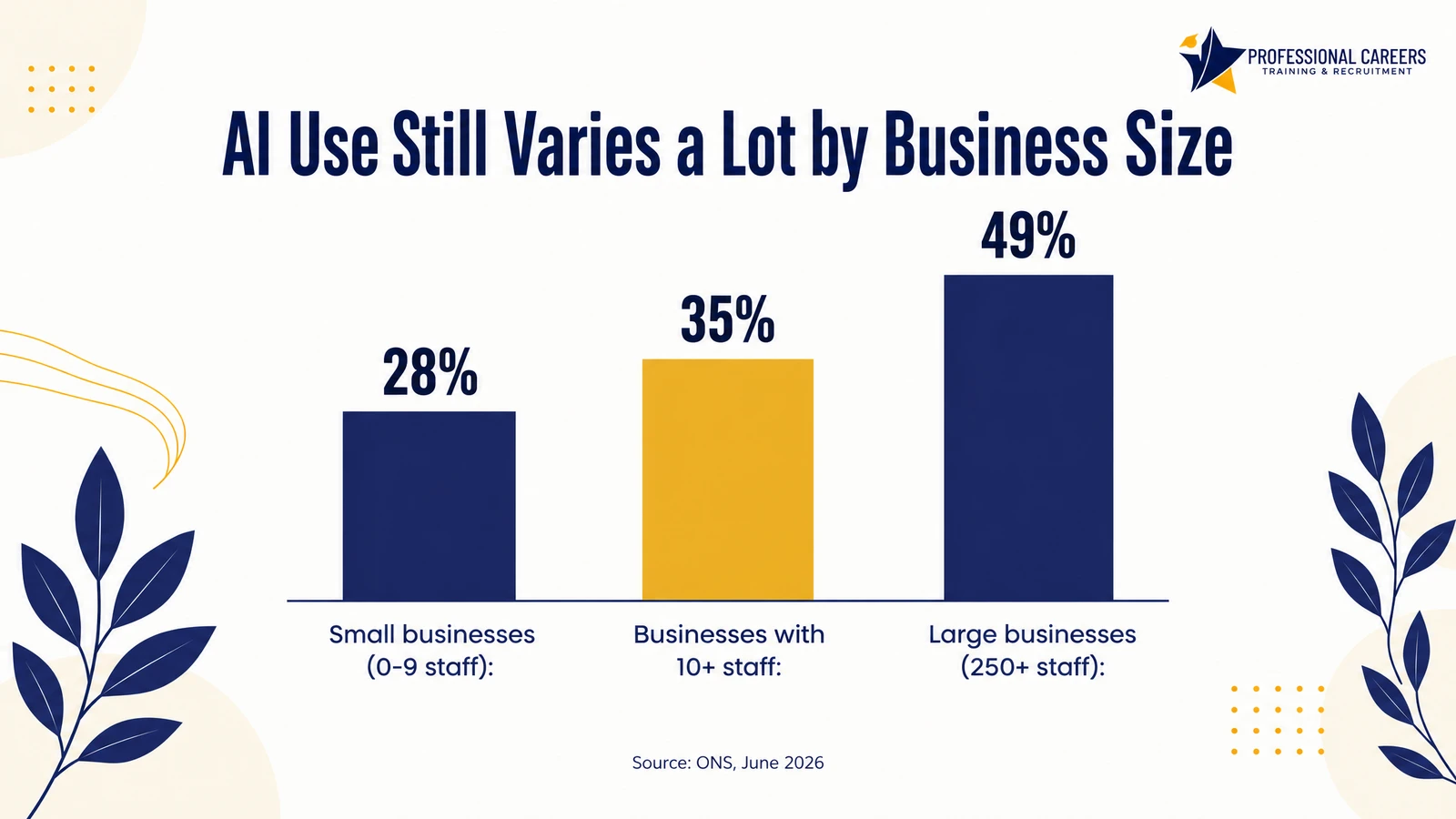
The 35% figure for businesses with 10 or more employees is nearly three times the 12% recorded in September 2023. That is a real, fast-moving trend, not a one-off blip.
But the ONS also found adopting businesses use an average of just 1.6 AI technologies each, up from 1.4 in 2023 — what the ONS itself calls “relatively shallow” adoption.
Most are using one or two specific features, not running the whole back office through it.
The ONS found that 53% of businesses using image-processing technology, exactly the kind of tool that reads a receipt or invoice, report it has affected administrative or clerical roles specifically.
That is the clearest official sign that bookkeeping-adjacent admin work is one of the areas genuinely being touched.
What UK Bookkeepers Themselves Say
A 2025 survey by AAT, the professional body behind the UK’s main bookkeeping and accounting technician qualifications, backs this up from the profession’s own side.
Among UK accounting professionals surveyed, 42% said they found AI tools genuinely useful day-to-day, rising to 55% among those aged 25 to 34.
At the same time, 71% agreed that anyone using AI tools needs proper training to do it safely, not just access to the software.
“AI can be an enabler of success, building a more dynamic, inclusive, and tech-enabled finance profession,” says Claire Bennison, AAT’s Executive Director. The emphasis is on AI as a tool the bookkeeper uses well, not a replacement for the bookkeeper.
Is AI Taking Bookkeeping Jobs, or Changing Them?
The honest answer is that it is changing what the job involves, not removing the job. The same AAT survey found 64% of respondents believe AI will enhance the accounting profession rather than shrink it.
80% of current accountants surveyed agreed AI will free them up for more strategic, advisory-style work rather than pure data entry.
What AI Still Cannot Do
AI software can match a transaction to a pattern it has seen before. It cannot decide whether an unusual transaction is a genuine business expense or a mistake that needs querying with the client.
It cannot explain to a nervous sole trader why their VAT bill has gone up this quarter, or spot that a director’s loan account is quietly becoming a problem. Judgement and accountability are still entirely human.
Where Making Tax Digital Fits In
Part of why bookkeeping software has become more automated is regulatory, not just technological. Making Tax Digital for VAT already requires VAT-registered businesses to keep digital records and file through compatible software.
That is exactly the kind of system AI features get built into first. A bookkeeper who understands both the rules and the software is in a stronger position than one who only knows one.
AI is taking over the parts of bookkeeping that were always the least interesting part of the job. It is not taking over the parts that actually required a bookkeeper.
The Skills That Matter More Because of AI, Not Less
If AI is handling more of the data entry, the skills that set a bookkeeper apart shift accordingly. Four areas stand out.
Checking AI’s Work, Not Just Trusting It
Software that learns from past coding will happily repeat a past mistake with total confidence. A bookkeeper who understands the underlying accounting well enough to spot a wrong suggestion is doing genuinely skilled work.
Client Communication and Advisory Conversations
With less time spent on manual entry, more of a bookkeeper’s week can go on explaining figures to clients and flagging cash flow issues early.
This is exactly the advisory work the AAT’s surveyed accountants expect AI to free up time for.
Software Fluency Across More Than One Platform
Clients arrive on Xero, QuickBooks, Sage, FreeAgent and others, each with its own version of these AI features. Our guide to the software tools taught on PC Training’s Bookkeeping & VAT course covers the platforms employers actually ask for.
Solid Fundamentals Underneath the Automation
None of this works without the basics. A bookkeeper who does not understand double entry bookkeeping cannot sense-check the software. They can only accept it on faith, which is how errors slip through unnoticed.
What This Means for Bookkeeper Pay and Demand in the UK
There is no evidence in current UK data that AI is depressing bookkeeper salaries or demand. If anything, the roles now ask for more, not less: software fluency on top of the accounting knowledge always required.
| Source | Figure |
|---|---|
| National Careers Service – starter salary | £24,000/year |
| National Careers Service – experienced salary | £35,000/year |
| Indeed – average salary, England | £28,826/year |
| Indeed – typical range, England | £25,420–£41,204/year |
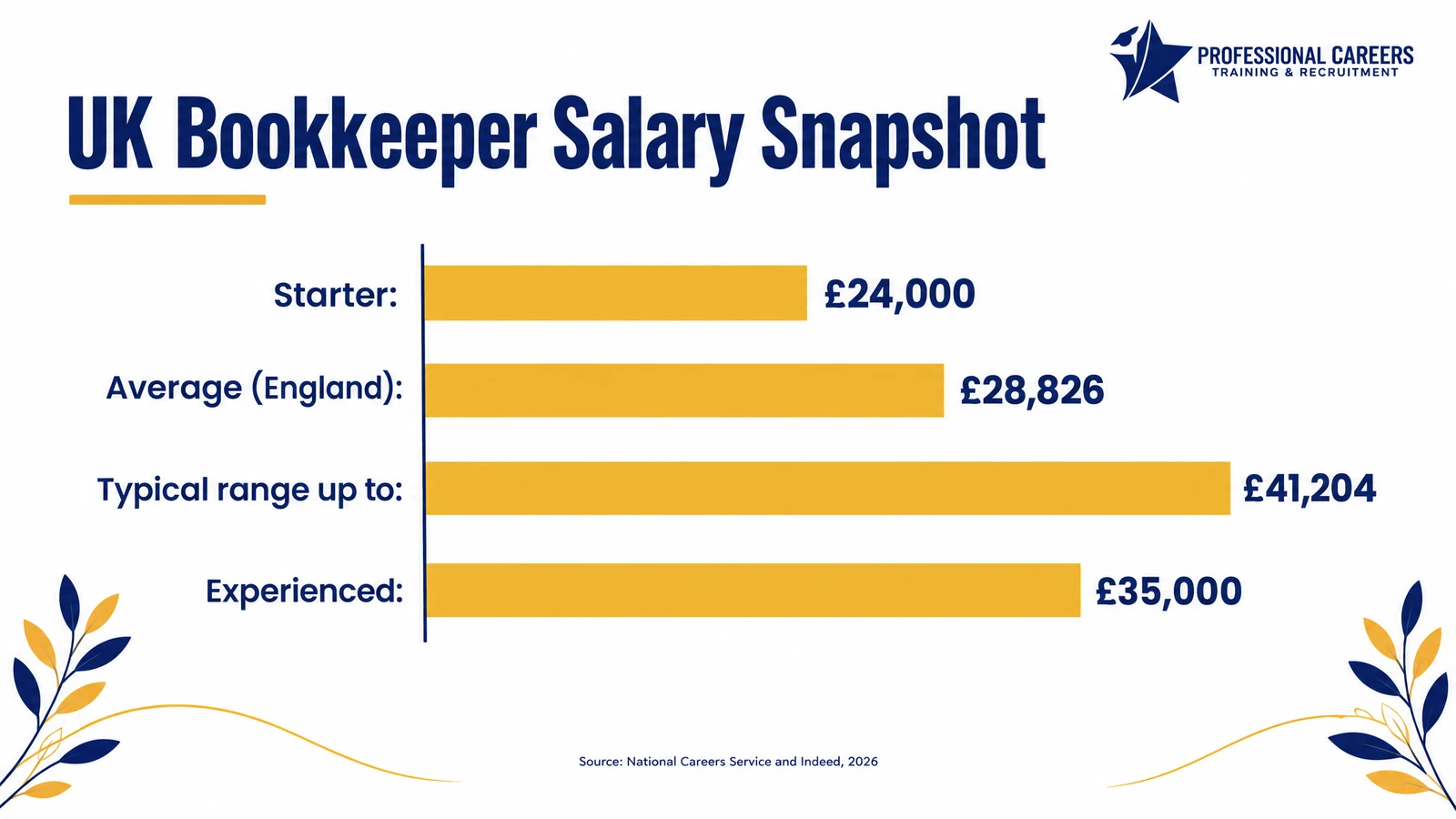
Those figures, from the government’s own National Careers Service and from Indeed’s August 2026 data (based on 3,200 reported salaries), sit comfortably within the range bookkeeping has occupied for years.
The job has not been devalued by automation. The automation has simply changed which parts of the day earn that salary.
Common Myths About AI and Bookkeeping
- “AI will replace bookkeepers within a few years.” UK adoption is real but shallow. Most adopting businesses use only one or two AI features, not a fully automated back office.
- “You don’t need to learn the fundamentals anymore, the software does it.” The software only works well when someone who understands the fundamentals is checking it. Skipping that step lets errors slip through.
- “AI tools are only for big firms.” Dext, Chaser and similar tools are priced and built for sole traders and small businesses, which make up most of PC Training’s learners’ future employers.
- “Learning AI tools is a separate qualification from bookkeeping.” Employers expect software fluency as part of the bookkeeping skill set itself, not as an add-on certificate.
How to Make Sure Your Bookkeeping Skills Keep Up
Whether you are training for your first bookkeeping role or already working and want to stay competitive, the same practical steps apply.
Five Steps to Keep Your Skills AI-Ready
- Get properly grounded in double-entry bookkeeping and VAT rules first. AI tools are built to assist that knowledge, not substitute for it.
- Get hands-on with at least one major platform’s AI features, Xero, QuickBooks or Sage, rather than only reading about them.
- Practise reviewing AI-suggested coding critically, so spotting an error becomes a habit rather than an afterthought.
- Keep an eye on Making Tax Digital requirements, since compliance rules are often where new software features appear first.
- Treat client communication as a core skill, not a bolt-on. It is the part of the job AI is least able to take over.
Where PC Training Fits In
PC Training’s Bookkeeping & VAT Training course is built around exactly this combination: solid double-entry and VAT fundamentals alongside the software skills employers now ask for, plus guaranteed recruitment support once you qualify.
For more on the qualification routes themselves, see our guide to UK bookkeeper qualifications.
The bookkeepers who do best out of AI are not the ones who ignore it, and not the ones who blindly trust it. They are the ones who understand the accounting well enough to use it properly.
Will AI replace bookkeepers in the UK?
No evidence points that way. ONS data shows adoption is real but shallow — most businesses using AI run only one or two features, not a fully automated back office. AI is replacing specific tasks, not the bookkeeper’s overall role.
What AI tools do UK bookkeepers actually use?
Most are built into existing software: bank-feed coding suggestions in Xero, QuickBooks and Sage, receipt-scanning apps such as Dext Prepare, automated invoice-chasing tools such as Chaser, and dashboard tools that flag coding errors across a client list.
Do I need to learn AI tools to become a bookkeeper?
You need to learn double-entry bookkeeping and VAT rules first, then get comfortable with how your chosen software’s AI features work. Employers expect both together, not one instead of the other.
Is bookkeeping still a good career with AI on the rise?
Current UK salary data shows no sign of AI depressing bookkeeper pay or demand. National Careers Service figures put experienced bookkeeper salaries at around £35,000 a year, consistent with long-standing norms.
How does Making Tax Digital relate to AI in bookkeeping?
Making Tax Digital for VAT requires digital record-keeping through compatible software, which is exactly where AI features such as automated coding and error-flagging get introduced first. Understanding MTD and AI-enabled software go hand in hand.