
You're probably staring at an export from Sage, Xero or payroll software right now. One column holds the detail you need. Another column holds the...
You're probably in one of two places right now.
You've either got a degree and a sinking feeling that employers still want experience you don't have, or you're trying to switch careers and wondering whether university is worth the cost when what you really need is a job. If you want to move into bookkeeping, VAT, advanced payroll, accounts assistant work, final accounts, business analysis, or data analysis, that decision matters. The wrong route costs you time. The right route gets you employable faster.
The degree vs certification debate often gets framed badly. People turn it into a status contest. That's a mistake. This isn't about prestige. It's about getting from where you are now to a role that pays, develops your skills, and gives you a future in the UK job market.
Your Career Crossroads Navigating Your Next Step
A common scenario looks like this. You finish university with a business, finance, or accounting-related degree. You've done essays, group projects, and exams. Then you start applying for jobs and see the same phrases over and over: Xero experience, Sage knowledge, payroll processing, VAT returns, Excel reporting, SQL, Power BI, month-end tasks, reconciliations.
That's when the panic kicks in. You've got education, but not enough proof that you can do the actual work.

The UK data makes the problem clear. In 2024, 87.6% of working-age graduates were employed, compared with 68.0% of non-graduates. But graduates from 2020 onwards faced a 12.7% unemployment rate, which equates to around 96,041 unemployed UK graduates annually according to the UK graduate labour market statistics. So yes, degrees still matter. No, they don't guarantee immediate job readiness.
Why this feels harder than it should
If you're changing careers, the stress is different but just as real. You might already have work experience in admin, retail, customer service, or operations. You know you can work hard. What you don't have is a clean route into bookkeeping, payroll, VAT, or data.
That's where individuals often freeze. They assume they must start from scratch with another degree. Often, they don't.
Practical rule: If a job advert names software, reporting tasks, or compliance work, you need evidence you can perform those tasks, not just talk about them.
You also need a plan that fits your stage. A graduate needs one kind of move. A career changer needs another. Someone already working in finance who wants to step into final accounts or advanced payroll needs a different answer again.
For a wider look at how to think about long-term progression rather than just your next job, Eztrackr's career guide is worth reading. It helps if you're trying to connect your immediate training choice to a bigger career path.
The Foundational Split Defining Degrees and Certifications
A degree gives you breadth. A certification gives you application.
That's the cleanest way to think about it.
A degree usually teaches the why behind a subject. In accounting, finance, business, or data, that means concepts, frameworks, analysis, and theory. You learn how organisations work, how financial information supports decisions, how data can be interpreted, and how to think critically. That matters. Employers still value people who can understand context, not just click buttons in software.
A certification does something else. It teaches the how. How to process payroll correctly. How to reconcile bank transactions. How to post journals. How to produce VAT returns. How to use Sage, Xero, QuickBooks, SQL, Excel, Python, or Power BI in ways that match real job tasks.
Degrees build range
If you want broad career flexibility, a degree still has weight. It can support movement into management, strategy, and roles where employers expect a wider academic base. It also helps if you enjoy structured study and want a qualification that sits well across multiple industries.
For finance and data careers, a degree is often most useful when you pair it with practical execution. On its own, it can leave a gap between what you know and what hiring managers need.
Certifications build proof
A good certification is sharper. It tells an employer, “I can do this part of the job.”
That makes certifications powerful for these roles:
- Bookkeeping: Software use, reconciliations, ledgers, trial balance work
- VAT work: Returns, thresholds, treatment, records
- Advanced payroll: Processing, compliance, reporting, payslips
- Accounts assistant roles: Purchase ledger, sales ledger, journals, bank recs
- Final accounts: Adjustments, accruals, prepayments, financial statements
- Business analyst and data analyst roles: Excel, SQL, Power BI, reporting logic
Think of a degree as the map and a certification as the toolkit. If you only have the map, you still can't build much.
There's also a common misunderstanding here. People act as if the choice must be one or the other. It often shouldn't be. A business graduate with practical training in SQL and Power BI becomes more employable for analyst roles. An accounting graduate with Sage, Xero, payroll, and final accounts training becomes more credible for entry-level finance roles.
If you're unsure what employers mean when they talk about professional qualifications, this guide to professional qualification meaning gives a useful breakdown.
A Core Comparison of Time Cost and Employer Perception
You need to judge this decision on three things. Time. Cost. Hiring value.
Here's the fast comparison.
Degree vs Certification At a Glance
| Attribute | Academic Degree | Professional Certification |
|---|---|---|
| Typical duration | Usually three years for an undergraduate course | Often 3 to 12 months |
| Typical cost | Usually £27,750 for a three-year programme, with some specialisations exceeding £50,000 | Usually £500 to £5,000 |
| Learning style | Broad, academic, theory-led | Focused, practical, task-led |
| Best for | Long-term foundation and broader progression | Fast entry, upskilling, career switching |
| Employer signal | Strong academic credibility | Strong proof of job-ready skill |
| Common use in finance and data | Graduate schemes, broader professional routes | Software, payroll, bookkeeping, analyst tools |
| Ideal outcome | Knowledge base plus later specialisation | Immediate employability in a defined role |
The cost difference isn't minor. It changes what's realistic for people who need work soon. UK undergraduate degrees typically cost £27,750 for a three-year programme, with some specialisations exceeding £50,000, while professional certifications usually cost between £500 and £5,000 and can be completed in 3 to 12 months according to VerifyEd's summary of degree and certification routes.
What employers actually care about
Employers don't hire qualifications in isolation. They hire for tasks. If they need an accounts assistant, they want someone who can handle ledgers, invoices, reconciliations, Excel, and accounting software. If they need a data analyst, they want someone who can clean data, query it, present it, and explain it.
That's why certifications have gained ground. The same source notes that 80% of UK HR professionals value certifications during hiring, and over half of companies are removing degree requirements for roles that traditionally demanded them. That doesn't mean degrees are dead. It means employers are getting more practical.
My blunt view
If you want speed, a certification wins.
If you want long-run breadth, a degree still matters.
If you already have a degree and still can't get interviews, getting another degree is usually the wrong move. Add practical training instead. For bookkeeping, VAT, payroll, accounts assistant, and analyst roles, employers respond to software and process competence. They want to see that you can start contributing without months of hand-holding.
- Choose a degree if you want broad education, can afford the time, and are aiming for routes that value formal academic progression.
- Choose certification first if you need a faster route into paid work.
- Choose both if you already hold a degree but lack applied skill.
A qualification only helps if it changes how employable you look on paper and how capable you are on day one.
Analysing Salary Impact and Career Progression
The salary question isn't as simple as “degrees pay more” or “certifications get you hired faster”. Both can be true, depending on timing.
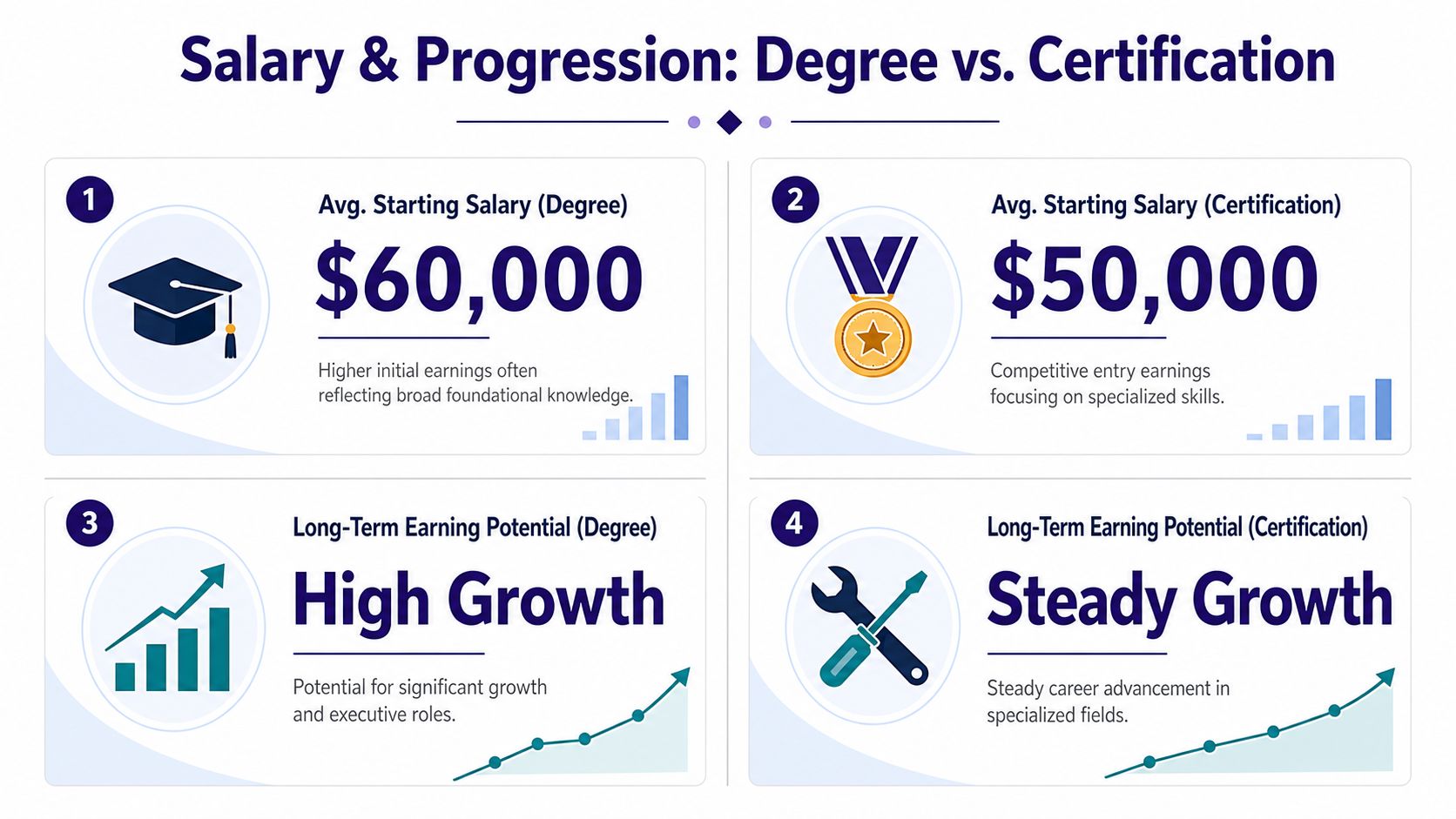
Degrees often support stronger earnings over the long run. That's one reason they still attract people despite the cost. But early-career outcomes in the UK aren't always tilted in favour of the standard university route.
The early-career surprise
This matters if you want to start earning quickly. In the UK labour market, some Further Education vocational qualifications, including Level 4 FE for men and Level 5 FE for women, show higher early-labour-market earnings on average than completing a standard university degree, after adjusting for observable characteristics based on research from the Centre for Vocational Education Research.
That finding matters more than many people realise. It means the “degree first, practical training later” model isn't automatically the best financial move in the short term.
What this means in real career paths
For finance roles, targeted vocational learning can move you into paid work faster because it aligns with direct business needs.
Examples:
- Advanced payroll can turn a general admin or junior finance background into a specialist track.
- Final accounts training can push someone from transactional work towards broader accounting responsibility.
- Bookkeeping and VAT training can lead to employed roles or self-employed service work.
- Business analyst and data analyst courses can help a graduate prove they can use SQL, Excel, and Power BI in practice.
A degree still has value for progression into broader leadership and strategic roles. Over time, that wider foundation can help when responsibilities move beyond execution into decision-making, team management, and commercial influence.
Don't confuse immediate return with total career value
The smartest question isn't “Which pays more?” It's “Which pays off at my stage?”
If you're stuck outside the market, the best return often comes from whatever gets you credible fastest. That's usually practical training. If you're already inside the field and thinking about long-term advancement, academic depth may become more useful.
If your next hurdle is getting hired, optimise for entry. If your next hurdle is moving up, optimise for depth.
When the job offer comes, don't undersell yourself. This advice on how to negotiate salary in a job offer is useful because many people focus so hard on getting in that they forget to handle the offer properly.
Bridging the Hands On Skill Gap in Todays Job Market
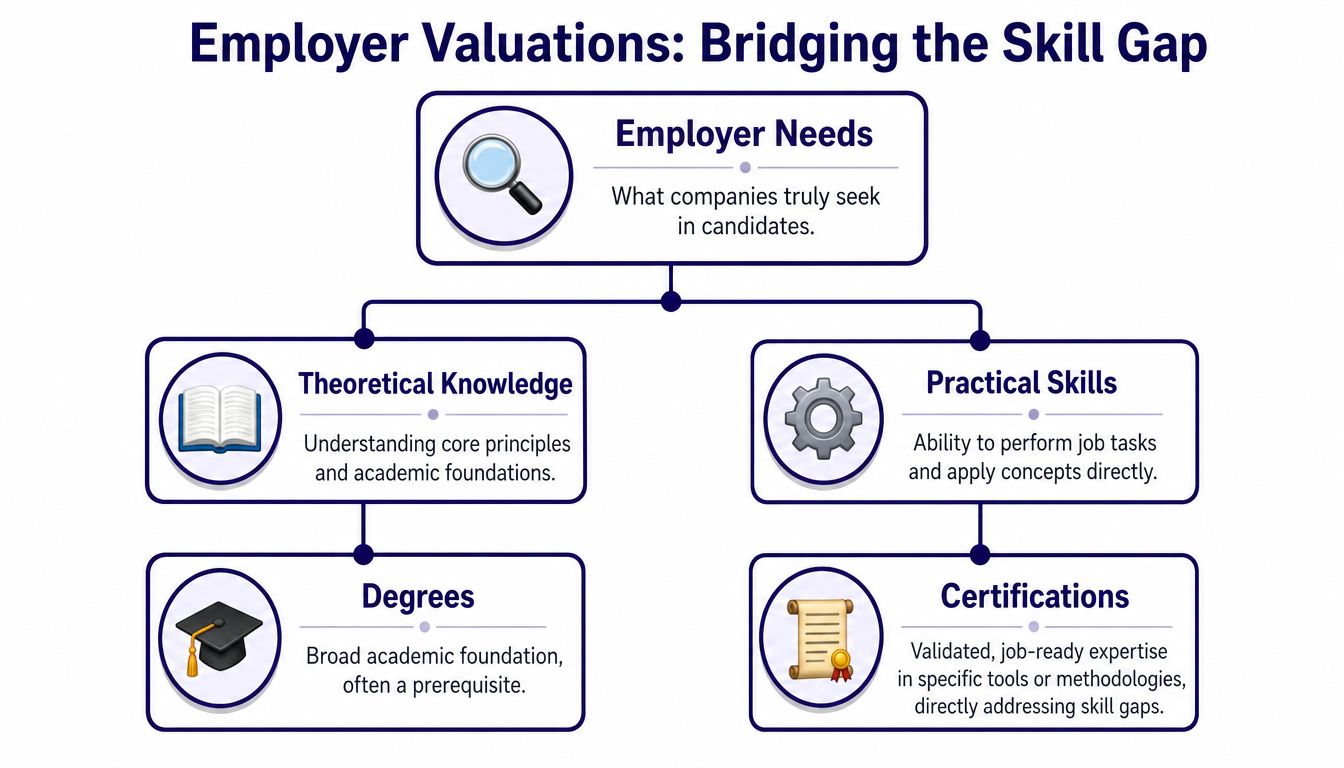
Employers keep saying they want “job-ready” people because training from scratch is expensive, slow, and risky for them.
That's why hands-on learning matters so much in the degree vs certification decision. A certification isn't magic paper. Its value comes from what it proves. If the course teaches you to use the same tools and workflows listed in real vacancies, the qualification becomes evidence, not decoration.
Why vocational learning feels more useful
The UK evidence on this is strong. Graduates with vocational qualifications report higher subjective labour market outcomes than those with general degrees. They report skills utilisation that is 16 percentage points higher, feeling “on track” in career progression that is 10 points higher, and meaningful work that is 6 points higher according to research published in Studies in Higher Education.
That makes sense. People feel better about work when they can do the work well.
The skills employers look for in these roles
For the roles this article focuses on, practical capability is easy to spot.
- Bookkeeping and VAT: Xero, Sage, QuickBooks, bank reconciliation, invoice posting, VAT return preparation
- Advanced payroll: payroll processing, statutory elements, reports, compliance handling
- Accounts assistant: purchase ledger, sales ledger, credit control support, month-end tasks, Excel
- Final accounts: journals, accruals, prepayments, adjustments, draft accounts preparation
- Business analyst: Excel, requirement gathering, reporting logic, process mapping, stakeholder communication
- Data analyst: SQL, Python, Excel, Power BI, data cleaning, dashboards, basic business interpretation
Here's a short explainer that captures why CPD and targeted training stay relevant even after you get hired.
What hiring managers are really checking
They're usually asking themselves four questions:
- Can this person use the tools we already use?
- Can they handle routine tasks with low supervision?
- Will they need months of basic training?
- Do they understand the UK context of the work?
That last point matters for international professionals in particular. UK payroll practice, VAT handling, and software workflows are specific. So are business reporting expectations in analyst roles.
A hiring manager will forgive limited experience faster than they'll forgive obvious unreadiness.
If you're building CPD into your progression plan, this guide to what CPD certification is helps clarify why ongoing practical learning carries weight.
Recommended Pathways for Your Career Goals
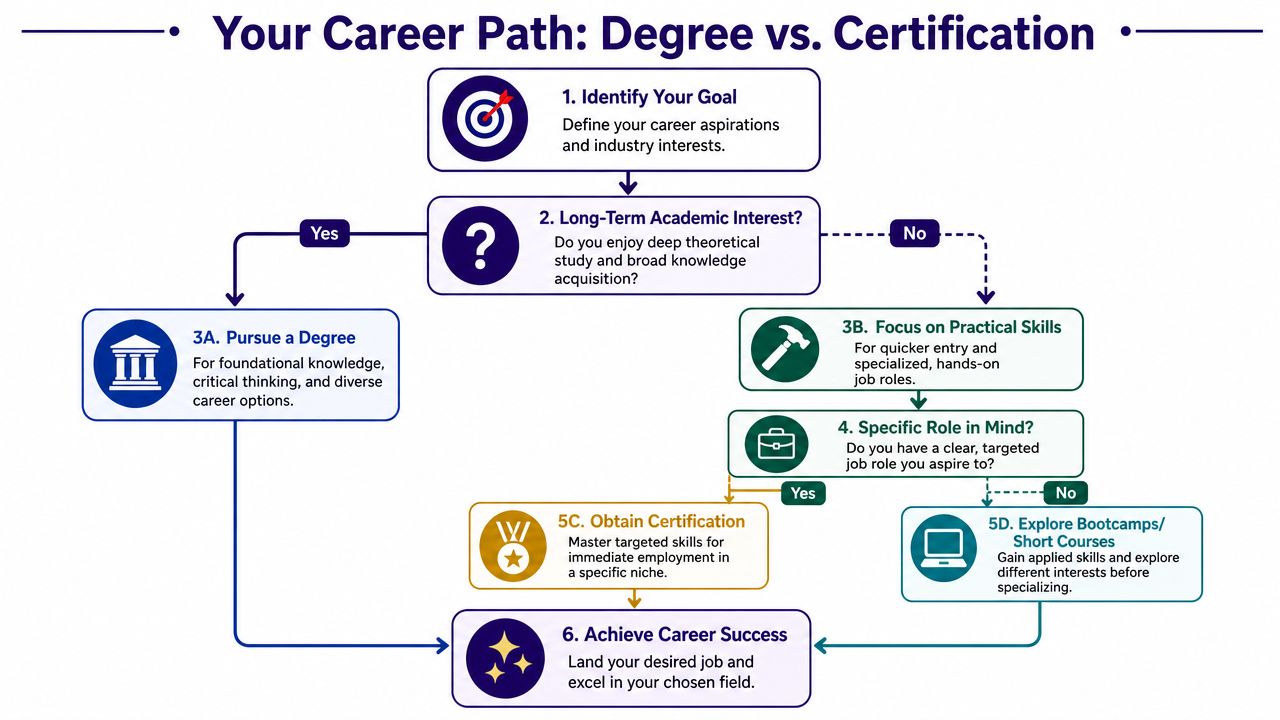
The need isn't for more information. It's for a decision.
Here's my advice based on the route you're on.
If you're a recent graduate
Don't sit there hoping your degree will eventually start working harder. Make it practical.
If your degree is in accounting, business, economics, or finance, add training that closes the execution gap. For accounting support roles, that means bookkeeping systems, VAT, payroll, accounts assistant tasks, or final accounts. For analyst roles, that means Excel, SQL, Power BI, and reporting practice.
Your degree already covers the broad story. Your next move should prove you can do the job.
If you're changing careers
In this regard, certifications often beat degrees decisively.
If you want to become a bookkeeper in the UK, there is no legal requirement to hold a university degree. Most beginners start with recognised vocational qualifications such as AAT Level 2 or Level 3 Certificate in Bookkeeping, which can be completed in 6 to 12 months via part-time study according to this guide on how to become a bookkeeper in the UK.
That should calm a lot of unnecessary fear. You do not need to reinvent your life through another full university programme just to get into bookkeeping.
- Move into bookkeeping if you want a practical finance route with clear task ownership.
- Choose payroll if you like process, detail, deadlines, and compliance.
- Choose accounts assistant training if you want broad entry into a finance team.
- Choose business or data analysis if you prefer reporting, systems, patterns, and decision support.
If you're already in finance and want to move up
Go specialised.
General experience only takes you so far. If you're already doing junior finance work, training in advanced payroll, VAT, or final accounts makes more sense than broad study. Specialist credibility often creates the jump from “supporting the process” to “owning the process”.
For VAT in particular, there's a clear top-end route. The CTA qualification from the CIOT is regarded as the “gold standard” and “highest level tax qualification in the UK” for VAT specialism, and it requires three years of demonstrable relevant professional tax experience plus two professional sponsors for membership according to Sage's guide to specialising in VAT accountancy practice. That's not a beginner route, but it shows where specialisation can lead.
If you're new to the UK market
Local proof matters.
You may already know accounting, payroll, or analytics. But UK employers still need to see UK software familiarity and UK working methods. For finance roles, software such as Sage, Xero, and QuickBooks helps localise your experience. For analyst roles, practical reporting projects using Excel, SQL, and Power BI make your ability visible.
One more practical point. If you're moving into bookkeeping or VAT support, know the basics of the legal framework. A UK business must legally register for VAT when taxable turnover exceeds £90,000 in any 12-month period as explained in this VAT registration threshold overview. You don't need to become a tax specialist overnight, but you do need to understand the operating environment.
Your Action Plan Turning Decision into Opportunity
Stop treating this as a philosophical question. Turn it into a career decision with deadlines.
Step 1 Assess your starting point
Write down what you already have.
That includes your degree, work history, software exposure, confidence with Excel, and whether you've handled any finance or data tasks before. Also write down your constraints. Time matters. Money matters. So does urgency.
If you need work quickly, your answer shouldn't look the same as someone who can spend years studying.
Step 2 Pick a target role, not a vague field
“Finance” is too broad. “Data” is too broad.
Choose a role title. Accounts Assistant. Bookkeeper. Payroll Administrator. VAT Assistant. Junior Business Analyst. Junior Data Analyst. Assistant Accountant with final accounts exposure. Once you choose the role, the training path becomes easier because the task list becomes clearer.
Step 3 Build the shortest credible route
Many tend to overcomplicate the process. They stack random courses instead of building a coherent profile.
Use this logic:
- Already have a degree but no practical skill: add hands-on certification
- No degree and need a quick pivot: start with vocational training aligned to the role
- Already working in the field: specialise with advanced modules
- International background: localise your profile with UK software and process training
Your goal isn't to collect certificates. Your goal is to remove reasons for an employer to reject you.
For bookkeeping and payroll, focus on systems and routine accuracy. For accounts assistant and final accounts pathways, build from transactional work into month-end and reporting. For business analyst and data analyst routes, your proof should include Excel, SQL, and Power BI applied to business problems, not just theory.
A good training provider should help with more than lessons. You should expect support that connects learning to employability, including CV preparation, interview positioning, and job search structure.
If you want a practical route into bookkeeping, VAT, advanced payroll, accounts assistant work, final accounts, business analysis, or data analysis, Professional Careers Training is built for that transition. Their training includes 1-to-1 support from ACCA qualified Chartered Accountants and CPD approved trainers, flexible evening and weekend study options, official Sage, Xero and QuickBooks certification, software support, and recruitment help such as CV preparation, career coaching, job hunting strategy, LinkedIn optimisation, and employer referrals. If your priority is becoming job-ready rather than staying stuck in theory, that's the kind of support that moves you forward.


