Holiday pay is one of the areas payroll teams get wrong most often. It is usually not carelessness. The rules genuinely changed in 2024, and...
Holiday pay is one of the areas payroll teams get wrong most often. It is usually not carelessness. The rules genuinely changed in 2024, and a lot of guidance still in circulation describes the old system.
This guide sets out how UK statutory holiday pay actually works in 2026. It covers how much leave workers are entitled to, and how to calculate a week’s pay for different working patterns.
It also covers how rolled-up holiday pay and the 12.07% figure work, notice periods for booking leave, carryover rules, and the mistakes that trip up payroll teams most often.
What Statutory Holiday Entitlement Actually Is
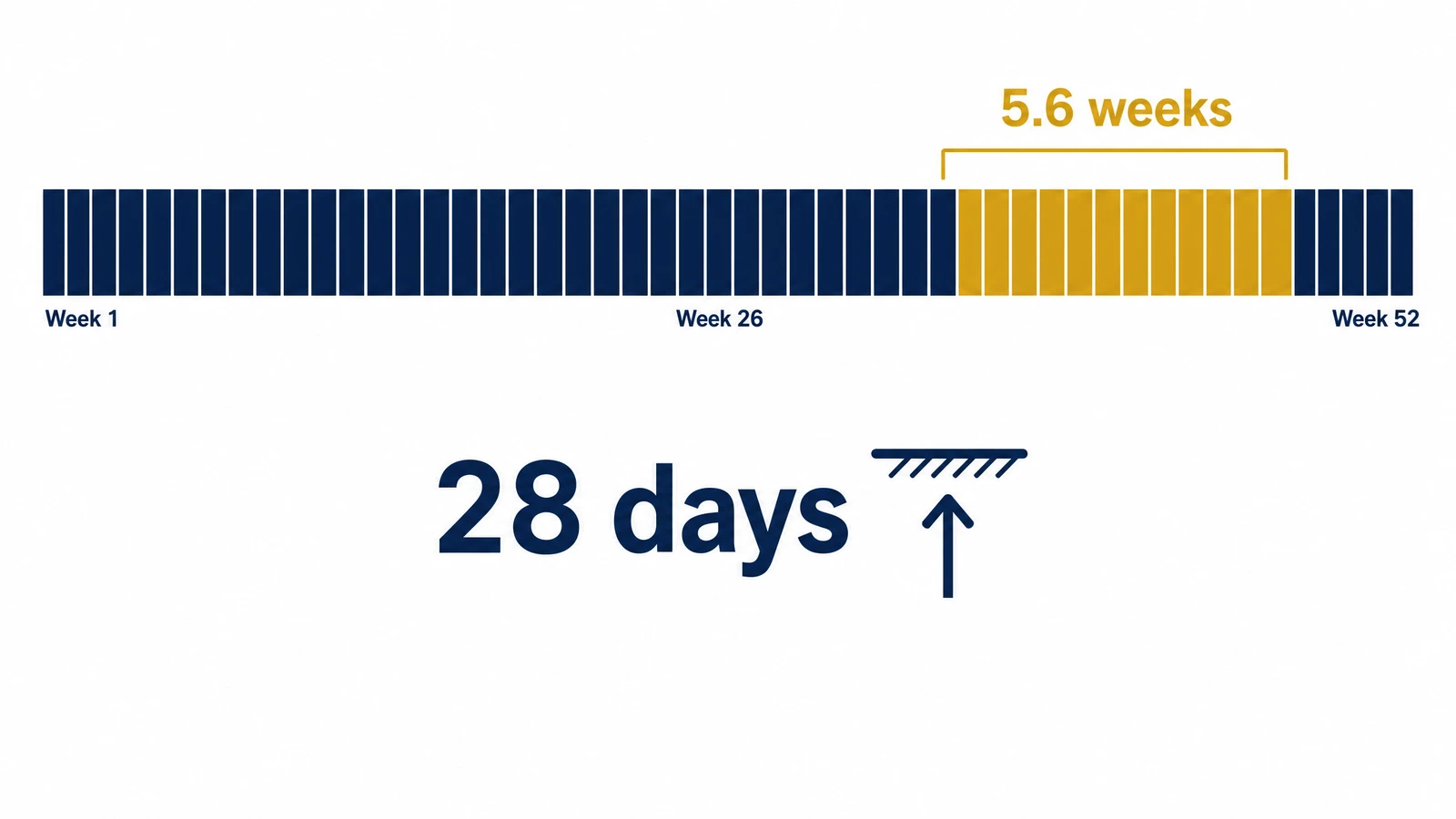
Almost all UK workers are entitled to 5.6 weeks of paid holiday a year. For someone working a standard five-day week, that works out at 28 days.
That figure is also the maximum statutory entitlement, regardless of how many days a week someone actually works.
That 28-day cap matters in practice. A worker on a six-day week is not entitled to 33.6 days, even though 5.6 weeks multiplied by six is higher than 28. The 28-day ceiling still applies.
Bank holidays are not an automatic extra on top of the 5.6 weeks by law, although many employers choose to treat them that way. Whether bank holidays are included or additional should always be set out clearly in the contract.
5.6 weeks is the statutory floor for almost every worker, capped at 28 days, and bank holidays only count as extra if the contract says so.
How to Calculate a Week’s Pay for Holiday
The method for working out what a week’s holiday pay is worth depends entirely on how someone is paid. There are three distinct calculations, and using the wrong one is one of the most common errors on this topic.
Fixed Hours, Fixed Pay
For a worker with fixed hours and fixed pay, holiday pay is simple. It is whatever they would normally earn for a week’s work.
Someone contracted to 37 hours a week at £500 a week is paid £500 for a week of holiday, no calculation needed.
Variable Pay With Fixed Hours
Where hours are fixed but pay varies, for example shift workers on differing rates, holiday pay is based on average hourly pay over the previous 52 weeks.
Any week not actually worked is excluded and replaced by looking further back, up to a maximum of 104 weeks.
Irregular Hours and Part-Year Workers
Irregular hours workers, such as casual or zero-hours staff, and part-year workers, such as term-time-only staff, use the same 52-week average principle. This category is where most of the 2024 reforms were aimed.
Whichever method applies, “normal pay” must include payments linked to contractual tasks such as commission, and payments tied to professional or personal status.
It must also include any overtime a worker has been paid regularly over roughly the past year. Leaving any of this out under-calculates holiday pay.
The 2024 Reforms, and Why They Still Matter in 2026
The Working Time Regulations were amended from 1 January 2024. Three specific changes applied only to leave years starting on or after 1 April 2024.
Those three changes were the accrual method for irregular hours and part-year workers, how leave built up during maternity, family or sick leave is calculated, and rolled-up holiday pay as a payment method.
By 2026, every leave year in the country has started under the new rules. There is no transitional period left to account for.
Any payroll process still running on the pre-2024 approach for irregular hours or part-year workers is out of date.
The reform followed a 2022 Supreme Court ruling, Harpur Trust v Brazel. It found that part-year workers could not have their holiday entitlement simply pro-rated down using the old 12.07% method as it was applied at the time.
The government’s response was to rebuild the rules around a clearer accrual method rather than leave the old approach in place.
For a worker off sick or on statutory family leave, holiday still accrues. It is calculated using their average pay from the 52 weeks they were actually working, not the weeks they were away.
The 2024 reforms are not new anymore. Every leave year since has started under them, so there is no old system left to fall back on for irregular hours or part-year staff.
Rolled-Up Holiday Pay: The 12.07% Method
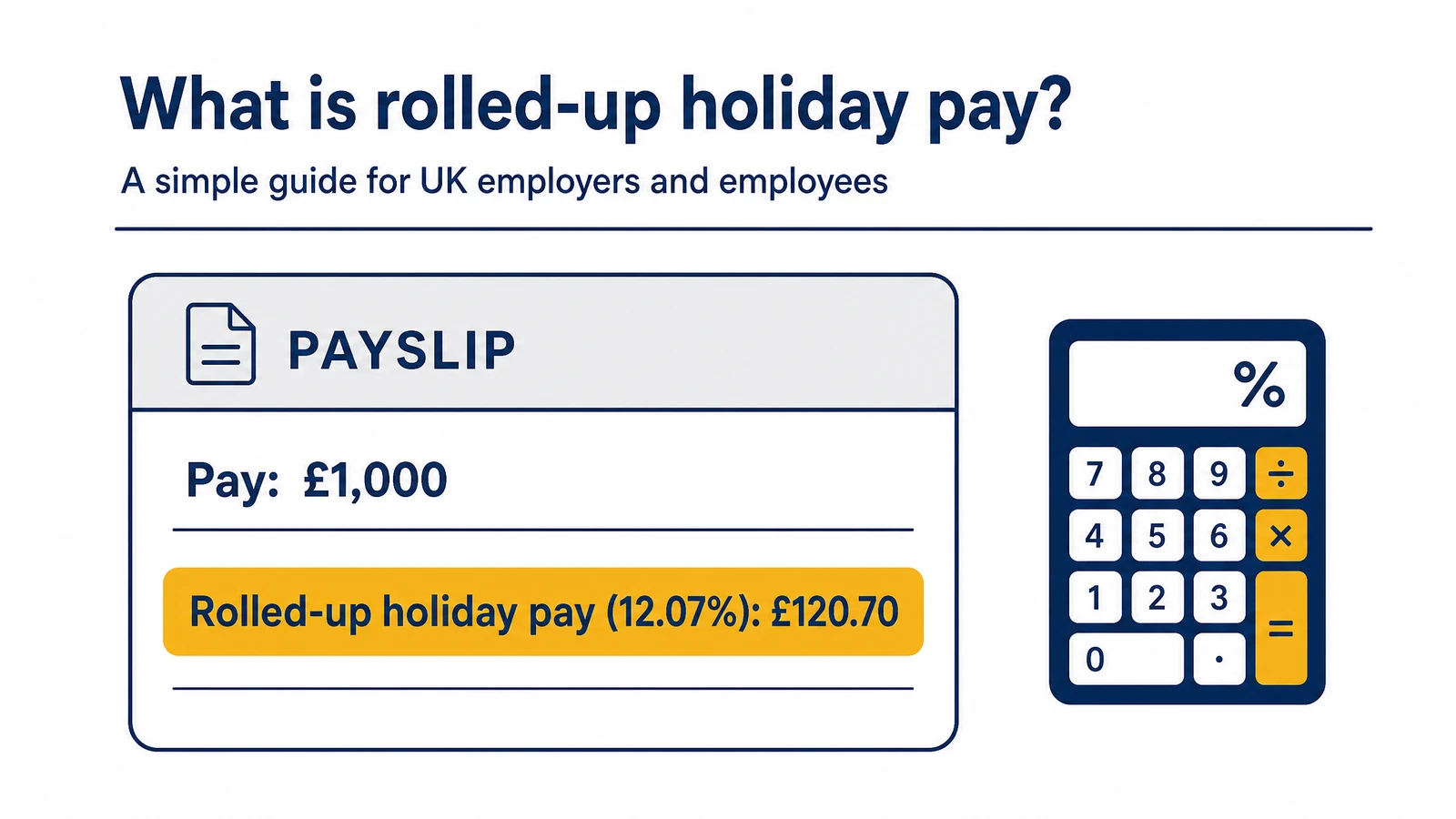
Rolled-up holiday pay lets an employer add holiday pay to a worker’s regular pay each pay period, instead of paying it separately when leave is actually taken. It is only permitted for irregular hours workers and part-year workers.
The rate is at least 12.07% of the worker’s total pay in that pay period. That figure comes from dividing the standard 5.6 weeks of leave by the 46.4 weeks left in the year once holiday is taken out.
An example from Acas makes the mechanics clear. A worker earning £1,000 in a given month under a rolled-up arrangement receives an additional £120.70 that same month, calculated as 12.07% of £1,000.
Rolled-up holiday pay must always be shown as its own separate line on the payslip. It cannot be folded invisibly into the headline pay figure.
A payslip that does not break it out is not compliant, even if the total amount paid is technically correct.
The method cannot be used for workers with fixed hours and pay, whatever the temptation to simplify payroll by applying one approach to everyone. Using rolled-up pay outside its permitted worker categories is a compliance risk, not a shortcut.
Notice Periods for Booking and Refusing Holiday
Payroll teams are not usually the ones approving individual leave requests, but understanding the notice rules matters when holiday pay disputes end up on a payroll manager’s desk.
The Worker’s Notice to Request Leave
Unless the contract sets a different rule, a worker must give notice of at least twice the number of days they want off. Requesting 10 days off means giving at least 20 days’ notice.
The Employer’s Notice to Refuse or Cancel
An employer can refuse a request, or cancel already-approved leave, but must give at least as much notice as the length of the leave itself. Cancelling an approved 7-day break needs at least 7 days’ notice.
An employer can also require staff to take leave at specific times, such as during a office closure over Christmas, but must give at least twice the number of days’ notice as the days being required.
Carrying Over Unused Holiday
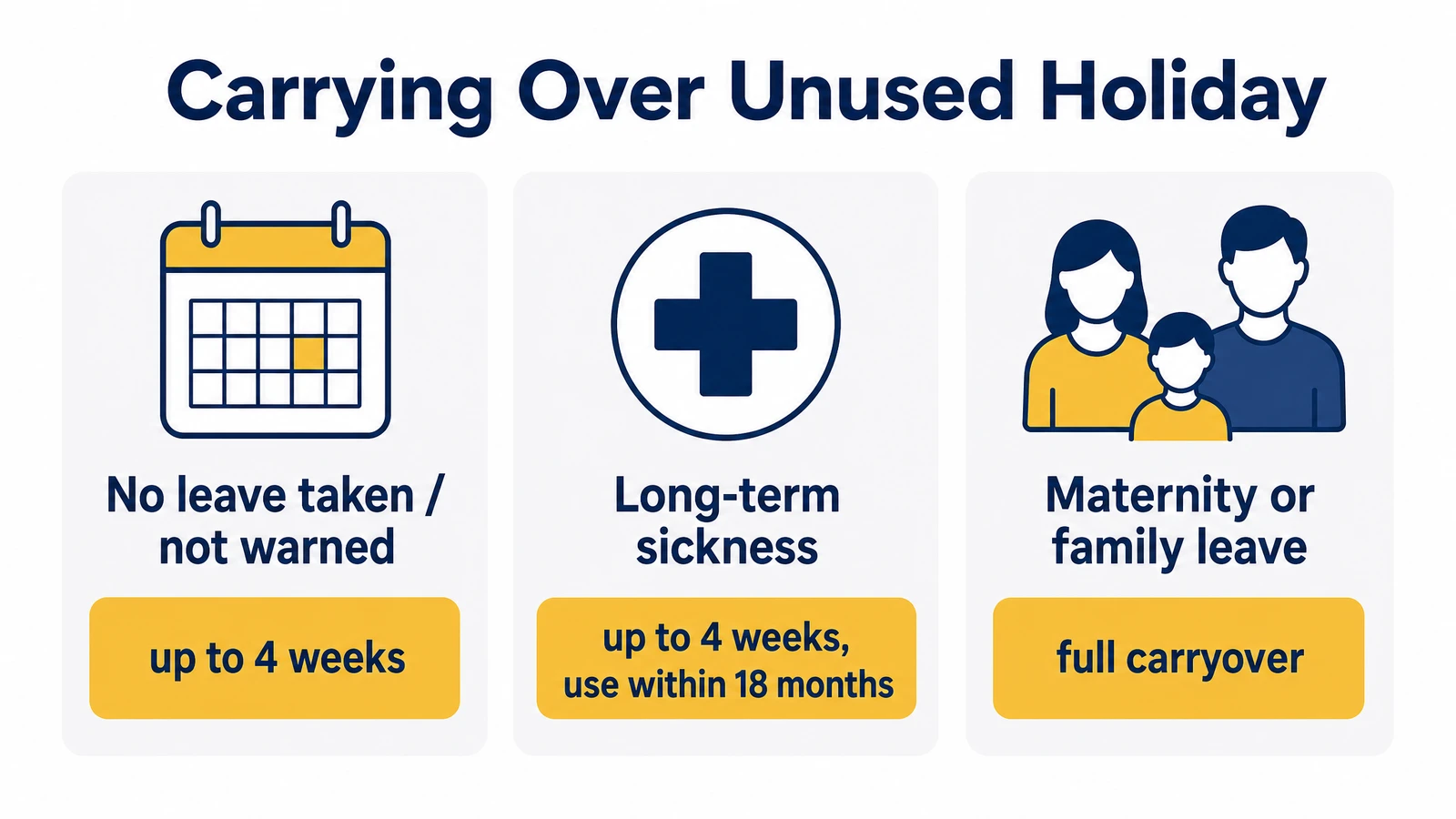
The default rule is that the 5.6 weeks must be taken within the leave year it was earned in. There is no automatic right to carry it forward, though a contract can allow more generous carryover.
Three situations create a genuine statutory right to carry leave over, and payroll and HR teams both need to recognise them.
- An employer who does not actively let a worker take their holiday, or does not warn them it will be lost, must allow up to 4 weeks to carry over.
- A worker on long-term sick leave can carry over up to 4 weeks, to be used within 18 months of the end of the leave year it was accrued in.
- A worker unable to take leave because of maternity or other statutory family leave must be allowed to carry the full entitlement into the next leave year.
Getting this wrong in either direction causes problems. Refusing a genuine carryover right is a compliance failure. Letting untracked leave roll over indefinitely creates a growing, unbudgeted liability on the books.
Common Payroll Mistakes With Holiday Pay
The same handful of errors come up repeatedly, whether in a first payroll job or a well-established finance team that has not revisited its process since before 2024.
- Leaving regular overtime or commission out of the holiday pay calculation, which understates what the worker is legally owed.
- Applying rolled-up holiday pay to a fixed-hours worker, where it is not permitted at all.
- Using the old, pre-2024 accrual approach for irregular hours or part-year staff without updating the process.
- Not showing rolled-up holiday pay as a clearly separate line on the payslip.
- Applying the 28-day cap incorrectly to workers on more than five days a week.
- Losing track of carried-over leave, so it either expires unlawfully or builds into an unbudgeted liability.
Any one of these can trigger a legitimate employment tribunal claim, since holiday pay is a statutory right rather than a matter of employer discretion. A consistent, documented process is the best protection against it.
Most holiday pay errors are process errors, not knowledge errors. A documented, repeatable method for each worker type closes off nearly all of them.
A Worked Comparison Across Working Patterns
The table below sets out how the calculation actually differs across three common working patterns, using simple illustrative figures rather than a specific real payslip.
| Working pattern | Entitlement basis | How a week’s pay is worked out | Example |
|---|---|---|---|
| Fixed hours, fixed pay | 5.6 weeks, capped at 28 days | Normal contracted weekly pay | 37.5 hrs/week at £600/week = £600 holiday pay |
| Fixed hours, variable pay | 5.6 weeks, capped at 28 days | Average pay over the previous 52 worked weeks | 52-week average of £480/week = £480 holiday pay |
| Irregular hours / part-year | 12.07% accrual of hours worked | Rolled-up pay at 12.07% of that period’s earnings, shown separately | £1,000 earned in a month = £120.70 rolled-up holiday pay |
Notice that the calculation basis changes completely between the three rows. Using the fixed-hours method on an irregular hours worker, or vice versa, produces the wrong figure even with accurate input data.
Why This Matters for a Payroll Career
Holiday pay is a good example of why payroll is a genuinely skilled role rather than a data-entry task. It combines legal knowledge, correct classification of each worker’s status, and careful, repeatable calculation.
PC Training’s Advanced Payroll Training course covers holiday pay calculation alongside the wider statutory payments framework, working pattern classification, and RTI reporting, with CPD certification and guaranteed recruitment support built in.
Employers consistently value payroll staff who understand where the genuine risk areas sit, not just how to run the software.
Holiday pay compliance is exactly the kind of detail that separates a confident payroll professional from someone still learning the basics.
Getting holiday pay right takes more than following a template. It takes knowing which of three different calculations applies, and why.
Related Reading
- Understand the wider deductions on a payslip in our guide to PAYE and National Insurance.
- See how statutory sick pay and parental pay fit alongside holiday entitlement in our guide to Statutory Sick Pay and Parental Pay.
- Check the current legal minimum hourly rates in our National Minimum Wage and National Living Wage guide.
- Read about the other major statutory payroll obligation for employers in our Workplace Pension Auto-Enrolment guide.
Together, these cover the core statutory obligations every UK payroll professional needs to know: tax and National Insurance, statutory payments, minimum pay, pensions, and now holiday pay.
Is holiday pay taxed the same as normal pay?
Yes. Holiday pay is treated as normal earnings for tax and National Insurance purposes, whether it is paid when leave is taken or rolled up into regular pay each period.
Do part-time workers get less holiday than full-time staff?
Part-time workers get the same 5.6 weeks, pro-rated for the hours or days they actually work. A worker doing three days a week is entitled to 16.8 days, not the full 28.
Can an employer use rolled-up holiday pay for all staff?
No. Rolled-up holiday pay is only permitted for irregular hours workers and part-year workers. Using it for staff with fixed hours and pay is not compliant, regardless of the amount paid.
What happens to unused holiday if an employee leaves?
Any statutory holiday accrued but not taken must be paid out as part of the final payslip, calculated using the same week’s-pay method that applied while they were employed.
Does regular overtime count towards holiday pay?
Yes. If a worker has been regularly paid overtime over roughly the past year, it must be included when working out their average week’s pay for holiday.