

You know the theory. You can explain double entry, accruals, journals, and the purpose of a trial balance. Then you open a UK job advert...
Building a Solid Foundation for Your Business Case
Before you even think about writing, the success of your business case comes down to two things: why you’re writing it and who you’re writing it for. This is your foundation. Don’t think of it as just another report; see it as a strategic conversation you’re having with key people in the business.
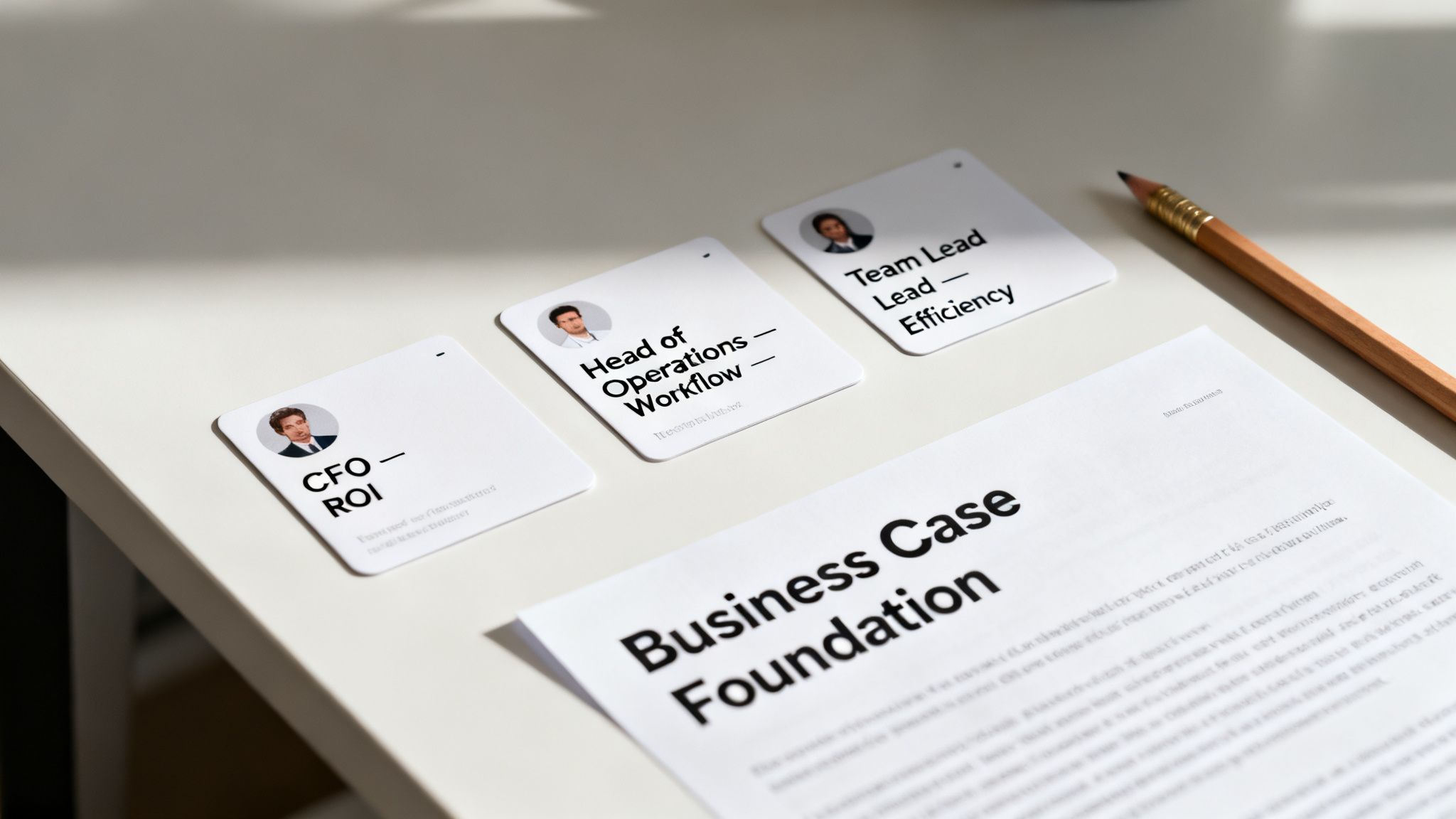
Your very first job is to figure out your audience. A pitch for new payroll software, for instance, is going to land very differently depending on who’s reading it. The Chief Financial Officer (CFO) will zero in on the Return on Investment (ROI), while the Head of HR is going to be more concerned with how long it takes to train everyone and get them using it. Meanwhile, an accounts assistant just wants to know if it will make their daily tasks less of a headache.
You absolutely have to tailor your message. Frame the problem or opportunity with total clarity, making sure it speaks to each stakeholder’s priorities and connects to the company’s wider goals.
This simple flow chart breaks down how to get that foundation right.
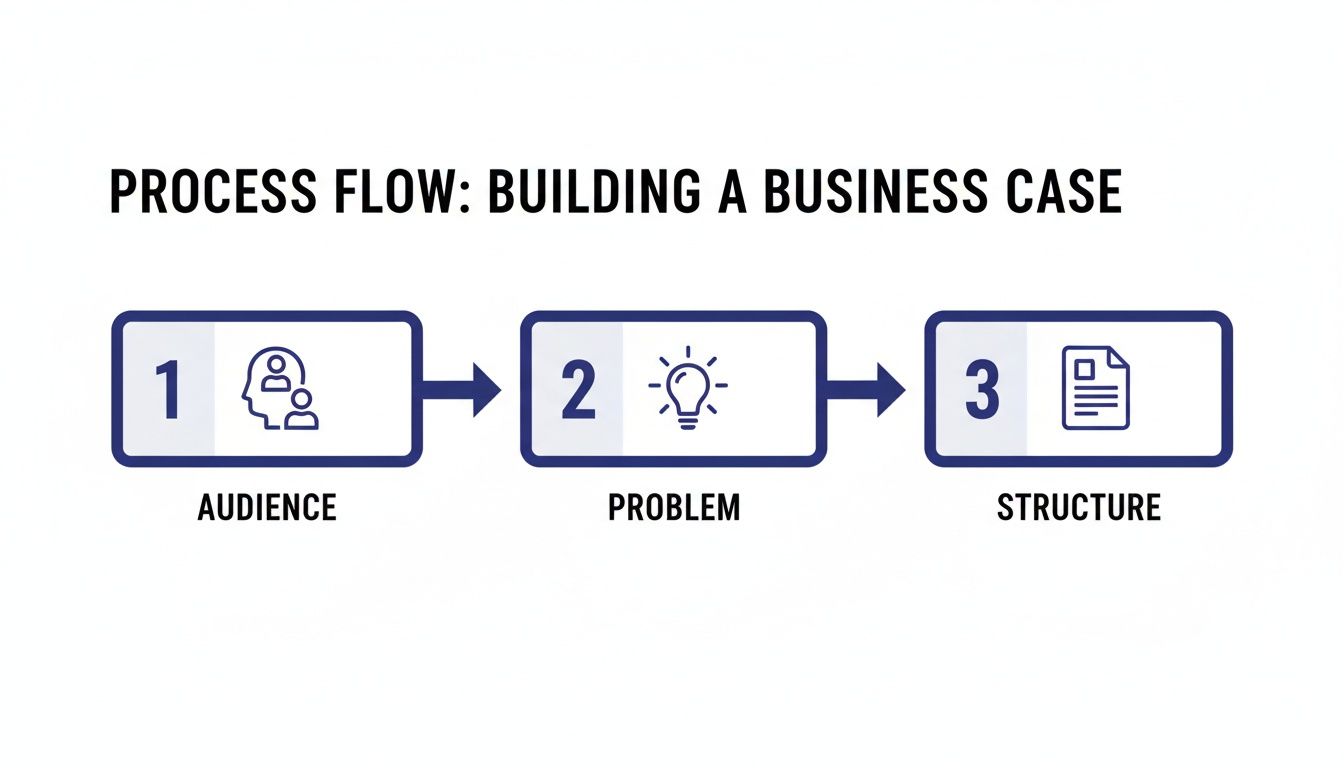
As you can see, a winning business case always starts with people (your audience), moves to the purpose (the problem), and finishes with a solid plan (the structure).
What Are the Core Components?
To make sure your argument is easy to follow, every business case needs a logical structure. This acts as a roadmap, guiding your reader from the initial problem all the way to your recommended solution. Without it, even the most brilliant ideas can get lost in a mess of disorganised information.
For a quick overview of what your business case should include, take a look at this table. It breaks down the essential parts and why each one matters.
Key Components of an Effective Business Case
| Component | Core Purpose | Key Questions to Answer |
|---|---|---|
| Executive Summary | To provide a high-level snapshot of the entire case for busy senior leaders. | What is the proposal, what will it cost, and what is the expected return? |
| Problem/Opportunity | To clearly define the issue being solved or the opportunity being seized. | What is the current situation, and why does it need to change now? |
| Options Analysis | To evaluate all viable solutions, including the ‘do nothing’ option. | What are the alternatives, and what are the pros and cons of each? |
| Financials & ROI | To present a detailed cost-benefit analysis and justify the investment financially. | What are the upfront and ongoing costs? What is the projected ROI and payback period? |
| Implementation Plan | To outline a realistic timeline, required resources, and key milestones for delivery. | Who is responsible for what? When will key milestones be achieved? |
| Risks & Mitigation | To identify potential risks and explain how they will be managed or minimised. | What could go wrong, and what is our plan to deal with it? |
| Measurement & KPIs | To define how success will be measured after implementation. | What key performance indicators will we track to confirm we’ve achieved our goals? |
| Stakeholder Engagement | To show who has been consulted and confirm buy-in from key people across the organisation. | Who supports this proposal, and have their concerns been addressed? |
Think of these components as the building blocks of your document. Each one plays a critical role in building a compelling and watertight argument for your proposal.
Making the Case for Investment in Training
This structure is particularly effective when you need to justify spending on professional development. Let’s say you want to propose training in advanced payroll, bookkeeping & VAT, or data analysis. You’re competing with other priorities, so you have to prove its value.
The demand for these skills is impossible to ignore. For example, the UK corporate training market hit £12 billion and is expected to surge to £22.5 billion by 2033. This growth is fuelled by the urgent need to upskill employees in technology and compliance—areas that CPD-certified courses directly address.
By connecting your training proposal to clear market demand and specific business needs, you shift it from a ‘nice-to-have’ expense to a strategic investment in the company’s future. You can learn more about the specific tools and techniques taught in business analyst training in our detailed guide.
Defining the Core Problem and Analysing Your Options
A strong business case always starts by painting a crystal-clear picture of the problem. This isn’t about listing minor gripes; it’s about defining the current pain so vividly that doing nothing is no longer a viable option. You have to move past vague complaints and get right to the quantifiable, negative impacts on the business.
Your first job is to lay out the ‘as-is’ situation. Frame the problem not as a departmental inconvenience, but as a direct threat to efficiency, profitability, or the company’s strategic goals. The trick is to use hard data to tell a compelling story about why change is needed—and needed now.
Quantifying the Current Pain
Vague statements like “our payroll process is slow” will fall on deaf ears. You need to attach real numbers to the issue. This is how you turn an abstract frustration into a tangible business cost that decision-makers simply can’t ignore.
Let’s look at a couple of real-world examples:
- For an Accounts Assistant: Instead of just saying manual reconciliation is tedious, do the maths. “Our team spends 35 hours per month on manual payroll reconciliation, which costs the business around £8,400 a year in lost productivity.” This highlights the need for courses in bookkeeping & VAT or advanced payroll to streamline processes.
- For a Data Analyst: Don’t just complain about not having the right tools. Show what it’s costing the business. “Because we don’t have predictive analytics software, we missed a 15% drop in customer retention for a key product last quarter. That represents a potential revenue loss of £50,000.” This clearly justifies investment in specialist data analyst training.
By putting a figure on the problem, you immediately raise its profile. It’s no longer just a team issue; it’s a direct hit to the bottom line. If you want to get better at mapping this out, it’s worth learning more about modelling business processes to properly quantify these weak spots.
Identifying and Evaluating Your Options
Once you’ve made the problem undeniable, the next step is to explore potential solutions. A classic mistake is to only put forward your favourite option. This comes across as biased and makes it look like you haven’t done your homework. A credible business case always explores a few realistic alternatives.
Crucially, one of those alternatives must always be the ‘do nothing’ option. This acts as your baseline. What are the consequences of just carrying on as we are? Outlining this proves you’ve considered every angle and forces you to demonstrate why taking action is better than staying put.
From there, identify two or three other sensible solutions. For instance, if you’re dealing with an outdated bookkeeping system, your options might look something like this.
Comparison of Potential Solutions
| Option | Description | Key Pros | Key Cons |
|---|---|---|---|
| 1. Do Nothing | Continue with the existing manual bookkeeping process. | No upfront cost or disruption. | Rising error rates; wasted staff hours; compliance risk. |
| 2. Invest in Training | Enrol the team on CPD-certified Bookkeeping & VAT training and upgrade to the latest version of Xero or Sage. | Hugely improved efficiency; better reporting; higher morale. | Initial software and training costs; implementation downtime. |
| 3. Outsource Bookkeeping | Hire an external firm to manage all bookkeeping and VAT returns. | Frees up internal resources; access to expert knowledge. | Higher ongoing running costs; less direct control over data. |
Presenting a simple, structured comparison like this lets stakeholders see at a glance that you’ve thoroughly weighed up the possibilities.
The goal here isn’t to bulldoze your preferred solution through. It’s to show, through clear-headed analysis, why your recommendation delivers the best value and strategic fit for the business compared to all other routes.
Finally, you need to set some clear criteria to judge each option against. Make sure these align with what the business actually cares about. They might include:
- Cost: What’s the initial outlay and what are the ongoing financial commitments?
- Feasibility: Do we have the skills and resources in-house to make this happen?
- Strategic Fit: How well does this option support our long-term company goals?
- Timescale: How quickly will we start seeing the benefits?
When you systematically score each option against these benchmarks, your final recommendation won’t feel like a personal preference. It will feel like the only logical, evidence-backed conclusion.
Mastering the Financials to Prove Your Case
Right, let’s get to the part that really makes or breaks your business case. This is where a great idea transforms into a genuine, unmissable investment. Your financial section is the heart of the argument, speaking the language that senior leaders—especially the CFO—understand and respect most: the numbers. Forget complicated jargon; this is about telling a clear, believable, and solid financial story.
Your first job is to meticulously map out every single cost involved. And I don’t just mean the headline price of a training course or a new software licence. You need to dig deeper and present the whole financial picture. It’s this thoroughness that builds trust and shows you’ve done your homework.

Uncovering the True Costs
To build a budget that holds up under scrutiny, you need to think about costs in two distinct buckets:
- Initial Investment (One-Off Costs): This is all the upfront cash needed to get things moving. Think of direct costs like buying software, enrolling your team on an advanced payroll course, or paying for installation.
- Ongoing Operational Costs: These are the recurring bills that keep the solution running long-term. This could be anything from annual software subscriptions and maintenance fees to ongoing CPD training to keep everyone’s skills sharp.
A classic rookie error is to underestimate the “hidden” costs. For instance, bringing in new accounts assistant software isn’t just about the purchase price. You’ve got to account for the cost of staff time spent in training and the very real possibility of a temporary dip in productivity while everyone gets up to speed.
Quantifying the Benefits
Once you’ve got a firm grip on the costs, it’s time to put a number on the benefits. This is where you draw a straight line from your solution to financial gains for the business. Vague promises like “improved efficiency” just won’t fly. You have to translate every single benefit into a tangible, pound-sterling value.
Let’s say you’re building a case for an in-house final accounts preparation course. Your benefits breakdown might look something like this:
- How things are now: The company currently spends £15,000 a year using external accountants to get the final accounts done.
- What you’re proposing: A one-off training cost of £5,000 for two members of your team.
- The quantified benefit: This training completely removes the need for external help, creating a direct cost saving of £15,000 every single year after that initial investment is paid off.
That simple, clear calculation turns a training expense into a powerful, money-saving initiative. If you want to get a better handle on this process, our guide on what is financial forecasting is a great place to start.
Calculating the Metrics That Matter
With your costs and benefits clearly laid out, you can now calculate the key financial metrics that decision-makers will zoom in on. These are the headline figures that prove your proposal is worth their time and money.
- Return on Investment (ROI): This is the big one. It measures the profitability of your investment as a straightforward percentage. The formula is: (Net Benefit / Total Cost) x 100. A high ROI is your clearest signal of a strong financial return.
- Payback Period: This tells stakeholders exactly how long it will take for the project to pay for itself. You calculate it by dividing the Total Investment Cost by the Annual Net Benefit. A shorter payback period is always going to be more appealing.
- Net Present Value (NPV): This is a slightly more advanced metric, but it’s powerful. It accounts for the time value of money—recognising that a pound today is worth more than a pound tomorrow. A positive NPV shows that the project’s future earnings, adjusted for today’s value, are greater than the initial cost.
To really get to grips with the numbers and present a watertight financial case, using tools like an ROI calculator can be incredibly helpful for measuring true performance.
From Idea to Reality: Building Your Implementation and Risk Plan
A brilliant idea with impressive financials is a fantastic start, but let’s be honest—without a clear roadmap for how to get it done, it’s just a nice document. This is the part of your business case where you prove you’ve thought beyond the why and have a solid grasp of the how. A detailed implementation and risk plan shows you’re not just an optimist; you’re a realist, and that’s what gets projects signed off.
This plan is what turns your proposal from an abstract concept into a tangible project. It’s where you answer the practical questions that will be on every stakeholder’s mind: Who’s doing what? When will it happen? And, most importantly, what happens if things go wrong? Nailing these answers upfront builds immense confidence.

Crafting a Realistic Implementation Timeline
A vague promise to “get it done soon” just isn’t going to fly. Decision-makers need to see a clear, realistic timeline that breaks the entire project down into manageable chunks and key milestones. This isn’t about just picking a deadline out of thin air; it’s about mapping the journey from the moment you get approval to the day it’s fully operational.
Let’s say your business case is for new payroll software, supported by an advanced payroll training programme. A credible timeline might look something like this:
- Phase 1: Procurement & Setup (Weeks 1-4): This covers finalising the contract with the vendor, getting the system installed, and handling the initial configuration.
- Phase 2: Data Migration & Testing (Weeks 5-8): Here, you’d plan for the careful transfer of all employee data from the old system to the new one, followed by rigorous testing to make sure every payslip is perfect.
- Phase 3: Team Training (Weeks 9-10): Scheduling and delivering CPD-certified training for all the accounts assistants and payroll staff who will be using the new software daily.
- Phase 4: Go-Live & Support (Week 11 onwards): This is the official launch, followed by a dedicated support period to iron out any initial wrinkles.
This level of detail demonstrates that you have a practical grip on what’s involved. It also makes it much easier to allocate resources and make sure the right people are available when you need them.
Identifying and Mitigating Potential Risks
Every single project, no matter how meticulously planned, has risks. A strong business case doesn’t try to hide them. Instead, it shines a light on them and lays out a clear strategy for what you’ll do if they pop up. This kind of foresight is a massive confidence-builder.
Think honestly about what could derail your project. This isn’t about being negative; it’s about being prepared.
Showing that you’ve anticipated potential roadblocks and already have a plan to navigate them is one of the most powerful ways to build trust. It proves your proposal is grounded in reality, not just wishful thinking.
Here are a few common risks and some simple ways to show you’re on top of them. A simple table is a great way to present this clearly.
| Potential Risk | Mitigation Strategy |
|---|---|
| Employee Resistance to Change | Involve key team members early in the process. Clearly communicate how the new system and associated accounts assistant training will make their jobs easier. |
| Data Migration Errors | Schedule a “parallel run” where both old and new systems are operated for one pay cycle to cross-verify all data and calculations. |
| Unexpected Technical Glitches | Allocate a small contingency in the budget for extra IT support hours during the initial go-live period. |
| Key Personnel Unavailable | Identify a backup project lead from the start and ensure all key documentation is shared and accessible. |
This simple format makes the information easy to scan and proves you have a logical, well-considered approach to managing risk.
Defining How You Will Measure Success
Finally, your plan has to define what success actually looks like. Six months down the line, how will you know this investment was the right call? This is where you pick a handful of relevant Key Performance Indicators (KPIs). These are the specific, measurable metrics you’ll track to prove the project delivered on its promises.
Crucially, these KPIs should link directly back to the problem you set out to solve in the first place. For a business analyst proposing a new Power BI dashboard after completing their training, success isn’t just about launching the tool. It’s about the impact it has.
Relevant KPIs could include:
- Adoption Rate: The percentage of the target user group actively using the new dashboard each week.
- Time to Insight: A reduction in the average time it takes for managers to generate key business reports.
- Decision Impact: A quick survey to measure if managers feel better equipped to make data-driven decisions.
By defining these KPIs upfront, you create a framework for accountability. It proves that your business case is built for long-term value, not just short-term approval.
Engaging Stakeholders and Nailing the Executive Summary
Even the most rock-solid, data-rich business case will fall flat without the right people backing it. This is where many proposals fail—not on the numbers, but on the human element. Before you even think about submitting your document, you need to build a coalition of support, turning your hard work into a proposal with genuine momentum.
This process starts long before you write the final word. You need to be thinking strategically about your stakeholders from day one. Who holds the influence? Who will be most affected by this change? And, critically, who signs the cheques?
Imagine a business analyst proposing a new reporting tool. It’s not enough to get the IT director on board. They also need to win over the department heads who will actually use the data and the finance team who will ultimately approve the budget.
Mapping Your Key Influencers
To get people on your side, you first need to see the world from their perspective. What are their biggest headaches? How does your proposal solve a problem for them or align with their team’s goals? A simple stakeholder matrix is a brilliant tool for mapping this out and planning your conversations.
Let’s say you’re proposing an advanced payroll training course for your team. Here’s how you might map it out.
Stakeholder Engagement Matrix Example
A simple template like this helps you organise your thoughts and tailor your approach for each key person you need to win over.
| Stakeholder (Role) | Interest Level (Low/High) | Influence Level (Low/High) | Key Concerns | Engagement Strategy |
|---|---|---|---|---|
| CFO | High | High | ROI, cost savings, compliance risk reduction. | Book a short one-to-one meeting to walk through the financial model and projected ROI. |
| Head of HR | High | High | Employee development, staff retention, training downtime. | Frame it around CPD certification and staff morale. Present a clear schedule showing minimal disruption. |
| Payroll Manager | High | Medium | Team efficiency, error reduction, ease of implementation. | Get them involved in choosing the course. Point out specific modules that address their current pain points. |
| Accounts Assistants | Medium | Low | New processes, impact on workload, skill relevance. | Hold a team briefing. Show them how this training will make their jobs easier and add to their skills. |
By thinking through this beforehand, you can anticipate objections and tailor your conversations, addressing potential roadblocks before they even appear. Early, strategic engagement is how you build a powerful base of support.
Crafting the Perfect Executive Summary
With your key stakeholders warmed up, the final piece of the puzzle is the executive summary. Don’t be fooled—for many senior leaders, this is the only part of your business case they will read. It has to be perfect. Its job isn’t to summarise every detail but to distil your entire proposal into one compelling page that screams “this is a no-brainer.”
Think of it as your ultimate elevator pitch. It needs to grab attention instantly and communicate the core value with absolute clarity.
Your executive summary is your one and only shot to make a powerful first impression. Always write it last, but treat it as the single most important page in your document.
To be truly effective, it must answer three questions, quickly and concisely:
- What’s the problem? Open with a clear, quantified statement of the issue you’re solving.
- What’s our solution? Briefly describe your recommended course of action, for example, “investing in a data analyst training programme for the marketing team”.
- What’s the value? Close with the most compelling financial and strategic benefits, putting the ROI front and centre.
This simple structure ensures that even the busiest executive can get the gist of your proposal in under a minute. Getting this right is non-negotiable. For a deeper dive into this vital skill, it’s worth reading up on how to write executive summaries. This guide offers fantastic insights that can help you sharpen your message until it’s impossible to ignore.
Giving Your Business Case One Final Polish
You’ve done all the hard work, but don’t hit ‘send’ just yet. A final, critical review can be the difference between getting that enthusiastic ‘yes’ and a polite ‘no’. This isn’t just about catching typos; it’s about pressure-testing your entire argument to sidestep the common mistakes that sink even the most promising proposals.
So many business cases fall at the final hurdle for the same few reasons. They might lean on optimistic guesswork instead of solid data, drown the reader in technical jargon, or completely miss the true costs of getting a project off the ground. A good checklist helps you spot these issues before your stakeholders do.
A Pressure-Testing Checklist for Your Business Case
Go through your document one last time and ask yourself these tough questions. Being brutally honest here will expose any weak spots and give you a chance to strengthen your argument.
- Is the Problem Crystal Clear? Could someone from a completely different department read the first page and instantly get what you’re trying to solve and why it’s urgent? Vague problem statements are easy to ignore.
- Are Your Financials Bulletproof? Have you included all the costs, even the “hidden” ones like staff training time or temporary dips in productivity? Are your benefit calculations built on reasonable assumptions you can explain and defend on the spot?
- Is Your Language Jargon-Free? Remember, your CFO doesn’t need to understand the technical architecture of a new software platform. They need to know what it’s going to do for the bottom line. It’s your job to translate features into financial benefits.
- Does It Align with Business Goals? Have you explicitly connected your project back to what the company actually cares about right now? A proposal that doesn’t clearly support wider strategic objectives is an easy one to push aside.
Finding a ‘no’ here isn’t a failure. It’s a huge opportunity to refine your proposal, turning a good business case into an undeniable one.
The single biggest mistake is failing to connect your project to the organisation’s strategic goals. If your proposal, no matter how brilliant, doesn’t help the company achieve what it has set out to do, it will always struggle to get funding.
The Most Common Stumbling Blocks
Beyond that checklist, keep an eye out for these frequent tripwires. Just knowing they exist is the first step to avoiding them.
For example, it’s easy for a business analyst to get lost in complex data models, completely losing the attention of non-technical stakeholders. An accounts assistant might focus too much on small, daily process tweaks without showing the powerful cumulative financial impact over a full year. You have to step back and read the document through your audience’s eyes.
Key areas to double-check:
- Wishful Thinking vs. Data: Make sure every claim is backed by some kind of evidence, whether that’s internal data, market research, or quotes from suppliers.
- Underestimating Change Management: Have you really thought about the human side of this? A fantastic new payroll system is useless if no one is properly trained or motivated to use it correctly. This is why a case for advanced payroll training is often essential.
- Ignoring the ‘Do Nothing’ Option: If you haven’t properly analysed the cost and risk of inaction, you’ve weakened your entire argument for making a change.
By meticulously reviewing your document with this critical eye, you can address stakeholder concerns before they’re even raised, bulletproof your logic, and dramatically increase your chances of success.
Frequently Asked Questions
When you’re pulling together a business case, a few questions always seem to come up. Getting them answered early saves a lot of headaches and helps you focus on what really matters: building a rock-solid argument. Here are some of the most common queries I hear from people in your shoes.
How Long Should a Business Case Be?
There’s no magic page count. The right length depends entirely on the project’s scale and what your organisation expects. A simple request for new team training, such as a course in bookkeeping & VAT, might only need a sharp 5-10 pages. On the other hand, a major capital investment could easily push past 50 pages once you factor in all the detailed appendices.
The golden rule is this: be concise but leave no stone unturned. Give enough detail to justify the proposal without burying your reader in information. Your executive summary, however, should always be a single, powerful page. No exceptions.
What Is the Most Important Section of a Business Case?
Every section plays its part, but two areas really make or break your proposal.
First up is the Executive Summary. It’s the most critical piece of the puzzle because if it doesn’t immediately grab your stakeholders’ attention and clearly state the case, the rest of your hard work might not even get a look-in.
After that, it all comes down to the Financial Analysis. This is where you win or lose. Decision-makers need to see a credible, compelling financial reason to say yes. A shaky financial argument will sink even the most brilliant idea, so mastering the numbers is absolutely essential, a key skill covered in final accounts training.
A great story is important, but remember that business cases are approved based on value. If the numbers don’t stack up, the proposal is dead in the water, no matter how well you’ve written it.
How Do I Handle Benefits That Are Difficult to Quantify?
This is a classic challenge, especially for projects like upskilling staff in roles like a business analyst or accounts assistant. You should always quantify what you can—for instance, translate time saved into salary costs—but some benefits are naturally qualitative.
Think about things like improved team morale, smarter data-driven decisions, or stronger regulatory compliance. Don’t just ignore them. Carve out a specific section for ‘Qualitative Benefits’ or ‘Strategic Value’. Describe them clearly and link their importance back to the company’s bigger goals, even if they don’t have a direct pound-sterling value attached.
What If I Don’t Have All the Data for My Financials?
Welcome to the real world! Perfect data is a myth. The key is to make reasonable, documented assumptions and be completely transparent about them.
Clearly state your assumptions and explain your reasoning. For example, ‘Based on industry benchmarks for similar training…’ or ‘Assuming a 5% efficiency gain…’. It shows you’ve done your homework.
It’s far better to present a projection with clear, defensible assumptions than to present nothing at all. It demonstrates thoroughness and helps decision-makers understand the potential outcomes.
Ready to build the skills that guarantee your next business case gets the green light? At Professional Careers Training, we provide hands-on, CPD-certified courses in bookkeeping & VAT, advanced payroll, accounts assistant, final accounts, business analyst and data analyst training designed to give you the practical expertise employers demand. From mastering Sage and Xero to optimising your CV, we provide the 1-2-1 support you need to advance your career.