If you work in payroll, or you're training to, "statutory payments" is one of those phrases that sounds dry until you realise how much rests...
You can be excellent at the spreadsheet, the VAT treatment, the payroll calc, or the dashboard and still feel stuck when a manager won't sign off, a client keeps changing the brief, or a senior stakeholder goes quiet after a meeting. That gap is where many early-career finance and data professionals lose momentum. The work is rarely failing because the technical answer is wrong, it's usually failing because the right people were not identified, engaged, documented, and followed up in a way that fits how UK workplaces run.

In UK project and public-sector work, this is no longer a vague soft-skill debate. The UK Infrastructure and Projects Authority's Functional Standard GovS 002 treats stakeholder engagement as part of formal governance, and that shift reflects a wider truth, stakeholder work is operational, not ornamental. For anyone building a career in bookkeeping, payroll, accounts support, or analysis, that means the question is not whether you are “good with people”, it's whether you can handle approvals, escalation paths, and expectation setting with discipline. If you also care about building your professional visibility, a practical guide for creators to build online can help you think about consistency and clarity in a similar way, just applied to your own career presence.
Why Finance Professionals Need Real Stakeholder Management Skills
A junior accounts assistant can get the numbers right and still miss the deadline that matters because the approver never confirmed the format they wanted. A payroll trainee can process a clean run and still face complaints because employee queries, pension provider questions, and manager sign-offs were handled as separate conversations with no clear cadence. A data analyst can build the report and still get blocked because the sponsor, operations lead, and IT team each expected a different output.
That's why generic “communication skills” advice falls flat in finance. In accounting and payroll, every important discussion tends to leave a trail, whether that's an email approval, a query log, a meeting note, or a written sign-off. People don't just want to be kept informed, they want to know who decided what, when it was agreed, and what happens if the scope shifts.
The UK context makes this more serious. The UK Government Major Projects Portfolio has typically contained more than 100 major projects and programmes at a time, and those projects rely on structured engagement rather than personality alone, as noted in the discussion of GovS 002 in Rachel Wells' overview of stakeholder management skills. That same logic applies in finance teams, where a missed approval or unmanaged objection can slow month-end, delay a VAT response, or complicate a final accounts timetable.
Practical rule: if a task needs someone else's decision, your stakeholder work starts before the task does.
For graduates and career changers, that distinction matters. People who progress usually learn to treat stakeholder management as part of delivery, not a personality test. They become the person who can explain the issue clearly, document the decision, and keep momentum without creating noise.
The Core Competencies That Make Stakeholder Management a Skill
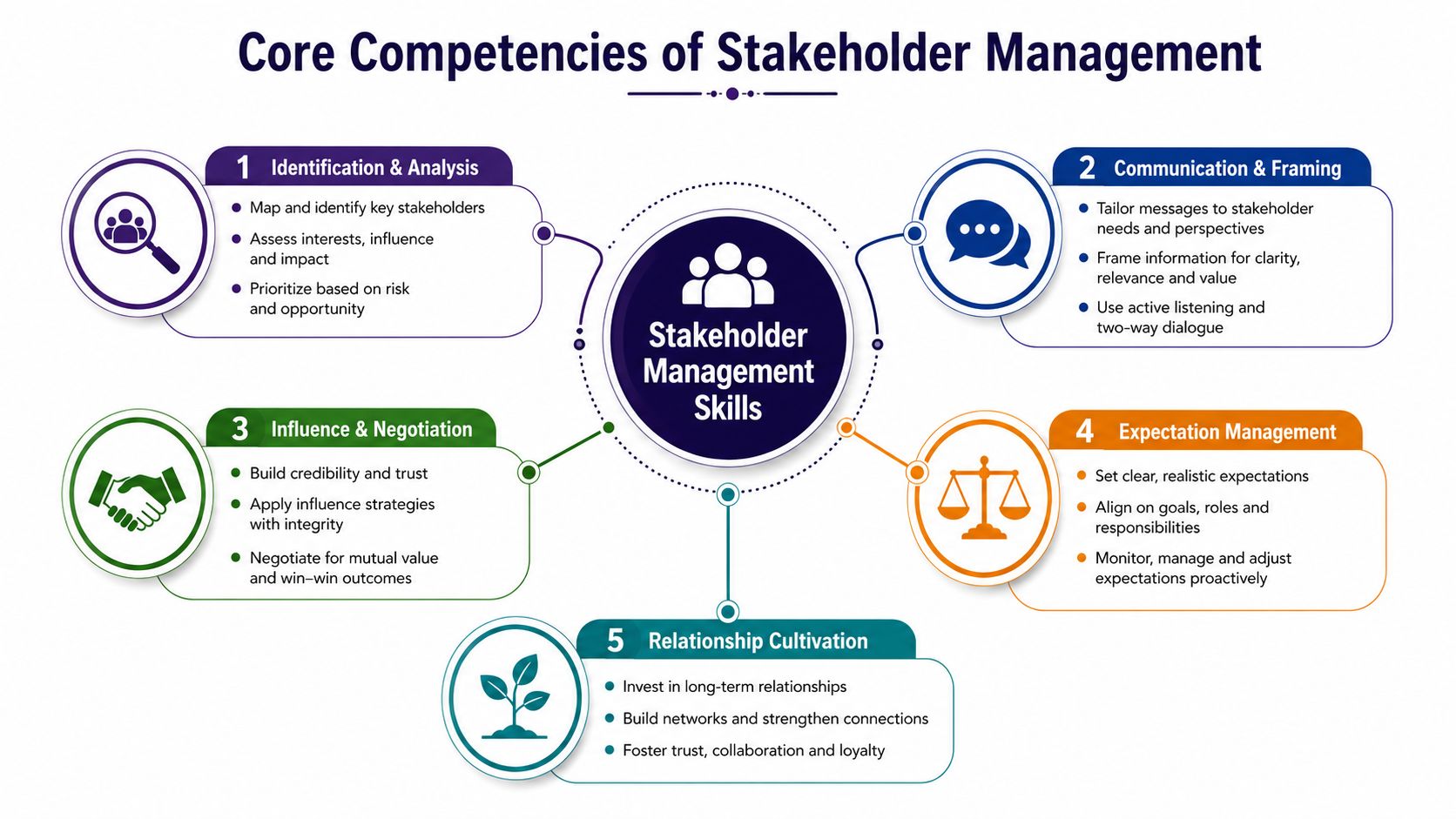
Stakeholder work becomes a real skill when it is repeatable. The most useful way to think about it is as a set of mechanics that can be trained, checked, and improved, not as a vague talent for being “good with people”. A strong practitioner identifies who matters, assesses their influence and interest, plans the right level of contact, and then keeps checking whether expectations still match reality.
Start with identification and analysis
The first mistake is to assume the obvious people are the only people. In finance roles, that often means the analyst only speaks to the immediate manager, or the payroll officer only speaks to HR, while the key blockers sit elsewhere. A more reliable method is power–interest mapping, which puts stakeholders into a simple grid so you can see who needs close management, who needs regular updates, who needs to stay informed, and who only needs monitoring.
The second mechanic is to separate your perception from the stakeholder's actual position. A stakeholder may look disinterested because they've said little, but they may still have strong influence or a hidden objection. Good analysis captures role, authority, needs, expectations, and likely response, then uses that information to shape communication.
Use cadence, not impulse
The other core competency is engagement cadence, which means deciding how often to contact people and through which channel. A one-off email rarely holds together a multi-week task. Written updates, one-to-ones, group meetings, approvals, and informal correspondence all have their place, but they should be chosen deliberately.
A stakeholder plan is weak when it depends on memory, mood, or who happens to be online.
Many people stall at this point. They over-rely on one channel, usually email, and then act surprised when expectations drift. Better practice is to document interactions, review reactions, and adjust the plan as delivery changes.
For a useful parallel on structured communication habits, the assertiveness training resource shows how directness and clarity support professional relationships, which is exactly what stakeholder management depends on in real roles.
How to Build a Stakeholder Map You Can Actually Use
A good stakeholder map should take less than an hour to build and be useful the same day. Start by listing every person or group touched by the work, then collect a small set of fields for each one, role, decision rights, what they care about, preferred channel, influence, interest, and any obvious support or resistance trigger. That is enough to move from guesswork to planning.
The easiest way to teach this is with a low-high scoring pattern. Rate influence on a low/high basis, then rate interest the same way, and plot each stakeholder on a two-by-two matrix. The point is not mathematical precision, it's disciplined prioritisation.
| Field | Purpose | Example Entry |
|---|---|---|
| Name or group | Identifies the stakeholder | Payroll manager |
| Role | Shows decision context | Approver |
| Influence | Indicates ability to block or shape work | High |
| Interest | Indicates how affected they are | High |
| Preferred channel | Guides communication choice | One-to-one meeting |
| Key concern | Surfaces likely friction | Deadline risk |
A simple workshop makes this faster. One PMI source recommends giving each participant ten minutes to write as many stakeholder names or groups as possible on sticky notes, one per note, then placing them on the grid. That makes the exercise visible, collaborative, and easy to repeat in a classroom, study group, or first week in a new role. You can find a useful companion overview in HuntingAlice's stakeholder mapping guide, especially if you want a plain-English example of how the matrix works in practice.
The four quadrants then drive action. High-power, high-interest people need close management and direct contact. High-power, low-interest people usually need concise updates and timely escalation only when decisions are needed. Low-power, high-interest stakeholders need steady information and opportunities to raise concerns. Low-power, low-interest stakeholders can usually be monitored with broadcast updates.
For a business-facing example of process clarity, the modelling business processes resource is a good reminder that the best maps link people, actions, and decisions instead of stopping at a list of names.
Applying the Skills in Bookkeeping, Payroll, and Analyst Roles
A bookkeeping and VAT trainee often works with HMRC queries, client approvals, and internal review points. The stakeholder set looks small at first, but it's easy to miss the client contact who signs things off, or the senior colleague who wants a quick explanation before anything is sent externally. The best approach is to keep the communication short, dated, and documented, because in VAT work the issue is rarely whether you spoke, it's whether you can prove what was agreed.
An advanced payroll professional faces a different pattern. Employee escalations are emotional, pension provider questions can be procedural, and line managers often want answers before the payroll cut-off. The mistake is to treat every query as urgent in the same way. A stronger habit is to separate what needs immediate escalation from what needs a recorded follow-up, then keep a clear log so payroll decisions don't get lost between messages.
A business analyst or data analyst works with a wider and more mixed group, operational managers, IT teams, and senior sponsors often want different levels of detail from the same analysis. That is where stakeholder mapping pays off most. The sponsor may need concise decision framing, the operational manager may need detail on impact, and the technical team may need the assumptions behind the data model.
For a useful bridge into broader finance role expectations, discover insights from HireAccountants and compare how staff-accountant duties often involve the same mix of reporting, coordination, and approval discipline.
What usually goes wrong: people answer the loudest stakeholder first and forget to maintain the record that protects the work later.
The same mechanics apply across all three roles, but the cadence changes. Bookkeeping and VAT needs cleaner approval trails. Payroll needs tighter escalation rules. Analysis work needs better framing, because a decision can stall when different stakeholders think they are looking at different versions of the truth.
A Practical Development Plan With Exercises and Cadence
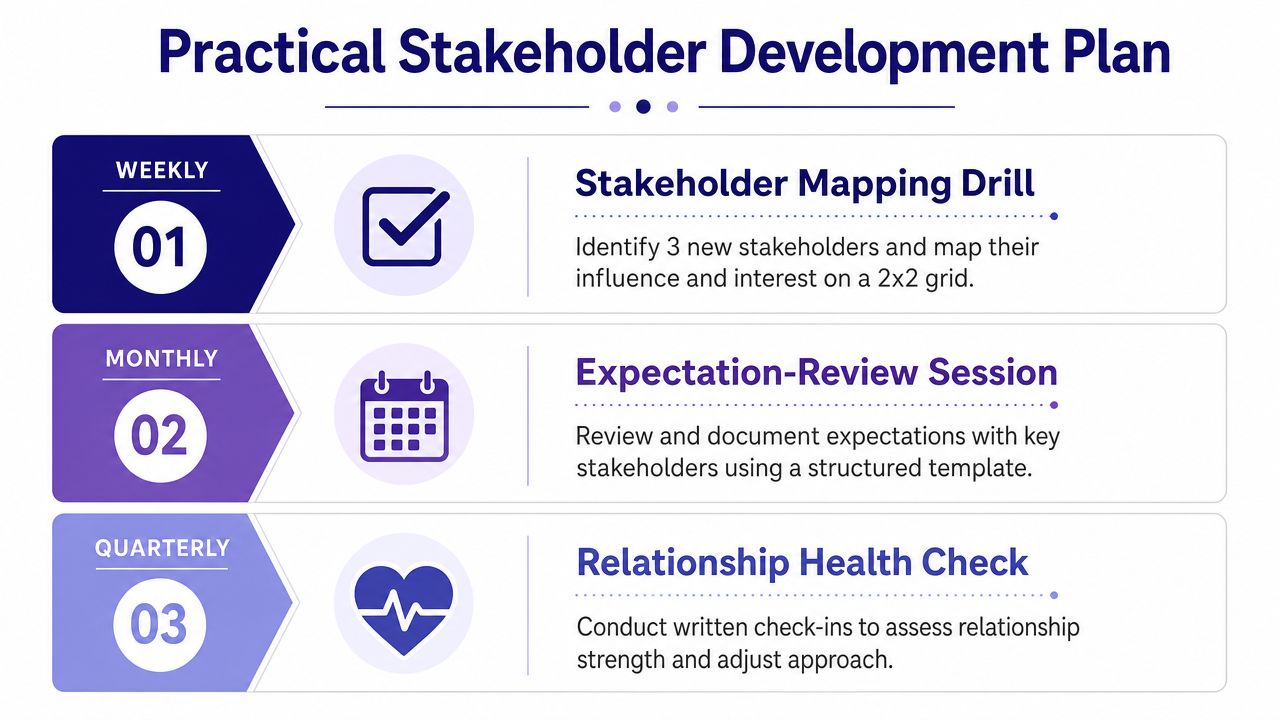
The fastest way to improve is to build the habit into your week. Keep it simple and measurable. A weekly stakeholder-mapping drill, a monthly expectation review, and a quarterly relationship check are enough to show progress in a CPD log if you write down what changed and what you learned.
Weekly drill
Choose one live task and identify three new stakeholders you had not fully accounted for. Put them on a simple grid and note influence, interest, and preferred channel. If your list feels too short, that's usually a sign you're under-mapping the work.
Monthly review
Hold one short expectation review with your key stakeholder, manager, client contact, or sponsor. Use the same structure each time, current status, risks, decisions needed, and any change in scope. Record the outcome in writing straight after the conversation.
Quarterly check
Run a relationship health check. Look at which stakeholders reply quickly, which ones need chasing, and where tension keeps reappearing. If a relationship needs repair, change the channel or the cadence before the issue hardens.
A workable 30-60-90 day progression looks like this.
- First 30 days: build the map, identify decision-makers, and start a written log.
- By 60 days: use a regular cadence, ask for explicit expectations, and reduce last-minute clarification.
- By 90 days: show you can manage disagreement, pre-wire decisions, and keep approvals moving.
How to Phrase These Skills on a CV and in Interviews
“Good communication skills” is too thin to help you stand out. It doesn't say what you did, who you managed, or how you kept delivery moving. Stronger CV language names the mechanics, for example, mapped stakeholders by influence and interest, maintained an engagement log, or managed written approvals across payroll and finance queries.
That wording works because it proves process, not personality. It also gives the interviewer a thread to pull on, which makes your experience feel real rather than generic. If you're applying for bookkeeping, payroll, or analyst roles, keep the verbs active and the outcomes specific to delivery, not to self-praise.
A simple interview prompt to prepare for is, “Tell me about a time you had to deal with a difficult stakeholder.” A strong answer focuses on what you identified, how you planned the communication, and how you documented the result. Another useful prompt is, “How do you handle conflicting expectations?” The best response shows you can prioritise, explain trade-offs, and keep a clear audit trail.
For interview structure and evidence framing, the competency-based interview resource is worth using alongside your own examples. It helps turn a vague story into a clean STAR-style answer without losing the practical detail that UK finance employers expect.
Key Takeaways and Where to Practise Next
Stakeholder management skills work best when you treat them as a technical discipline. Identify everyone who matters, map influence and interest, set a clear cadence, document interactions, and review expectations before they drift. That approach is useful whether you're reconciling ledgers, processing payroll, building a report, or supporting final accounts.
Start with three actions this week. Build one stakeholder map for a live task, write one expectation review note, and rewrite one CV bullet so it shows process rather than a generic claim. Then practise the same habits in your training or work tasks until they feel normal.
If you want to apply this in context, focus your practice through bookkeeping and VAT, advanced payroll, accounts assistant, final accounts, or business and data analyst training. Those pathways create the kind of real stakeholder pressure where this skill becomes visible, measurable, and worth hiring for.
Professional Careers Training helps you build job-ready finance and analysis skills with practical support, flexible learning, and coaching that fits real UK roles. If you want to strengthen your stakeholder management skills alongside bookkeeping, payroll, accounts, or analyst training, visit Professional Careers Training and explore the courses that match your next step.