
If you're training to become a business analyst, or you already work as one, you've probably noticed AI tools turning up in more of your...
You're in the middle of a live deadline stack, one client is asking for a VAT update, another wants year-end numbers, and your inbox keeps filling with “quick questions” that are never quick. This is the nature of time management for accountants in the UK, because the job isn't just about getting through a to-do list, it's about staying compliant when the timing of the work is fixed by law and client behaviour is not. HMRC's 31 January Self Assessment filing and payment deadline, plus the staged demands of Making Tax Digital, turn poor planning into a real business risk, not just a stressful day HMRC deadline and MTD context.
For trainee accountants, accounts assistants, payroll staff, and analysts moving into practice, this is why generic productivity advice falls short. You need a system that protects focus, groups work intelligently, and leaves room for review, escalation, and client contact without letting the day run you.
Why Standard Time Management Advice Fails Accountants
A normal productivity article tells you to start early, avoid distractions, and make a list. That advice does little when three statutory deadlines, a payroll issue, and a director's urgent query all land in the same morning. UK practice work is shaped by deadlines that do not move, so time management for accountants is a compliance skill as much as a personal habit HMRC deadline and MTD context.
The pressure is structural, not personal
Self Assessment has a fixed online filing deadline of 31 January after the tax year ends, and payments on account are also due on 31 January, which compresses workload at a predictable point every year HMRC deadline and MTD context. For VAT-registered clients, Making Tax Digital has shifted routine work toward digital record keeping and software-led returns, so work is no longer just about completing a form, it is about keeping an orderly workflow that can be checked, reviewed, and filed on time HMRC deadline and MTD context.
That makes the usual advice to multitask less too vague. The actual issue is that accountants are managing recurring obligations, client responsiveness, and review time at once, often while supporting bookkeeping & VAT, advanced payroll, accounts assistant tasks, final accounts, and reporting work that all carry different levels of urgency. A late answer to a client is frustrating. A missed filing creates a much bigger problem.
Practical rule: if the deadline is statutory, it gets protected time before it gets attention.
Time management is also an employability issue
The UK labour market rewards accountants who can work cleanly and consistently. The Office for National Statistics reported that the annual median full-time pay for chartered and certified accountants and finance managers in the UK was in the region of £60,000 in recent releases, which shows how economically valuable efficiency and judgement are in this profession UK accounting pay context. Employers do not just want someone who works hard, they want someone who can protect billable time, review time, and client service time.
That is why trainees should treat time management as part of technical competence. If you can organise deadlines, batch routine work, and keep focus during peak periods, you become easier to trust with bookkeeping & VAT, advanced payroll, accounts assistant support, and later final accounts work.
A useful starting point for handling routine document intake is AI receipt capture for accountants, because removing manual admin from the day gives you back attention for the work that needs judgement.
Building Your Foundation with a Strategic Weekly Plan
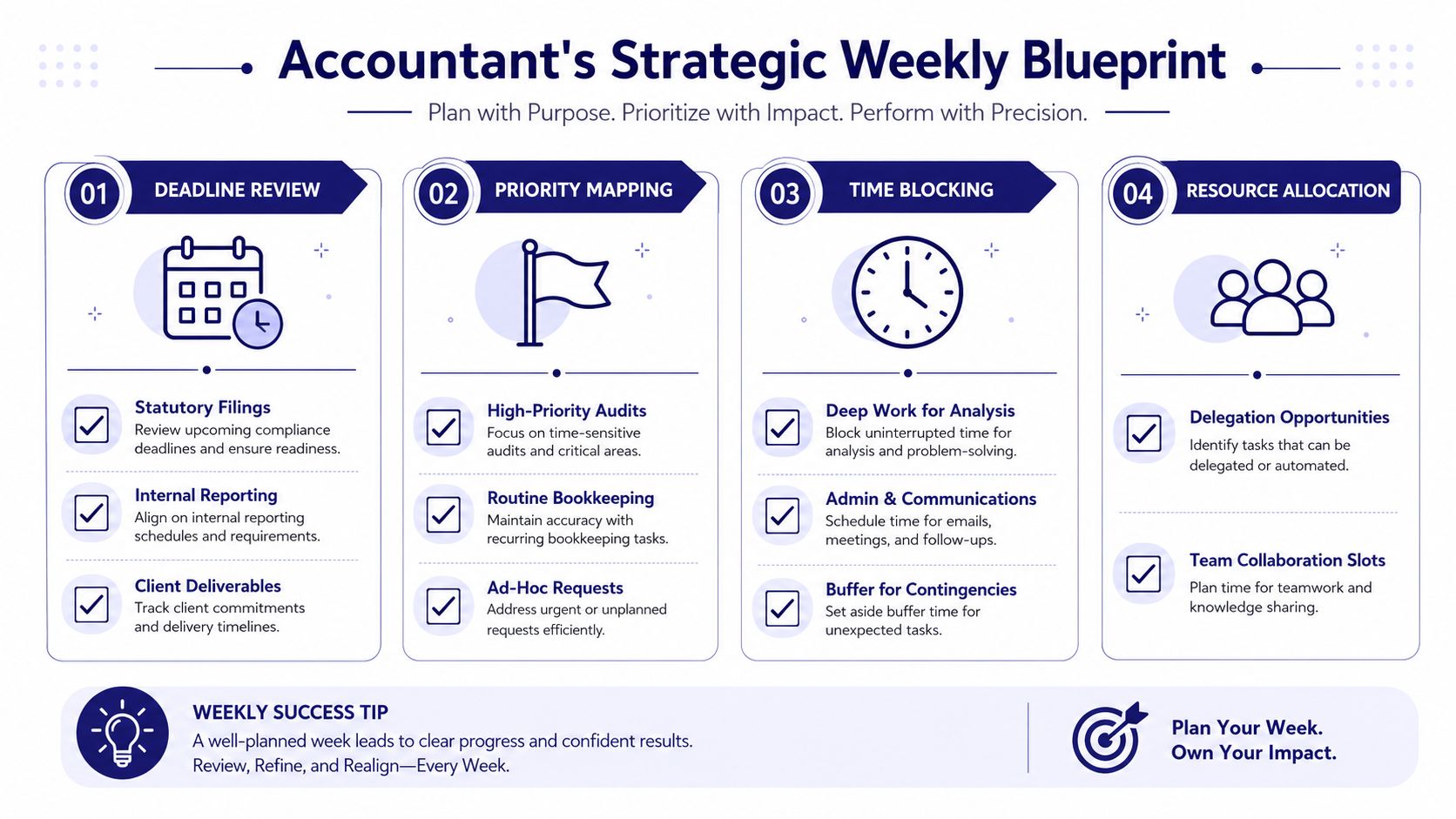
The strongest weekly plan starts with the compliance calendar, not with your inbox. If you begin the week by looking at live email, you're already reacting to other people's priorities. A good plan maps the week around fixed obligations, then assigns the remaining capacity to review, calls, and deep work.
Start with deadlines, then rank the work
Build your week in this order.
- List all fixed dates first. Put VAT submissions, Self Assessment milestones, payroll cut-offs, year-end review work, and Companies House filing dates on one calendar before anything else.
- Separate urgent from important. A director's last-minute question may be urgent, but a statutory return may be more important because the deadline is immovable.
- Batch similar work together. One block for VAT checks, one block for accounts preparation, one block for client replies.
- Protect a buffer. Leave space for rework, missing records, and approval delays.
That structure fits the Eisenhower-style split between urgent and important work, but it needs accounting language to be useful. In practice, urgent work is the item with a deadline today. Important work is the task that protects compliance or fee value later in the week. ABC analysis works the same way. Class A work is the item that could cause immediate damage if ignored, such as a filing due soon. Class B work supports the client relationship. Class C work can wait or be delegated.
Build your week around work type, not mood
A strong weekly template usually has three lanes. One lane for statutory or recurring compliance work like bookkeeping & VAT updates. One lane for focused production, such as final accounts drafting or analysis. One lane for communication, including calls, approval chasing, and supervisor updates.
Useful habit: keep meetings short and selective, because every unnecessary meeting eats review time and makes the rest of the week harder to control.
That approach is especially valuable for accounts assistant and final accounts training, because trainees learn the difference between internal working papers and delivered output. It also helps with advanced payroll, where routine processing benefits from repetition and clear time blocks rather than scattered attention.
For accountants who want a practical benchmark, a weekly plan should answer three questions every Friday. What must be filed, what must be reviewed, and what can be delegated before next week begins? If you can't answer those clearly, the plan is too vague to protect you when deadlines start colliding.
Mastering Daily Execution and Deep Work
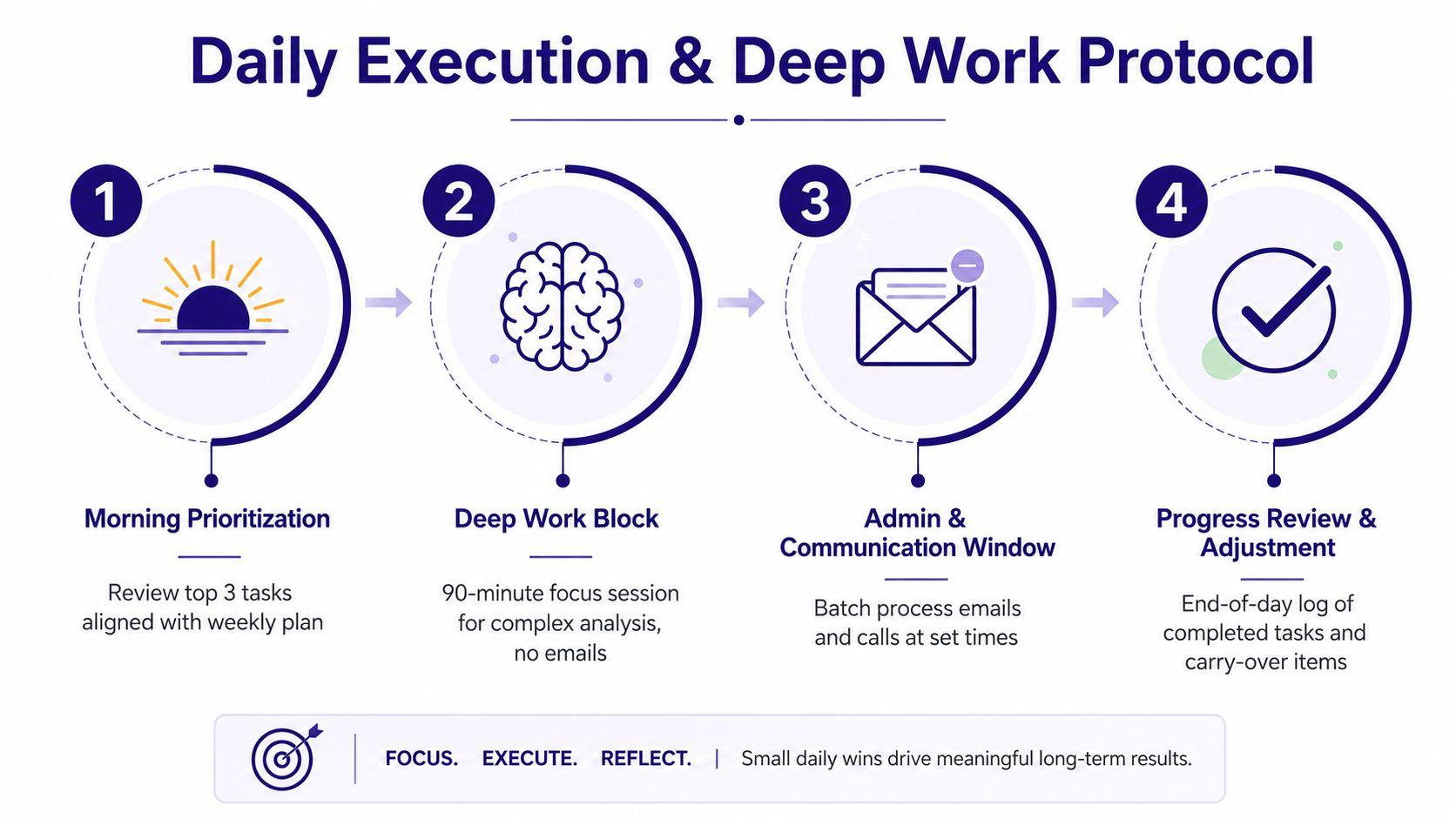
Weekly planning only works if your day is designed to defend concentration. The biggest time loss in practice is rarely the job itself, it's the constant switching between email, calls, software screens, and half-finished tasks. Once you accept that, daily execution becomes about controlling access to your attention.
Batch the work that drains your focus
Task batching is one of the simplest ways to reduce friction. Process all purchase invoices in one go. Handle payroll queries in one dedicated window. Return client calls together rather than letting them interrupt every fifteen minutes. The point is not speed for its own sake, it's reducing the mental reset that comes from changing context too often.
For bookkeeping & VAT work, batching is especially effective because similar tasks follow similar checks. For final accounts, a focused block helps with reconciliations, review notes, and disclosure checks. For accounts assistant roles, batching builds rhythm and reduces the chance of forgotten follow-ups.
The same logic applies to inbox management. Check messages at set times, not continuously. If you're waiting for one reply before progressing, use that waiting period for another task with a similar level of concentration.
Use Pomodoro for analytical work, not for busywork
The Pomodoro cycle is straightforward, 25 minutes of uninterrupted work, then a 5-minute break, with a longer 15 to 30 minute break after four cycles Pomodoro guidance for accountants. It works well for tasks that need accuracy and steady thinking, such as ledger review, exception analysis, or draft final accounts notes. It's less useful for work that needs a full uninterrupted block, such as a complex review with multiple linked adjustments.
Use it like this.
- Set one clear task: “Check this client's VAT coding exceptions” is better than “do VAT”.
- Turn off notifications: a steady stream of alerts kills the point of the cycle.
- Stop at the break: don't keep going just because you've warmed up.
- Write the next step down: that makes the next sprint easier to start.
Deep work for accountants isn't about intensity alone. It's about giving yourself enough uninterrupted time to see the error before it becomes a filing problem.
For a wider commercial perspective on cash flow and planning, financial insights for scaling companies can be useful context when you're thinking about how finance teams support decision-making under pressure.
Leveraging Technology for Smarter Time Allocation
Software should not sit in your workflow as another admin burden. It should remove manual steps, shorten review time, and make recurring processes predictable. For accountants, that means tools like Xero, Sage, and QuickBooks are not just accounting systems, they're time allocation systems.
The most time-saving work happens before you start the job. If bank feeds are mapped properly, invoice rules are set, and reporting dashboards are configured, you're not rebuilding the same process every month. That matters for bookkeeping & VAT, and it matters just as much for advanced payroll, where accurate set-up reduces repeated correction later.
Set up the software once, then make it do repeat work
The key features worth mastering are not glamorous. They're practical.
- Automated invoicing: reduces repetitive billing admin.
- Bank feed rules: categorise recurring transactions without retyping the same entries.
- Dashboards and reports: surface exceptions faster than manual checking.
- Payroll modules: support consistent processing and reduce scattered follow-up work.
These features save time because they move routine tasks out of your daily attention. The first hour spent learning the software often returns much more later in the month, especially in accounts assistant and final accounts work where repeatable processes are common.
If your team works across several calendars and client channels, tools that synchronise schedules can also help. SyncThemCalendars recommendations are worth reviewing when diary clashes are causing avoidable meeting drift.
Training matters as much as the tool
A system only works if the team knows how to use it. That's why structured training in technology, payroll, and software workflow is often more valuable than another informal tip sheet. Professional Careers Training offers accountancy training alongside software support, including official certification in Sage, Xero, and QuickBooks, which makes it relevant for trainees building practical workflow confidence as well as technical knowledge.
For readers who want a direct route into software-led efficiency, the internal resource on technology for accounting is a sensible place to look. The underlying point is simple, the less time you spend on manual entry, the more time you have for review, exception handling, and client value.
Software doesn't replace judgement. It removes the repetitive work that hides your judgement from view.
Advanced Strategies for Busy Season and Delegation
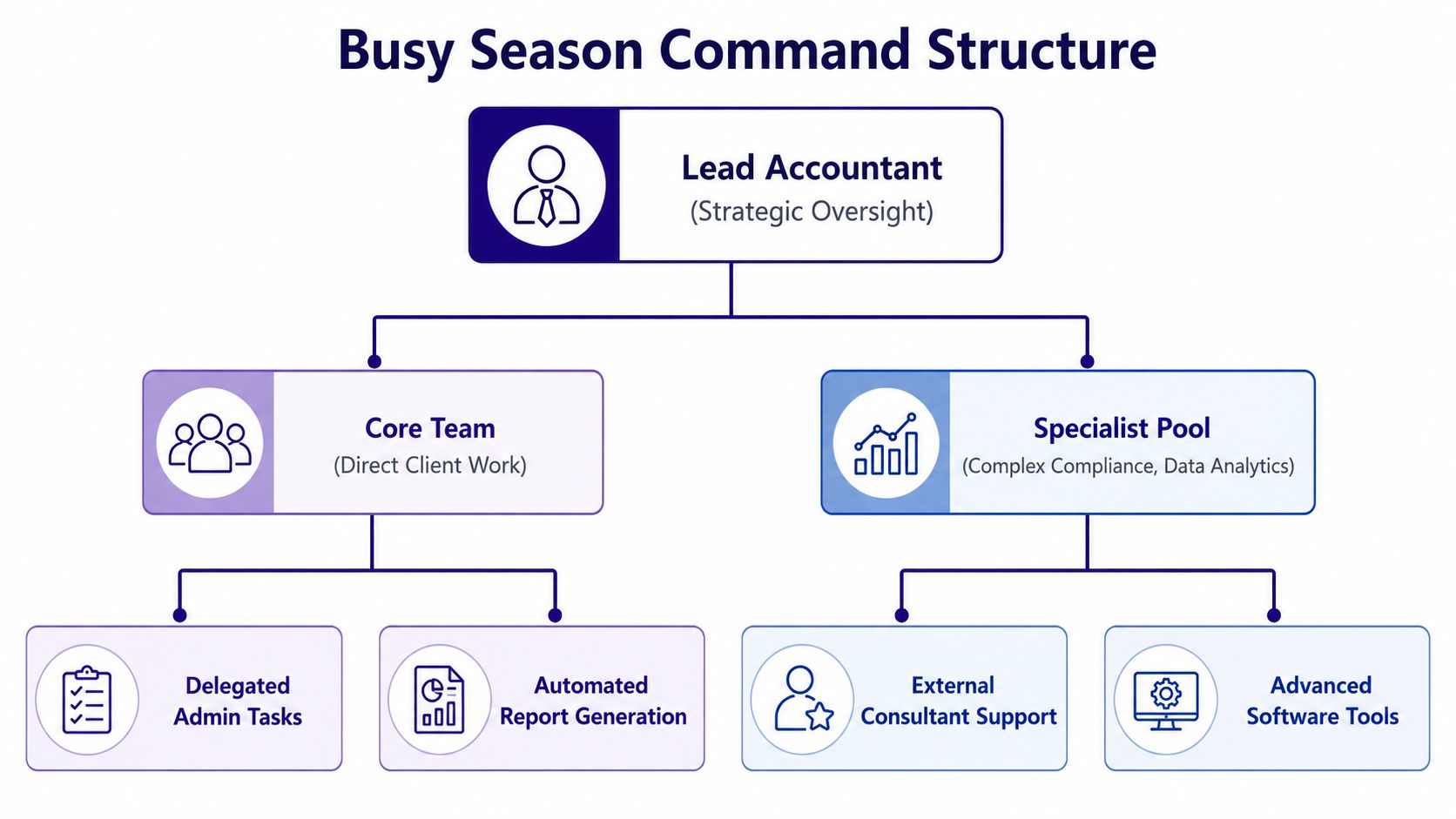
Busy season exposes weak systems quickly. If your work is organised only by urgency, you spend the day chasing the loudest request. A better approach is a triage workflow that sorts tasks by deadline, client value, and the cost of delay, then assigns the work to the right level of the team.
Build a busy season playbook
Start by classifying incoming work into three groups.
- Statutory and fixed-date items: anything with a hard deadline and obvious compliance risk.
- Client-value items: work that protects an important relationship or supports advisory fees.
- Routine production items: repeat tasks that can be standardised, checked, or delegated.
That ranking matters because not every urgent request deserves equal protection. A low-value interruption can consume the same time as a high-value review task, so the team needs a rule for what gets immediate attention and what goes into the next block. In practice, that means ranking clients by profitability, identifying where time is being spent, and making sure recurring work doesn't swallow senior capacity busy season prioritisation and profitability angle.
Delegate work before the pressure peaks
Delegation is not a sign that you've fallen behind. It's how senior accountants protect review time and advisory work. An accounts assistant can often take on data gathering, chasing missing records, and routine processing once the method is clear. That frees the senior person to review exceptions, handle client judgement calls, and manage the conversations that need authority.
A good delegation handover includes three things, what the task is, what “done” looks like, and when it must come back. If those three points are missing, the work usually returns with avoidable errors or delays.
The internal resource on accounting automation tools is relevant here because automation and delegation solve the same problem from different angles. Both reduce the amount of senior attention spent on repeat work.
In busy periods, the best teams are not the ones who look the busiest. They're the ones who protect the work that only experienced staff can do and move everything else into systems or lower-cost hands. That is how final accounts, advanced payroll, and bookkeeping & VAT work stay controlled when deadlines cluster.
Turning Time Management into Career Growth
Good time management is not just about finishing earlier. It creates the capacity to do better work, take on harder work, and train for the next level. Once your deadlines, inbox, and software workflow are under control, you can start using that space deliberately instead of constantly firefighting.
That matters for career progression because the people who move up in practice are usually the ones who can be trusted with responsibility and still stay organised. A trainee who handles bookkeeping & VAT cleanly, understands advanced payroll timing, and supports final accounts without constant rework becomes far more useful than someone who is always busy but rarely prepared.
Use freed time for skills that raise your value
The smartest use of reclaimed time is training. Business analyst and data analyst skills are especially relevant because firms increasingly want people who can read patterns, explain numbers, and support decision-making rather than just process transactions. If you can pair accounting discipline with data handling, you become more valuable in practice, in industry, and in advisory roles.
That is where structured development pays off. A course in time management, software use, or analysis gives you a better base for CPD, and it also helps you move from repetitive execution to judgement-based work. The internal time management course is one route for building that discipline in a more structured way.
Make time management part of your professional identity
The long-term benefit is confidence. When you know where your time goes, you stop guessing, and that changes how you behave under pressure. You become calmer in deadlines, clearer with clients, and better at protecting review time from avoidable interruptions.
That's the shift. Time management for accountants is not a side skill, it's the operating system behind reliable work, better client service, and genuine progression. If you want to move from surviving deadlines to leading them, start by building systems that make your time visible, defensible, and worth more.
Professional Careers Training supports accountants, trainees, and career changers with practical, job-focused learning in software, payroll, bookkeeping, and analysis. If you want structured support that connects time management with real accounting skills, visit Professional Careers Training and explore training that fits the way UK finance teams work.