
You know the moment a shift starts badly. A nurse is asking where the medication chart lives, a support worker isn't sure how to record...
You know the moment a shift starts badly. A nurse is asking where the medication chart lives, a support worker isn't sure how to record a safeguarding concern, and a manager is trying to calm everyone down while a family waits for answers. In that kind of setting, policies and procedures in health and social care are not background documents, they're the working system that keeps care safe, consistent, and accountable.
When those documents are missing, outdated, or vague, staff fill the gaps with guesswork. That's when mistakes spread, confidence drops, and services struggle to show that daily practice matches what they say on paper. In England, the Care Quality Commission's 2022 to 2023 state-of-care review reported that only 71% of adult social care services were rated good and 2% were rated inadequate (CQC state of care review), which is a clear reminder that written controls matter in real inspections, not just in file folders.
Introduction to Policy Importance
A care home can look organised from the outside and still have weak day-to-day control. One staff member assumes the next person has checked a medicine, another thinks a concern was already reported, and the handover note never gets updated. Once that happens, the problem isn't only the mistake itself, it's the absence of a clear rule for what should happen next.
That's why written policies and procedures matter so much. They turn “we usually do this” into “this is the agreed way we do it”, which gives staff a shared base for action and makes it easier for managers to spot drift before harm builds up. The same discipline shows up in bookkeeping and VAT, advanced payroll, and accounts assistant work, where accuracy depends on following the same process every time instead of improvising under pressure.
The point is simple. In care, as in finance, good systems protect people from avoidable errors. Clear documents don't replace judgement, but they do give staff a reliable map when the shift gets busy.
Understanding Key Concepts
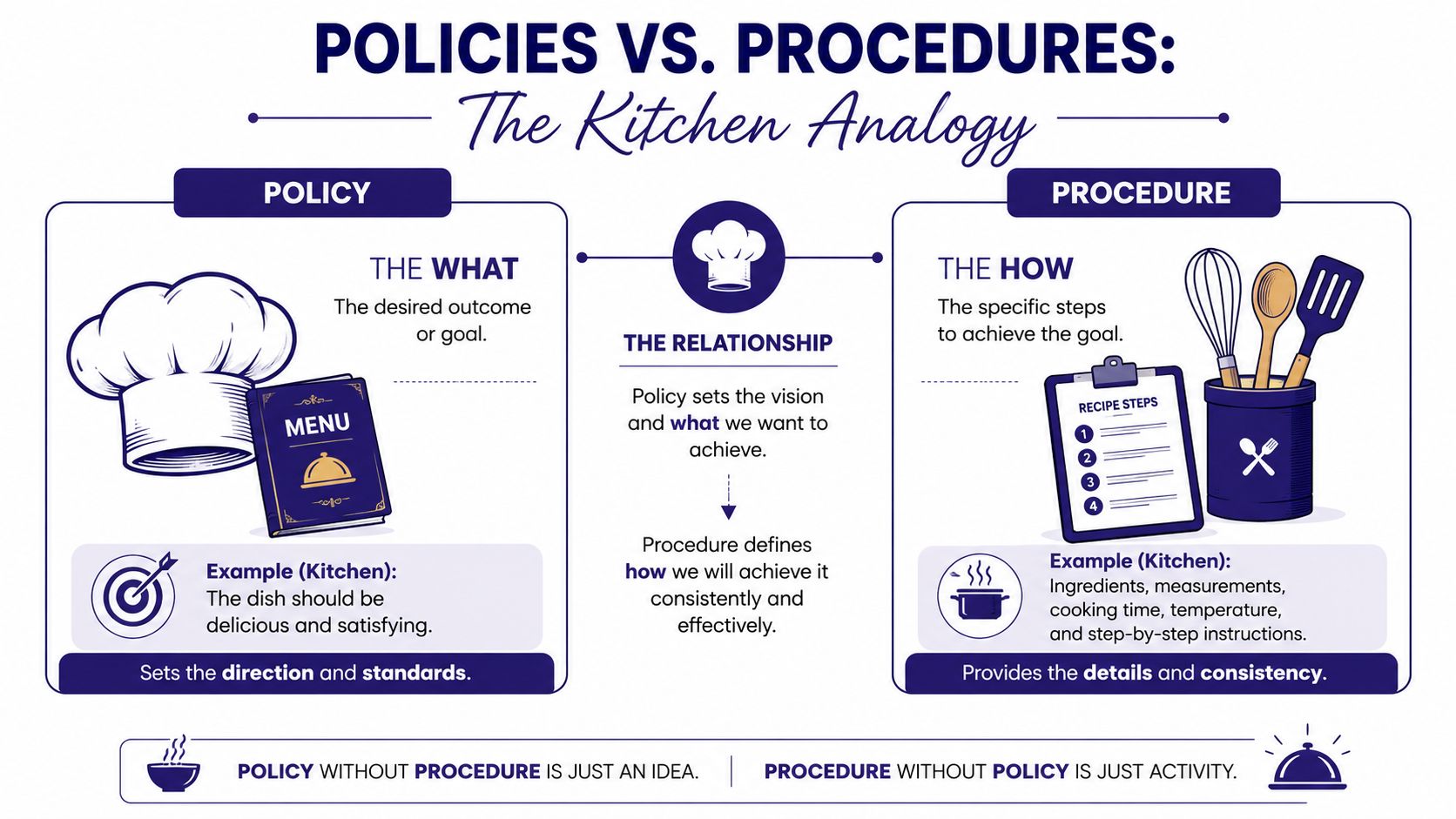
A policy is the rulebook. A procedure is the step-by-step route that puts the rulebook into action. That difference sounds small, but in practice it decides whether staff know the standard they're working to, or just have a rough idea and a lot of room to guess.
Policy is the what, procedure is the how
Think of a kitchen. The policy is the goal of the dish, the flavour, the standard, and the outcome you want every time. The procedure is the recipe, including the order of ingredients, the temperature, the timing, and the checks that keep the result consistent. If the policy says the meal must be safe, nourishing, and suitable for the diner, the procedure tells the cook exactly how to reach that result.
That same split helps in care settings. A safeguarding policy says the organisation protects people from abuse and neglect. The safeguarding procedure tells staff how to spot a concern, how to record it, who to tell, and when to escalate it. One gives direction, the other prevents uncertainty when somebody needs to act fast.
Why the distinction matters in daily work
Policies are usually broader and more stable. Procedures are more practical and often more detailed, because they have to guide a task in a repeatable way. If a policy is too detailed, staff struggle to find the main rule. If a procedure is too vague, staff still won't know what to do when the pressure is on.
Practical rule: if a document is meant to tell staff what the organisation stands for, it's a policy. If it's meant to tell staff how to do a job safely, it's a procedure.
That logic also helps learners in accounts assistant and final accounts training. A finance policy might define who can approve spending or how records are protected. A finance procedure then shows how invoices are coded, checked, and filed so the same controls happen every time. In both care and finance, the value comes from consistency, not from wording that sounds impressive.
Legal and Regulatory Framework
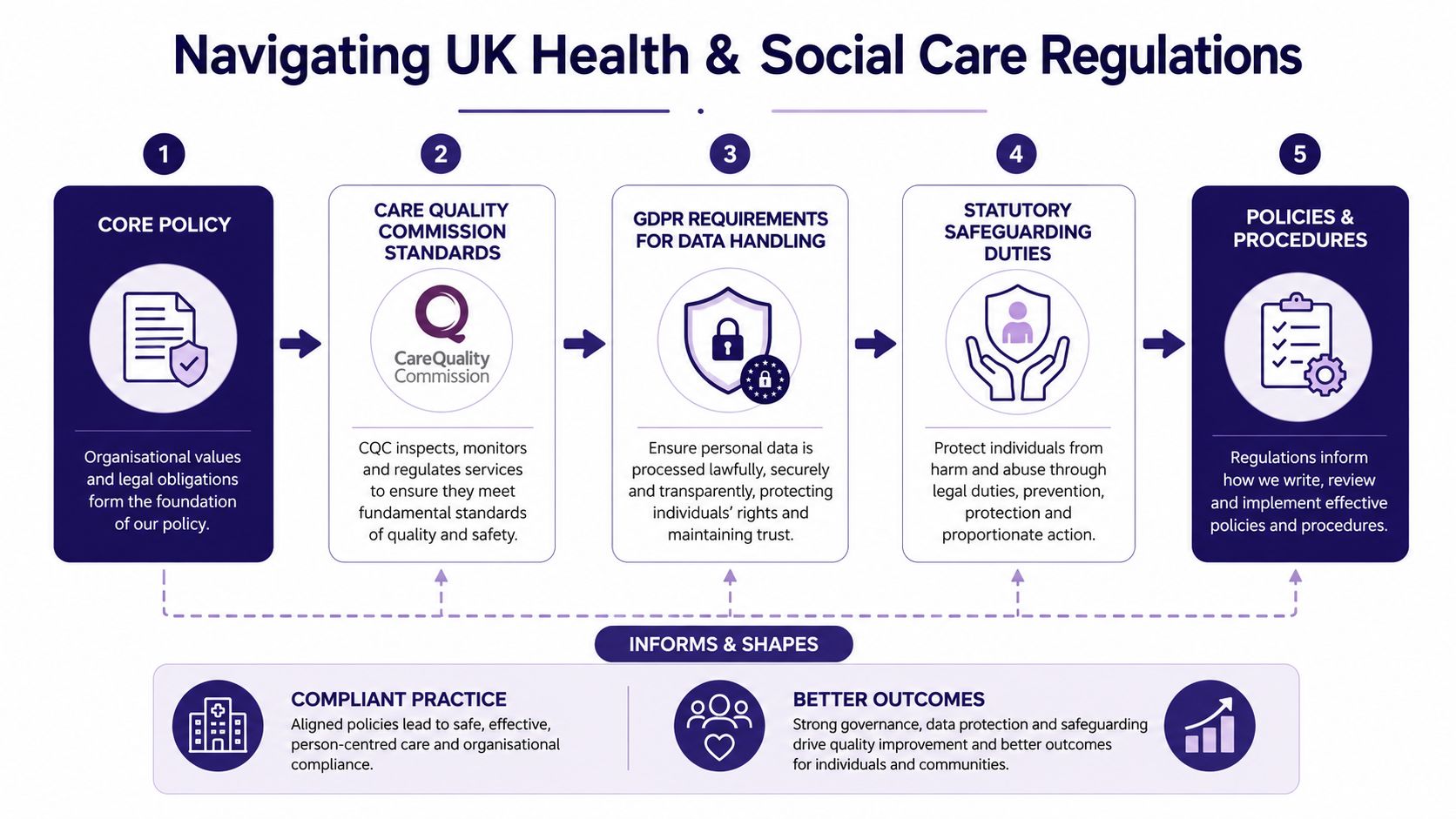
A care service can have a clear mission, warm values, and detailed handover notes, but none of that replaces the legal duty to show how people are kept safe. Policies exist because regulators, law, and national standards expect organisations to prove their controls, not just describe them. In England, the CQC sits at the centre of that accountability system as the statutory body responsible for monitoring, inspecting, and rating care services, so policy compliance becomes part of formal service oversight rather than private internal guidance (CQC state of care review).
How legal duties become written controls
The simplest way to read regulation is to split it into two parts. The law sets out what must be protected, and the policy explains how the organisation will protect it. Safeguarding, consent, infection control, incident reporting, and record keeping all need written controls because staff need one shared route for action, and managers need evidence that the route was followed. The CQC's 2022 to 2023 review also highlighted ongoing concerns about quality and safety, including for people with protected equality characteristics, which shows that procedures have to support safe care and fair treatment together (DHSC statistics and policy oversight).
A helpful comparison is bookkeeping. A finance policy says what must be controlled, for example who can approve spending or how records are protected. The procedure shows the steps, such as how invoices are coded, checked, and filed so the same control happens each time. Care policies work the same way. They turn legal duties into actions staff can repeat under pressure, which is why they are so closely tied to day-to-day compliance.
NHS England's standards infrastructure adds another layer. Its Information Standards process publishes and maintains standards through the NHS Standards Directory, which supports interoperable data handling and more auditable care pathways. For managers, payroll staff, and analysts, that matters because data rules are not abstract. Standardised definitions reduce transcription errors, make handovers easier to trace, and help records line up across systems.
Training in data handling makes that link easier to see. A good starting point is training in data protection, because it shows how legal duties become everyday habits around access, storage, sharing, and record checks.
Why this matters for data work
The strongest policies are the ones staff can follow when the work gets busy. That is why data analyst training fits naturally here. Analytic thinking helps teams spot missing fields, inconsistent entries, and patterns that suggest a procedure is not being followed properly. In care, that can mean stronger record trails, better monitoring, and clearer evidence when a service is inspected.
The same logic also helps learners in accounts assistant, payroll, and business analyst roles. An accounts assistant may check whether entries follow the approved coding rules. Payroll work depends on accurate, repeatable steps so people are paid correctly and records match. A business analyst often looks for gaps between the written process and the way the work is done, then explains where controls break down. That is the shared lesson across care and finance. Formal procedures are not paperwork for its own sake, they are the working instructions that keep people, data, and decisions aligned.
Core Policy Areas in Health and Social Care
Some policy areas need extra attention because the risks are higher and the consequences of poor control are immediate. These are the areas where a loose approach causes the most trouble, and where staff need clear rules, not broad encouragement.
The controls that matter most
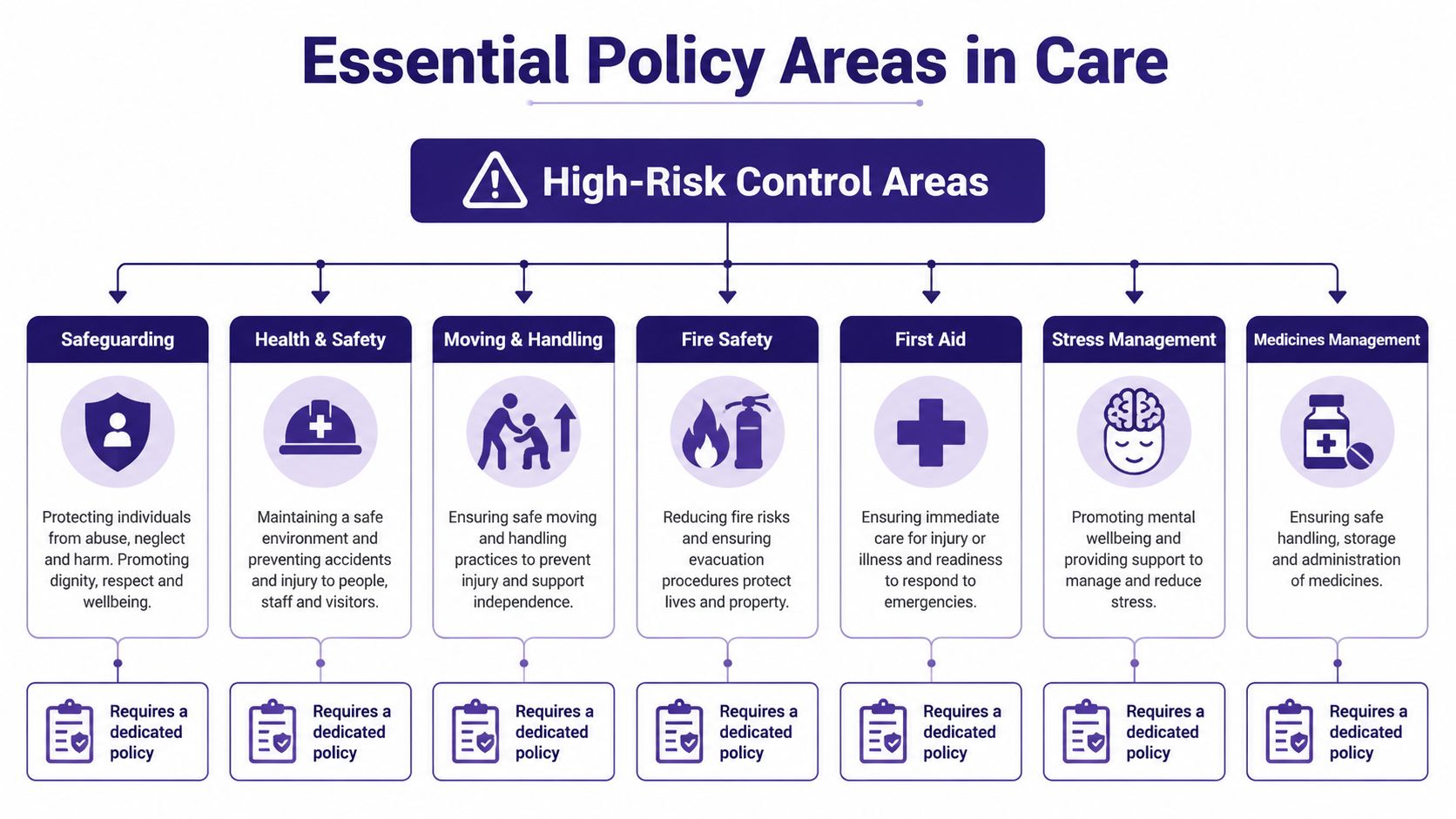
A typical care service needs dedicated policies for safeguarding, health and safety, moving and handling, fire safety, first aid, stress and wellbeing, and medicines management. Each one exists for a reason. Safeguarding protects people from abuse or neglect. Moving and handling reduces avoidable injury. Medicines management reduces the chance of the wrong dose, the wrong record, or the wrong person receiving treatment.
Policies and procedures often centre on these high-risk areas because they create a measurable chain from risk assessment to staff action (mandatory training overview of policy areas). That chain matters. If the risk assessment identifies a hazard, the procedure has to tell staff how to respond, and the record has to show that the response occurred.
How structured thinking helps spot gaps
A business analyst mindset becomes useful. Instead of asking only whether a policy exists, a good analyst asks whether the process works end to end. Who starts it? Who approves it? What happens if the first person is off sick? Where does the record sit? That kind of questioning exposes weak points that staff often stop noticing because they've always done things a certain way.
A policy that sounds right but breaks down at handover is not strong enough for a regulated care service.
Templates help because they force structure. A good template keeps the focus on purpose, scope, responsibilities, escalation, and record keeping, so staff don't bury the important parts inside generic language. That's also why people in final accounts training recognise the same discipline, because a good control system depends on clear ownership, clean trails, and no ambiguity about who signs off what.
Writing and Implementing Policies
Good policies start with a narrow question. What risk are we controlling, who needs to follow this, and what would count as safe practice? If those questions stay broad, the final document becomes a catch-all file that nobody trusts when they need it most.
From scoping to approval
Start by defining the problem in plain language. A medication policy, for example, should focus on storage, administration, recording, escalation, and error response, not on every possible issue in the whole service. Once the scope is clear, draft the objective in one sentence, then map the key responsibilities, the procedure steps, and the records that prove the process happened.
Stakeholder input matters because the people who use the policy every day will spot gaps quicker than the person drafting it alone. That includes frontline staff, supervisors, and where relevant, people who use the service. NHS England's inclusion-health framework recommends co-production with affected communities and named inclusion-health leads so policies address digital exclusion and missed appointments in ways that fit real-life access barriers (inclusion-health framework).
If you want a practical parallel from another sector, the workplace health and safety policy resource shows how a policy can stay focused on risk, responsibility, and implementation without becoming cluttered.
Version control and rollout
Once a policy is approved, the version needs to be controlled. Staff should know which copy is current, who approved it, and when it will be reviewed again. That sounds basic, but it's where many services fall apart, because an out-of-date document is worse than no document at all if staff still rely on it.
- Scoping a policy clearly: Define the exact risk, task, or service area before drafting.
- Drafting plain objectives: Write the outcome in language staff can understand quickly.
- Getting real input: Ask the people who use the process where it usually breaks down.
- Testing the procedure: Trial the steps in a live-like setting before full rollout.
- Recording approval properly: Keep the sign-off, version number, and review date together.
Final accounts work the same way in spirit. The numbers have to tie back, the paperwork has to match, and someone has to be able to trace the logic from draft to sign-off. In care, that discipline protects both service users and staff.
Examples and Templates
A usable template saves time only if it's built around the core tasks involved. A medication template, for instance, should include purpose, scope, responsibilities, storage, administration, error reporting, and review date. A safeguarding template needs concern recognition, escalation routes, recording standards, and who to contact if the first manager is unavailable.
Sample template layout
| Template area | What it should include | Best-fit training link |
|---|---|---|
| Medication management | Storage rules, administration checks, incident reporting | Bookkeeping and VAT training for accuracy, evidence trails, and control discipline |
| Safeguarding concerns | What counts as a concern, how to report, how to escalate | Business analyst training for process mapping and gap analysis |
| Data protection | Access control, secure storage, retention, sharing rules | Data analyst training for handling structured information carefully |
| Incident reporting | Immediate action, who records, who reviews, follow-up actions | Accounts assistant training for organised documentation and reconciliation habits |
The VAT point is especially useful for people who handle business records in care settings. The UK VAT registration threshold is £90,000 in taxable turnover over any 12-month period, which means controls have to be documented and reported once that legal line is crossed (UK VAT threshold). That same habit of threshold awareness helps care managers understand when a rule changes from optional learning to required control.
Why templates still need tailoring
Templates are starting points, not finished answers. A homecare service, a care home, and a day centre will all need different wording because their risks and workflows aren't identical. The best templates are the ones that make local adaptation easy without losing the structure that keeps staff on track.
Training and Auditing for Compliance
Policies only work if staff know them, can use them, and keep using them after the first induction session. That's why training and audit sit at the heart of compliance, not around the edge of it.
Training turns documents into practice
A policy can be beautifully written and still fail if staff don't understand where it fits into their work. Short refreshers, supervised practice, and scenario-based discussions help people remember what to do when the shift gets busy. The AAT's Level 3 Certificate in Bookkeeping is a good example of how structured learning supports control design, because it builds practical habits around accuracy and maintained records (AAT Level 3 Certificate in Bookkeeping).
That same mindset carries into advanced payroll, accounts assistant, and final accounts training. If you can track what should happen, what did happen, and where the difference came from, you're already thinking like an auditor.
For a deeper look at audit-focused learning, the internal guide on auditing courses is a useful next step.
Audits keep the standard alive
Audits shouldn't feel like a punishment. They should ask simple questions, are staff following the current procedure, are records complete, and are issues being escalated properly? Once those questions are asked regularly, the service can correct weak spots before they become patterns.
Audit rule: if a procedure can't be checked, it can't be trusted for long.
The same logic applies to staffing and rotas. A useful external example is smarter leave management, because even leave and cover arrangements affect whether policies are followed on the floor. If the right person isn't available, the procedure doesn't disappear, it just becomes harder to carry out safely.
Conclusion on Sustaining Quality
Strong care services treat policies and procedures as living tools, not static paperwork. The basic test is still the same, does the document tell people what to do, and does the procedure help them do it consistently? That's what regulators, managers, and service users all need to see.
The services that do this well keep reviewing, training, and auditing their controls, then updating them when practice changes. That habit connects naturally with continuing professional development, because quality improves when people keep learning how systems operate.
Policies and procedures in health and social care become far more effective when they're matched with practical skills from bookkeeping, payroll, and data analysis. That combination gives staff the confidence to handle risk, record evidence properly, and keep care safe when conditions change.
A CTA for Professional Careers Training.