
AI is already part of the data analyst's job, not a future threat to it. Across UK finance and data teams, AI tools now help...
If your employer tells you your role is redundant, one of the first things you’ll want to know is how much you’re owed. Statutory redundancy pay is the legal minimum.
It’s worked out using a fixed formula based on your age, your length of service and your weekly pay. This guide walks through exactly how that formula works for the 2026/27 tax year.
It covers the weekly pay cap that increased on 6 April 2026, a full worked example, and how statutory pay differs from the enhanced packages some employers offer instead.
What Is Statutory Redundancy Pay?
Statutory redundancy pay is a lump sum an employer must pay to an eligible employee whose role is being genuinely made redundant. It’s separate from notice pay, holiday pay owed, and any wages still due.
The amount is set by law, not negotiated case by case. It’s calculated using a formula set out in gov.uk’s official redundancy pay guidance, based on the Employment Rights Act 1996.
That formula takes your age, your length of continuous service and your weekly pay, and turns them into a number of weeks’ pay.
Statutory redundancy pay is a fixed, legally-set minimum, calculated from age, length of service and weekly pay, not a figure your employer can simply choose.
Who Is Eligible for Statutory Redundancy Pay
The Two-Year Rule
You need at least two years of continuous service with the same employer to qualify for statutory redundancy pay. This applies whether you work full time or part time, and however many hours you do each week.
Continuous service means an unbroken employment relationship with that employer. A short gap between contracts can sometimes still count as continuous, depending on the reason for the break, so it’s worth checking rather than assuming a gap disqualifies you.
Who Isn’t Covered
A few groups fall outside the statutory scheme entirely. The self-employed and genuine contractors aren’t eligible, because the right only applies to employees.
- Employees with less than two years’ continuous service, unless their contract offers something better.
- Anyone who unreasonably turns down a genuine offer of suitable alternative employment from the same employer.
- Employees dismissed for gross misconduct before the redundancy takes effect.
- Armed forces personnel, who have a separate compensation scheme.
If your employer becomes insolvent and can’t pay, you can claim statutory redundancy pay directly from the government’s Redundancy Payments Service instead, using the same formula.
How Statutory Redundancy Pay Is Calculated
The calculation runs in three steps. Once you understand each one, working out a rough figure yourself takes a couple of minutes.
Step 1: Work Out a Week’s Pay
Your weekly pay is the average you earned per week over the 12 weeks before you got your redundancy notice. For a fixed salary this is straightforward.
For variable hours or overtime, payroll needs to average out actual earnings across that same 12-week reference period instead.
Step 2: Apply the Age Multiplier
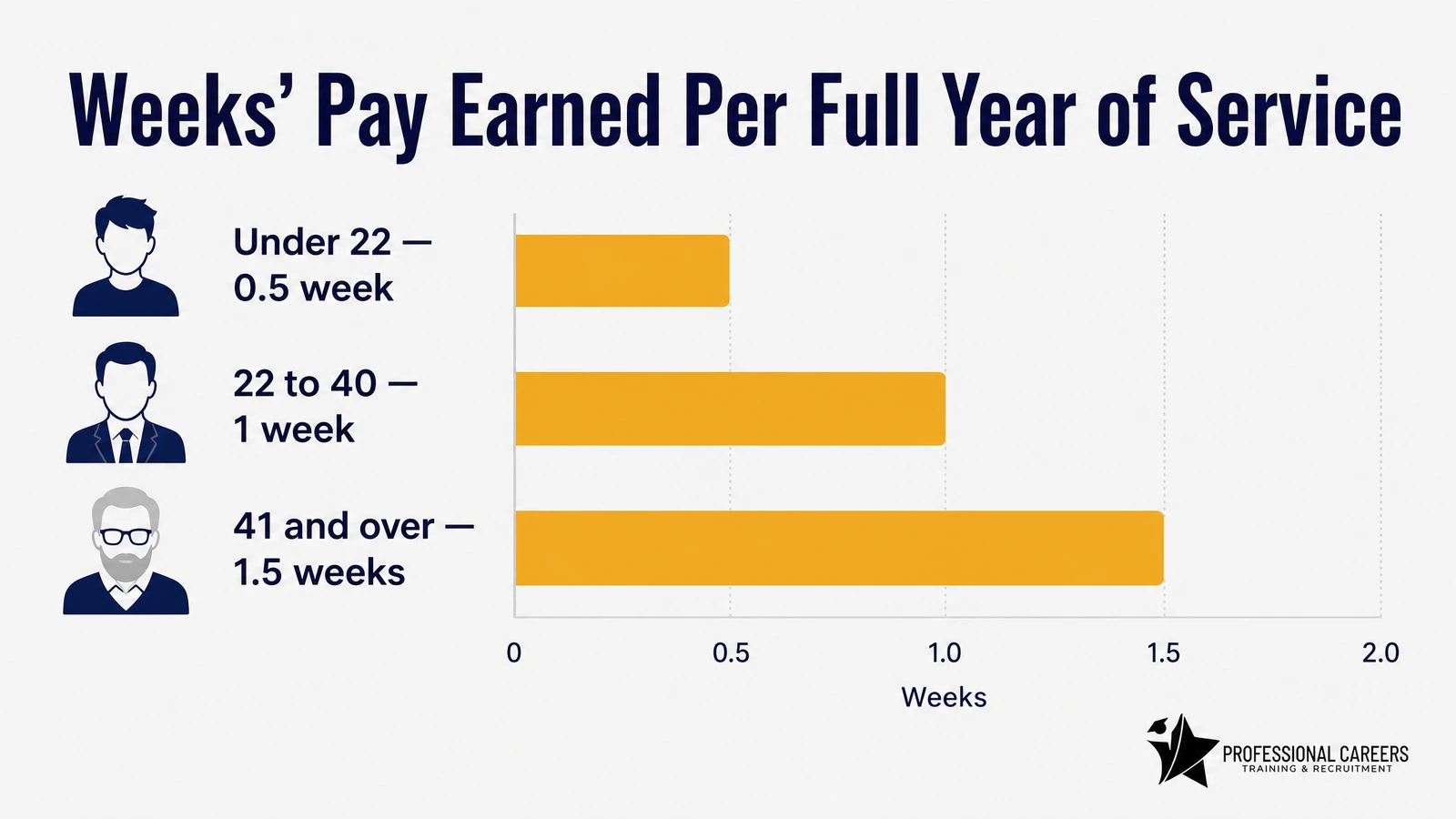
Each full year of service earns a different number of weeks’ pay depending on how old you were during that year. The rates get more generous the older you were.
| Age during that year of service | Weeks’ pay per full year |
|---|---|
| Under 22 | 0.5 week |
| 22 to 40 | 1 week |
| 41 and over | 1.5 weeks |
Step 3: Cap the Years of Service
Length of service is capped at 20 years for this calculation. Any service beyond 20 years doesn’t add further weeks, even for a long-serving employee.
The formula rewards both age and length of service: older employees and longer tenures earn more weeks’ pay per year, up to a 20-year service cap.
The 2026/27 Weekly Pay Cap
The government caps how much of your weekly pay counts towards the calculation, even if you actually earn more. That cap is reviewed and usually increased every April.
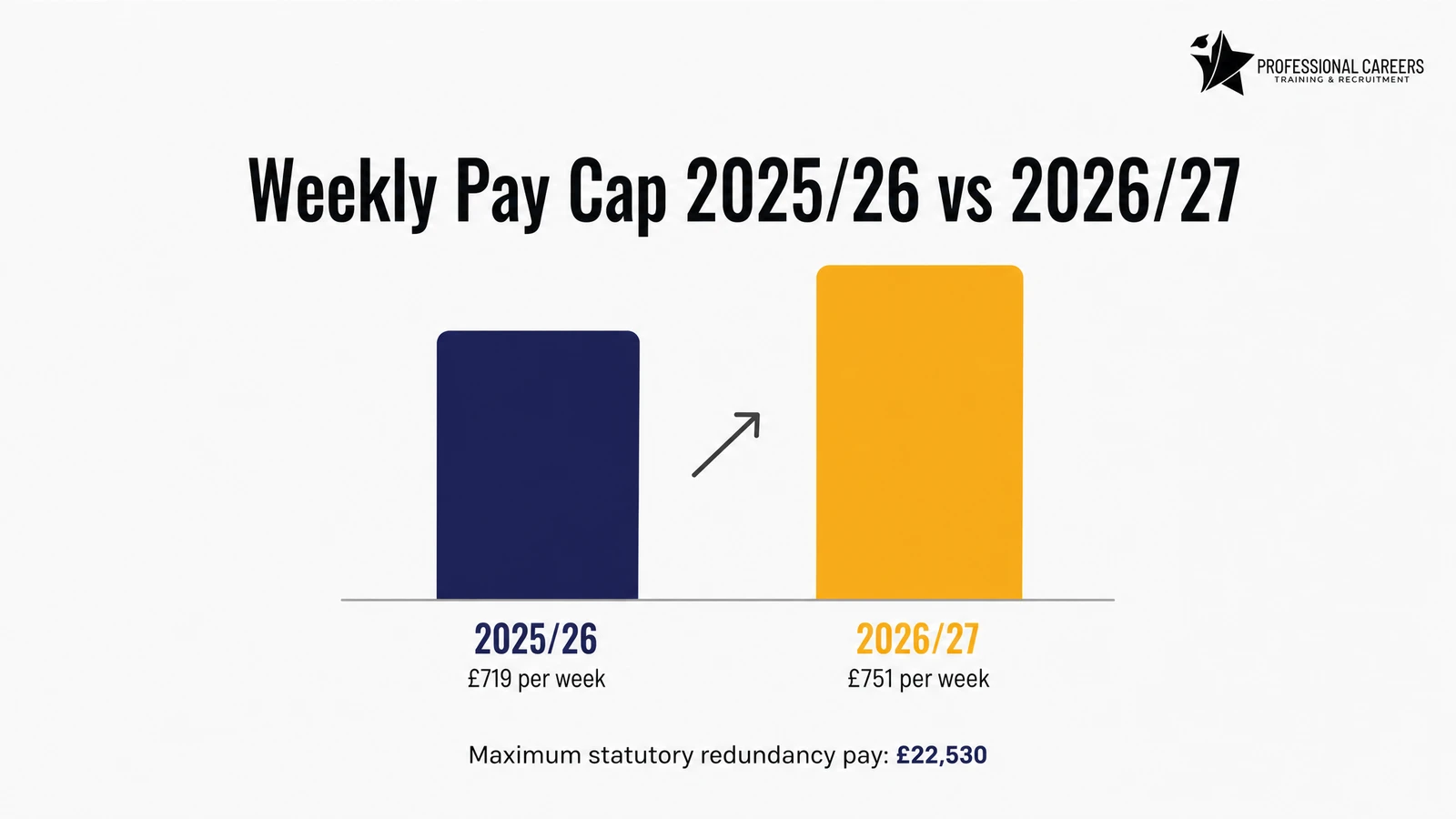
From 6 April 2026, the Great Britain cap rose from £719 to £751 a week, under the Employment Rights (Increase of Limits) Order 2026.
This is confirmed by the Chartered Institute of Payroll Professionals, and it pushed the maximum possible statutory redundancy payment up too.
| Tax year | Weekly pay cap | Maximum statutory redundancy pay |
|---|---|---|
| 2025/26 | £719 | £21,570 |
| 2026/27 (from 6 April 2026) | £751 | £22,530 |
The maximum figure assumes the longest possible service (20 years) entirely within the most generous age band (41 and over), giving 30 weeks’ pay at the capped weekly rate.
Northern Ireland runs its own, slightly higher cap: £749 for 2025/26, rising to £783 from April 2026. If you’re processing payroll across the UK, don’t assume the Great Britain figures apply everywhere.
Worked Examples: Redundancy Pay by Age and Service
The numbers make more sense with real examples. Here are three, each showing an employee whose whole period of service falls within a single age band, to keep the maths clear.
| Employee | Age band throughout service | Years of service | Weekly pay used | Weeks’ pay owed | Redundancy pay |
|---|---|---|---|---|---|
| Employee A | Under 22 | 3 years | £320 (actual, under cap) | 1.5 weeks | £480 |
| Employee B | 22 to 40 | 8 years | £600 (actual, under cap) | 8 weeks | £4,800 |
| Employee C | 41 and over | 20 years (capped) | £751 (capped; actual pay was £900) | 30 weeks | £22,530 |
Employee C’s figure is the statutory maximum for 2026/27. No amount of extra service or higher pay increases it further, since both the years and the weekly rate are already capped.
- Work out the employee’s average weekly pay over the 12 weeks before their notice, then compare it to the current cap.
- Use whichever figure is lower: actual weekly pay, or the £751 cap for 2026/27.
- Count each full year of continuous service, up to a maximum of 20 years.
- Assign the correct multiplier (0.5, 1 or 1.5 weeks) to each of those years, based on the employee’s age during that specific year.
- Add up the total weeks’ pay across all the years, then multiply by the capped weekly figure from step 2.
Most employees’ service spans more than one age band, which makes the real calculation more layered than these three examples. It works out weeks band by band, year by year, counting backwards from the leaving date.
Gov.uk’s own redundancy pay calculator handles that automatically, and is the most reliable way to get an exact figure for a specific employee.
Statutory Redundancy Pay vs Enhanced Redundancy Pay
Statutory redundancy pay is a floor, not a ceiling. Many employers choose to pay more than the legal minimum, and this is called enhanced or contractual redundancy pay.
Enhanced schemes vary hugely between employers. Some simply remove the weekly pay cap so employees are paid on their real salary. Others multiply the statutory weeks by two or three, or add a flat lump sum on top.
Statutory redundancy pay is the legal minimum every eligible employee is entitled to; enhanced redundancy pay is anything an employer chooses to add on top of it.
Whatever an employer offers, it must be at least the statutory amount. Any redundancy policy or contract clause that tries to pay less than the statutory formula simply isn’t enforceable.
Notice Periods During Redundancy
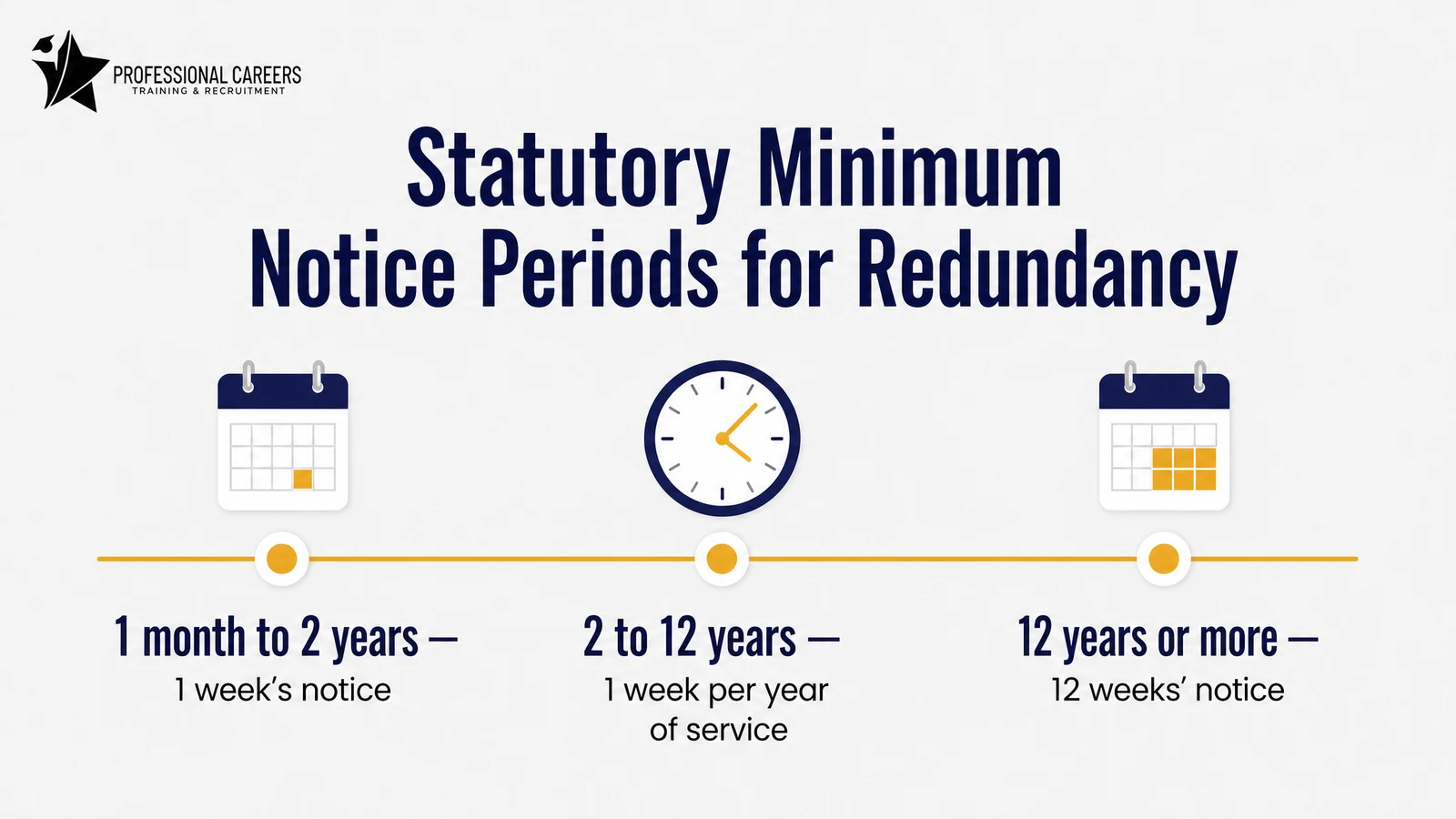
Redundancy pay and notice pay are separate entitlements, and payroll needs to calculate both correctly. The statutory minimum notice period depends on length of service.
| Length of continuous service | Statutory minimum notice |
|---|---|
| 1 month to 2 years | 1 week |
| 2 to 12 years | 1 week for each full year of service |
| 12 years or more | 12 weeks |
An employment contract can offer a longer notice period than the statutory minimum, and if it does, the longer contractual period applies. A contract can never offer less than the statutory figure.
Some employers pay in lieu of notice instead of having the employee work it, provided the contract allows this. That payment must match what the employee would have earned, including contractual benefits such as pension contributions.
Is Redundancy Pay Taxable?
The first £30,000 of a redundancy payment is tax free. This threshold covers the combined total of statutory and any enhanced redundancy pay, not just the statutory element on its own.
Anything paid above £30,000 is taxed as income in the normal way. National Insurance treatment differs from tax treatment, so payroll should check the current guidance rather than assume the two always match.
Other payments made alongside redundancy, such as notice pay, holiday pay and any bonus, are taxed as normal earnings and don’t fall under the £30,000 exemption.
If the employee has an active attachment of earnings order, check whether it applies to the final payment before processing it, rather than assuming redundancy pay is automatically exempt.
Up to £30,000 of combined statutory and enhanced redundancy pay is tax free; notice pay, holiday pay and bonuses are taxed separately as normal earnings.
Common Payroll Mistakes When Processing Redundancy Pay
Redundancy pay doesn’t come up often enough for most payroll teams to have it fully memorised, which is exactly why mistakes creep in.
- Using current weekly pay instead of the true 12-week average, especially for employees with variable hours or regular overtime.
- Forgetting to apply the correct year’s cap, particularly for redundancies processed close to the 6 April changeover.
- Treating the whole payment as tax free, rather than only the amount up to £30,000 across statutory and enhanced pay combined.
- Miscounting age bands for employees whose service spans more than one, instead of working out each year separately.
- Confusing redundancy pay with notice pay and calculating only one of the two entitlements.
Getting this right matters. An underpayment can lead to a tribunal claim, while an overpayment is money the business can’t easily recover.
Redundancy pay is just one of several statutory calculations payroll teams get wrong under pressure. The same discipline applies to PAYE and National Insurance, statutory sick and parental pay, and student loan deductions.
Time Off to Look for Work During Your Notice Period
Redundancy pay isn’t the only entitlement to track. Employees with two or more years’ service also have a statutory right to reasonable paid time off during their notice period to look for a new job or arrange training.
This paid time off is capped at 40% of a week’s pay in total across the notice period. For someone working a standard five-day week, that works out to roughly two days’ worth of pay.
It’s a separate entitlement from holiday pay, so payroll needs to track both rather than assuming one covers the other.
The time can be taken at any point during normal working hours, for job applications, interviews or job-related training. An employer can’t insist it’s made up elsewhere in the week.
Anyone with two or more years’ service has a statutory right to reasonable paid time off to job hunt during their notice period, capped at 40% of a week’s pay overall.
Redundancy Protection During Pregnancy and Family Leave
Employees who are pregnant, or on (or recently returned from) certain types of family leave, get extra legal protection during a redundancy process.
If a suitable alternative role exists anywhere in the business, protected employees must be offered it ahead of other staff at risk of redundancy, even if a colleague is equally or better suited to it.
- Pregnancy, from the point the employer is told, through to 18 months after the expected week of childbirth or the actual birth date.
- Maternity leave, with the same 18-month protected window running from the birth.
- Adoption leave, running 18 months from the placement date or the child’s entry into the UK.
- Shared parental leave, neonatal care leave, or bereaved partner’s paternity leave of six weeks or more, also carrying an 18-month protected window.
This priority right doesn’t mean a protected employee can never be made redundant. It means they must be considered for any genuinely suitable vacancy before the wider selection pool.
Where This Fits Into a Payroll Career
Redundancy calculations are one of the more complex, higher-stakes tasks a payroll professional handles, alongside statutory payments like sick pay, parental pay and student loan deductions.
Getting comfortable with them is part of becoming genuinely job-ready, not just familiar with routine monthly processing.
PC Training’s Advanced Payroll Training course covers these calculations alongside PAYE, National Insurance, statutory payments and year-end processes, with guaranteed recruitment support once you’re qualified.
Frequently Asked Questions
Do I get redundancy pay if I’ve worked for less than two years?
No. Statutory redundancy pay requires at least two years of continuous service with the same employer. Some employers offer enhanced schemes with a lower qualifying period, but this isn’t a legal requirement.
Is statutory redundancy pay taxable?
The first £30,000 of your combined statutory and enhanced redundancy pay is tax free. Any amount above £30,000 is taxed as income, and other payments like notice pay or holiday pay are taxed separately as normal earnings.
What’s the difference between statutory and enhanced redundancy pay?
Statutory redundancy pay is the fixed legal minimum, calculated from age, service and a capped weekly pay figure. Enhanced (or contractual) redundancy pay is anything an employer chooses to pay on top of that minimum.
Can my employer make me redundant without any notice?
No, unless your contract includes a payment in lieu of notice clause. Even then, you must receive a payment equivalent to your notice period, including any contractual benefits, rather than simply losing the notice entitlement.
How is a week’s pay worked out if my hours or pay vary?
Payroll averages your earnings over the 12 weeks immediately before your redundancy notice was given. This average is then compared against the current statutory cap, and the lower of the two figures is used in the calculation.