
AI is already part of the data analyst's job, not a future threat to it. Across UK finance and data teams, AI tools now help...
If your payroll team handles the apprenticeship levy, the rules changed under your feet this year.
From 1 August 2026 the levy was folded into a wider “Growth and Skills Levy”. The funding rules that go with it shifted too, in ways that affect how much training actually costs once your levy pot runs dry.
If you run payroll for a business with a pay bill over £3 million, or you’re weighing up taking on an apprentice for the first time, here’s what’s actually changed and what it means for your numbers.
What Is the Apprenticeship Levy, and Why Is It Suddenly “The Growth and Skills Levy”?
The apprenticeship levy itself hasn’t been scrapped. It’s been rebranded and widened.
UK employers with an annual pay bill above £3 million still pay the same 0.5% levy, collected the same way through PAYE. What’s changed is what the money in your levy account can now be spent on.
Before this year, levy funds could only pay for full apprenticeships. Under the Growth and Skills Levy, the same pot can now also fund two new, shorter training products: foundation apprenticeships and apprenticeship units, both covered below.
For a payroll team, the levy calculation on your payslip run doesn’t change at all. What changes is the advice you might reasonably pass on to whoever owns training spend at your business.
The apprenticeship levy hasn’t disappeared, it’s been renamed and expanded. The 0.5% rate and £3 million threshold are unchanged, but the levy pot can now fund shorter training courses as well as full apprenticeships.
Who Has to Pay the Levy, and How Much?
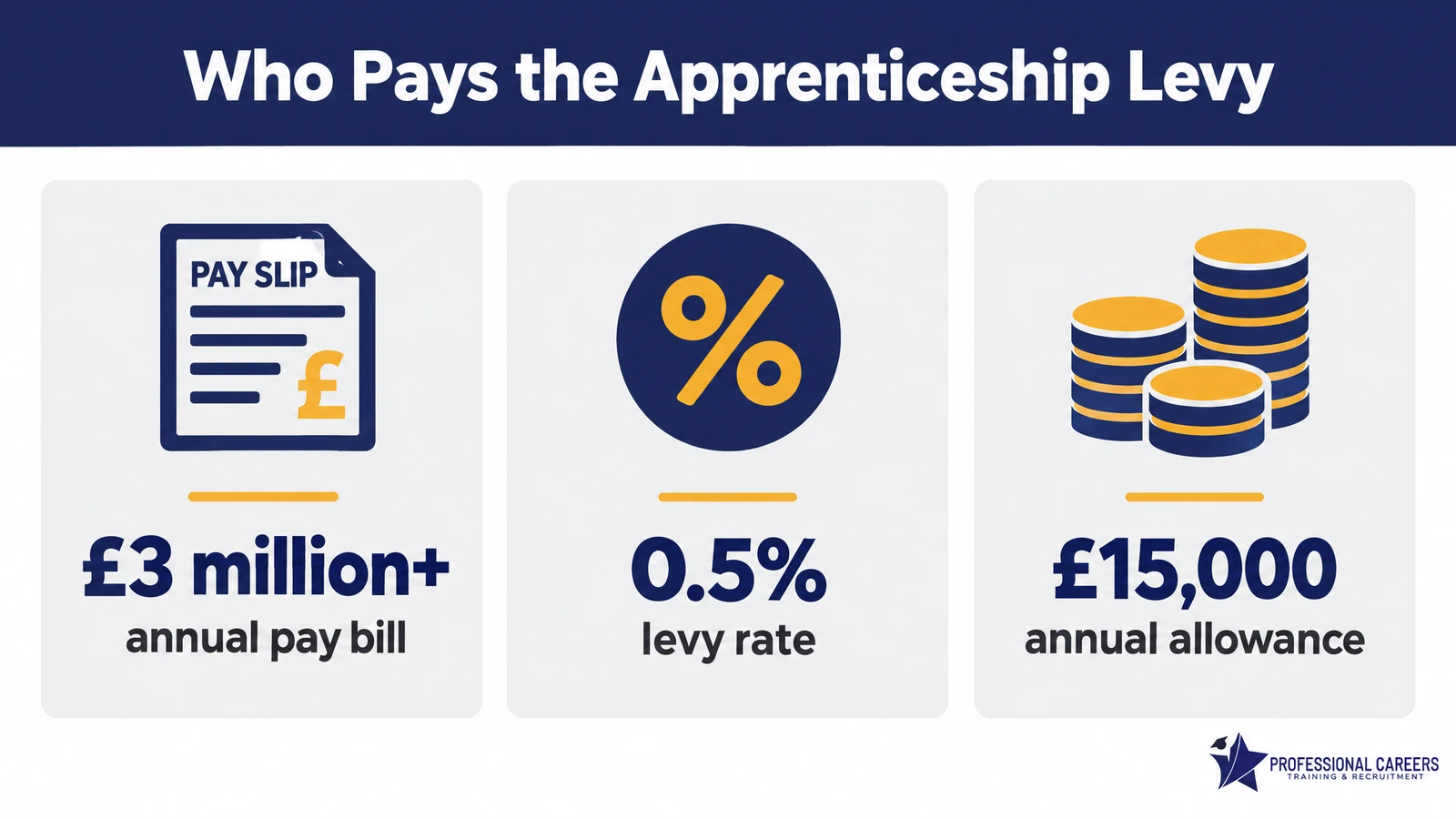
Any UK employer with an annual pay bill of more than £3 million has to pay the levy, whether or not you actually employ any apprentices. It’s charged at 0.5% of your total annual pay bill.
The levy is collected monthly, alongside your normal PAYE and National Insurance reporting, not as one annual bill.
Calculating the Levy as Part of Your Payroll Run
You don’t calculate the levy as a single annual figure. It’s worked out cumulatively, month by month, through your Employer Payment Summary (EPS).
Each month, you take your year-to-date pay bill and apply the 0.5% rate. Then you subtract the year-to-date allowance you’ve used, and whatever levy you’ve already paid that tax year.
Your “pay bill” for this calculation means all earnings that attract employer (secondary) Class 1 National Insurance contributions. That includes wages, bonuses and commission.
It also includes pay to employees under 21 and apprentices under 25, even though those groups are usually exempt from employer NICs themselves. This is a common place for the levy figure to come out wrong.
The £15,000 Allowance, and What It Means for Connected Companies
Every employer gets a £15,000 annual allowance that reduces the levy owed. In practice, this means a business only starts actually paying the levy once its pay bill passes £3 million, since 0.5% of £3 million is exactly £15,000.
The allowance doesn’t carry over if you don’t use it, and it can’t be banked for next year.
If your business is part of a group of connected companies or charities, the group shares a single £15,000 allowance between them, not one each.
How that single allowance is split between group companies has to be agreed and submitted to HMRC before the tax year starts. It can’t be changed part-way through.
| What it covers | Figure |
|---|---|
| Who pays | Employers with an annual pay bill over £3 million |
| Levy rate | 0.5% of annual pay bill |
| Annual allowance | £15,000 (shared across connected companies) |
| Reported via | Employer Payment Summary (EPS), monthly, alongside PAYE |
| Tax treatment | Deductible expense for Corporation Tax |
How the Levy Account and Fund Expiry Actually Work
Once you’ve paid the levy, the money doesn’t just sit with HMRC. It appears in your apprenticeship service account, a digital account every levy-paying employer can set up.
The account is where you spend on approved training, as the Chartered Institute of Payroll Professionals’ own guidance sets out in detail.
There are over 700 approved apprenticeship standards to choose from, covering everything from accountancy to engineering.
Funds in your account have always had a use-it-or-lose-it clock attached. Each monthly payment into your account stays usable for a set period before it expires.
Unused funds don’t vanish into nothing though. They get recycled by the Department for Education to help fund apprenticeship training at smaller, non-levy-paying employers.
The Expiry Change From August 2026
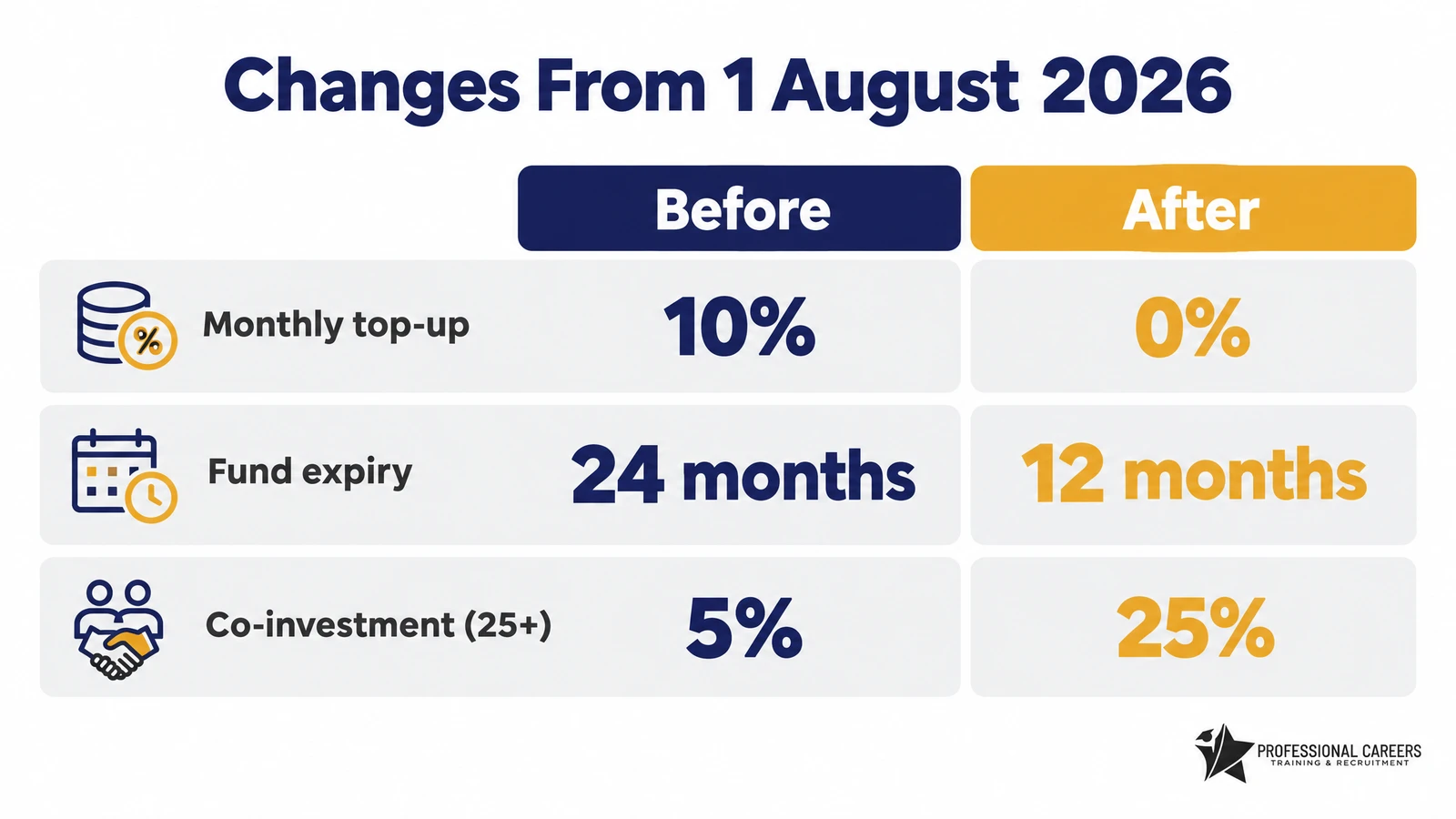
Historically, funds stayed usable for 24 months from the date they entered your account. From 1 August 2026, new funds expire after just 12 months instead.
This is one of the more consequential changes for payroll and finance teams to flag internally. It roughly halves the window you have to actually spend what you’ve paid in before it’s lost.
Funds that were already in your account before 1 August 2026 keep their original 24-month expiry. The change doesn’t retroactively shrink money you’ve already accrued.
Transferring Levy Funds to Another Business
If you’re not going to use all your levy funds, you can transfer up to 50% of your unused annual funds to another employer. This is commonly used to support apprenticeships in a supply chain or a smaller connected business.
This 50% limit was raised from 25% back in 2024. The August 2026 reforms didn’t change it any further.
- Training and assessment costs for an approved apprenticeship standard
- The new, shorter apprenticeship units covered below
- Foundation apprenticeships for young or disadvantaged learners
- Funds transferred to another employer, up to 50% of your unused annual total
From August 2026, new levy funds expire after 12 months rather than 24, so payroll and training teams need to plan spend sooner. Funds paid in before the change still get the original 24-month window.
What Changed From 1 August 2026: The Growth and Skills Levy Reforms
The August 2026 reforms are the real news here, and they go further than a simple rename.
Three changes matter most for anyone budgeting around levy-funded training, set out in the Department for Education’s own Growth and Skills Levy reforms factsheet.
The 10% Top-Up Has Been Scrapped
Previously, the government added a 10% top-up to every monthly levy payment, so £100 paid in actually appeared in your account as £110.
That top-up has stopped for funds entering your account from 1 August 2026 onwards. Over a year, for a mid-sized levy payer, losing that uplift is a genuine reduction in buying power, not just a technical accounting change.
Co-Investment for Over-25s Has Jumped From 5% to 25%
If your levy account runs dry and you want to keep training an apprentice aged 25 or over, you used to pay 5% of the remaining training cost yourself, with the government covering 95%.
From August 2026, that employer share rises to 25%, with the government covering the remaining 75%.
This only applies once your own levy funds are exhausted. It doesn’t apply retroactively to apprentices who started before the change, who keep the old 95% government rate through to completion.
16 Apprenticeship Standards Lose Funding From September 2026
Separately, funding was withdrawn from 16 existing apprenticeship standards for new starts from September 2026. These include some Level 2 to Level 6 programmes, such as Professional Security Operative and Chartered Manager degree apprenticeships.
Anyone already partway through one of these standards keeps their funding through to completion. You simply can’t enrol a new apprentice onto a defunded standard after that date.
| Rule | Before | From August 2026 |
|---|---|---|
| Government top-up on levy payments | 10% added monthly | Removed |
| Fund expiry (new funds) | 24 months | 12 months |
| Co-investment, apprentices aged 25+ once levy funds are used up | 5% employer / 95% government | 25% employer / 75% government |
None of this changes the 0.5% levy rate or the £3 million threshold itself. It changes how far the money you’ve already paid actually stretches.
That’s worth flagging to whoever owns the training budget, even if payroll doesn’t own that decision directly.
Foundation Apprenticeships and Apprenticeship Units: What’s New
Alongside the funding changes, the Growth and Skills Levy introduced two genuinely new training products that sit under the same levy system.
Foundation Apprenticeships
Foundation apprenticeships are Level 2 programmes aimed at 16 to 21 year olds. They’re also open to under-25s with an Education, Health and Care plan, care leavers, and people leaving prison.
They run for a minimum of 8 months and currently cover construction, digital, engineering, health, catering and retail. They’re fully funded for employers of every size, levy-paying or not.
Apprenticeship Units
Apprenticeship units are a different shape of training altogether. They’re short, focused courses of 30 to 140 delivery hours, run over 1 to 16 weeks.
They’re designed to plug a specific skills gap in an existing employee, rather than train someone from scratch, and they’re aimed at staff aged 19 and over who are already employed, not new recruits.
Funding follows a two-stage payment structure: 30% is paid once the learner is onboarded and has completed 30% of the delivery hours. The remaining 70% is paid once they finish the course and pass a skills test.
- Confirm the learner is at least 19, already on your PAYE scheme, and not already doing a conflicting apprenticeship.
- Choose an approved apprenticeship unit relevant to the skill gap you’re training for.
- Non-levy employers, and levy employers training 19 to 24 year olds, get this fully funded; levy employers training someone 25 or over use levy funds or co-investment.
- Pay standard National Minimum Wage or above, since the apprentice rate doesn’t apply to apprenticeship units.
- Track the 30%/70% milestone payments against your training provider’s invoicing.
Non-Levy Employers: What You Still Get for Free
If your pay bill is under £3 million, none of the levy mechanics above apply directly to your payroll. You’re still part of the same funding system though, as a training “customer” rather than a payer.
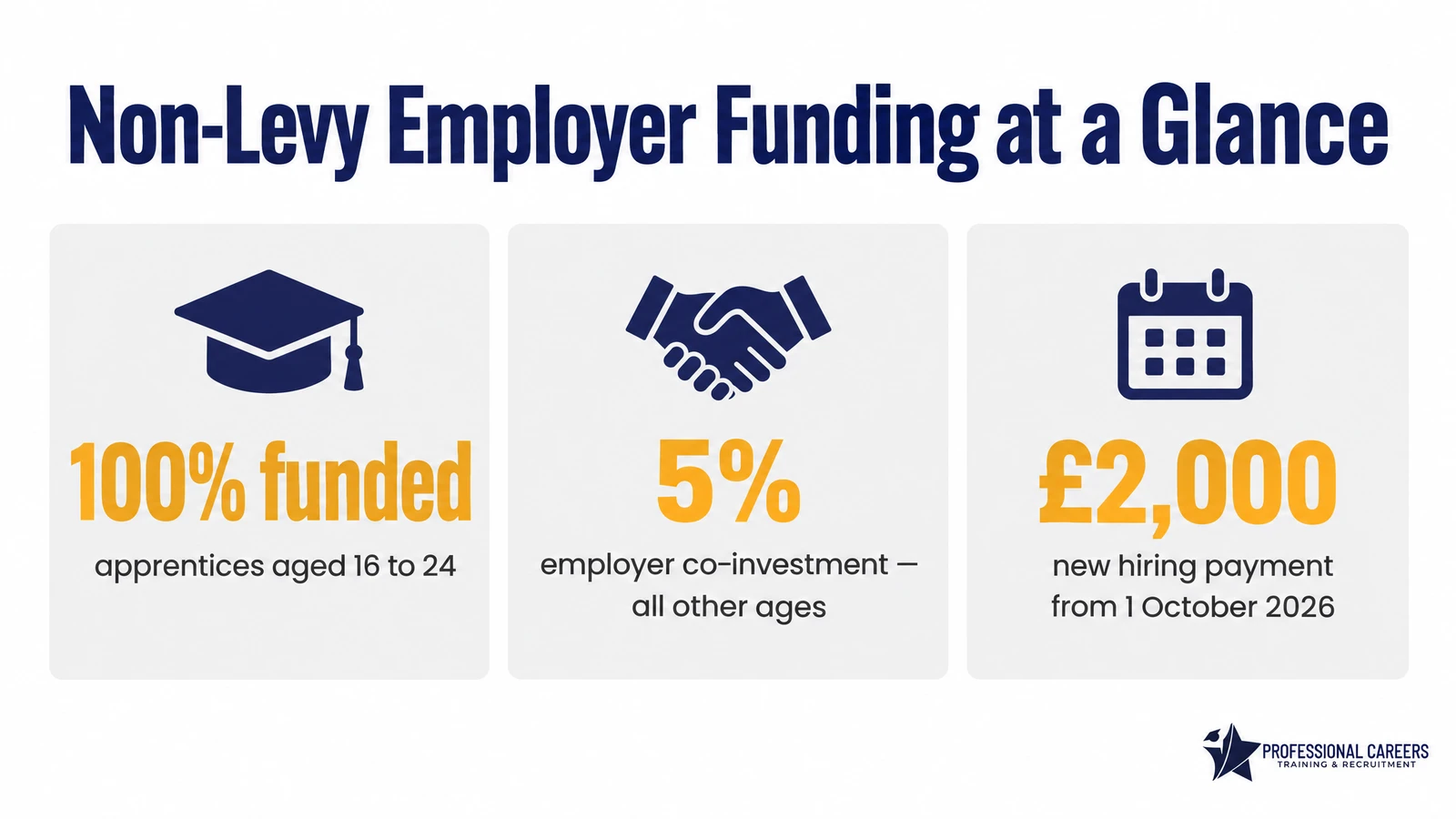
For apprentices aged 16 to 24, the government funds 100% of training and assessment costs. This also covers 15-year-olds whose 16th birthday falls between the last Friday of June and 31 August.
For apprentices of any other age, you pay a 5% co-investment towards the training cost, with the government covering the remaining 95% up to the funding band maximum.
Apprentices aged 19 to 24 with an Education, Health and Care plan come with extra financial support: a £1,000 Workplace Support Payment, paid in two instalments of £500, and up to £2,000 under the Foundation Apprenticeship Incentive.
There’s also a new incentive worth knowing about if you’re hiring right now. From 1 October 2026, non-levy employers recruiting an apprentice aged 16 to 24 can claim a new hiring payment of up to £2,000.
This is subject to eligibility checks, and it’s on top of the funding above.
Non-levy employers still get apprenticeship training fully funded for 16 to 24 year olds, plus a new £2,000 hiring payment from 1 October 2026. The levy reforms mostly affect levy-paying employers, not smaller businesses taking on their first apprentice.
An Apprentice Is Still an Employee: Other Payroll Obligations to Get Right
The levy only covers training costs. Once someone is on your payroll as an apprentice, every normal employment obligation still applies on top.
Paying the Right Rate
Most apprentices are entitled to the apprentice rate, currently £8 an hour, rather than the standard age-based National Minimum Wage or National Living Wage.
The apprentice rate applies if the apprentice is under 19, or 19 or over and still in the first year of their apprenticeship.
Once they’re 19 or over and past their first year, the normal age-based rate applies instead, up to £12.71 an hour for those 21 and over.
PAYE, National Insurance, and Pension Auto-Enrolment
Apprentices go through the same PAYE and National Insurance processing as any other employee, with the usual under-25 and under-21 NIC categories applied where they’re eligible.
They’re also assessed for workplace pension auto-enrolment in exactly the same way as other staff, based on age and earnings, not their apprentice status.
Apprentices also build up the same statutory holiday entitlement as any other employee, calculated the same way whether they’re full time, part time, or on an irregular-hours training schedule.
An apprentice is an employee first. The levy only covers training costs, so the apprentice rate, PAYE, auto-enrolment and holiday entitlement all still apply exactly as they would for any other member of staff.
Common Payroll Mistakes With the Apprenticeship Levy
- Forgetting that apprentices under 25 and employees under 21 still count towards your pay bill for levy purposes, even though their earnings are usually NIC-exempt.
- Assuming the £15,000 allowance applies per company rather than per connected group, and under-declaring the levy as a result.
- Not tracking the new 12-month expiry window on funds paid in from August 2026, and losing training budget that would have survived under the old 24-month rule.
- Missing that co-investment for apprentices aged 25 and over has risen to 25% once levy funds are exhausted, and under-budgeting a training programme as a result.
- Trying to pay an apprentice on an apprenticeship unit at the apprentice minimum wage rate, which doesn’t apply to units, only to standard apprenticeships.
Where This Fits With Payroll Training
The apprenticeship levy sits alongside PAYE, National Insurance, pension auto-enrolment and the other statutory deductions a UK payroll team is expected to get right every month.
If you’re building out your payroll knowledge from scratch, or brushing up ahead of a role change, our Advanced Payroll Training course covers the full range of employer obligations, with guaranteed job placement support once you’re qualified.
Is the apprenticeship levy still called the apprenticeship levy in 2026?
Yes, informally. The underlying 0.5% levy on pay bills over £3 million is now officially part of the broader “Growth and Skills Levy”, but most employers and payroll software still refer to the charge itself as the apprenticeship levy.
Who has to pay the apprenticeship levy?
Any UK employer, or group of connected employers, with a combined annual pay bill over £3 million. It’s charged at 0.5% of the pay bill, minus a £15,000 annual allowance, and collected monthly through PAYE.
What happens to unused apprenticeship levy funds?
Funds paid in before 1 August 2026 expire 24 months after they entered your account. Funds paid in from that date expire after 12 months. Expired funds are recycled to help fund training for smaller, non-levy-paying employers.
Can I transfer my levy funds to another business?
Yes, you can transfer up to 50% of your unused annual levy funds to another employer through the apprenticeship service, commonly used to support smaller businesses in the same supply chain or group.
Do small employers still get free apprenticeship training if they don’t pay the levy?
Yes. Non-levy employers get 100% government funding for apprentices aged 16 to 24, and pay a 5% co-investment for older apprentices, with the government covering the other 95%.
A new £2,000 hiring payment for 16 to 24 year old apprentices also starts from 1 October 2026.